From Mecca to the Moon: How Turkey is trying to become a player in space
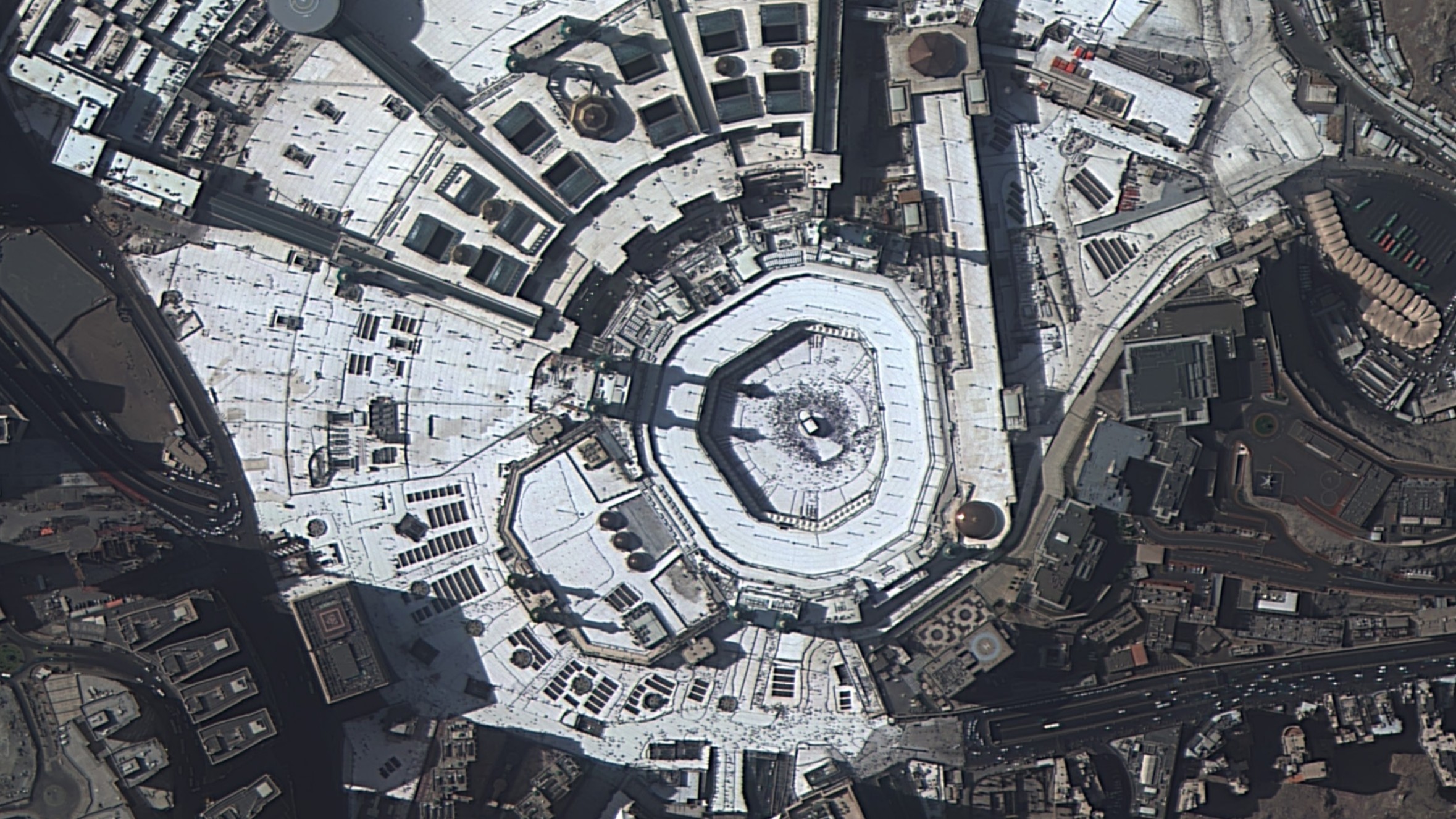
Mehmet Nefes looked with pride at the aerial photo of Mecca’s Grand Mosque on the wall.
Wearing a black polo shirt and sporting light stubble, Nefes adjusted his glasses, then pointed to the picture to show how small pilgrims in the holy mosque looked from space.
Nefes, who directs Tubitak Uzay, Turkey’s state-backed Space Technologies Research Institute, told Middle East Eye: “The picture was taken with a space camera designed and manufactured in Turkiye.
“We placed the camera on a satellite and then made sure to use it to take a picture of Mecca the same day the Mecca agreement was signed between Turkiye and Saudi Arabia,” said Nefes.
“Our optical team is particularly proud of this picture. We are developing our own capabilities and building our own systems for our country.”
New MEE newsletter: Jerusalem Dispatch
Sign up to get the latest insights and analysis on Israel-Palestine, alongside Turkey Unpacked and other MEE newsletters
But Nefes and Turkey have bigger ambitions. They want to go to the moon. Possibly even further.
The country is preparing its first lunar mission for 2027 as part of a wider national space programme designed to build domestic expertise, reduce reliance on foreign technology, and establish Turkey as a key player in space.
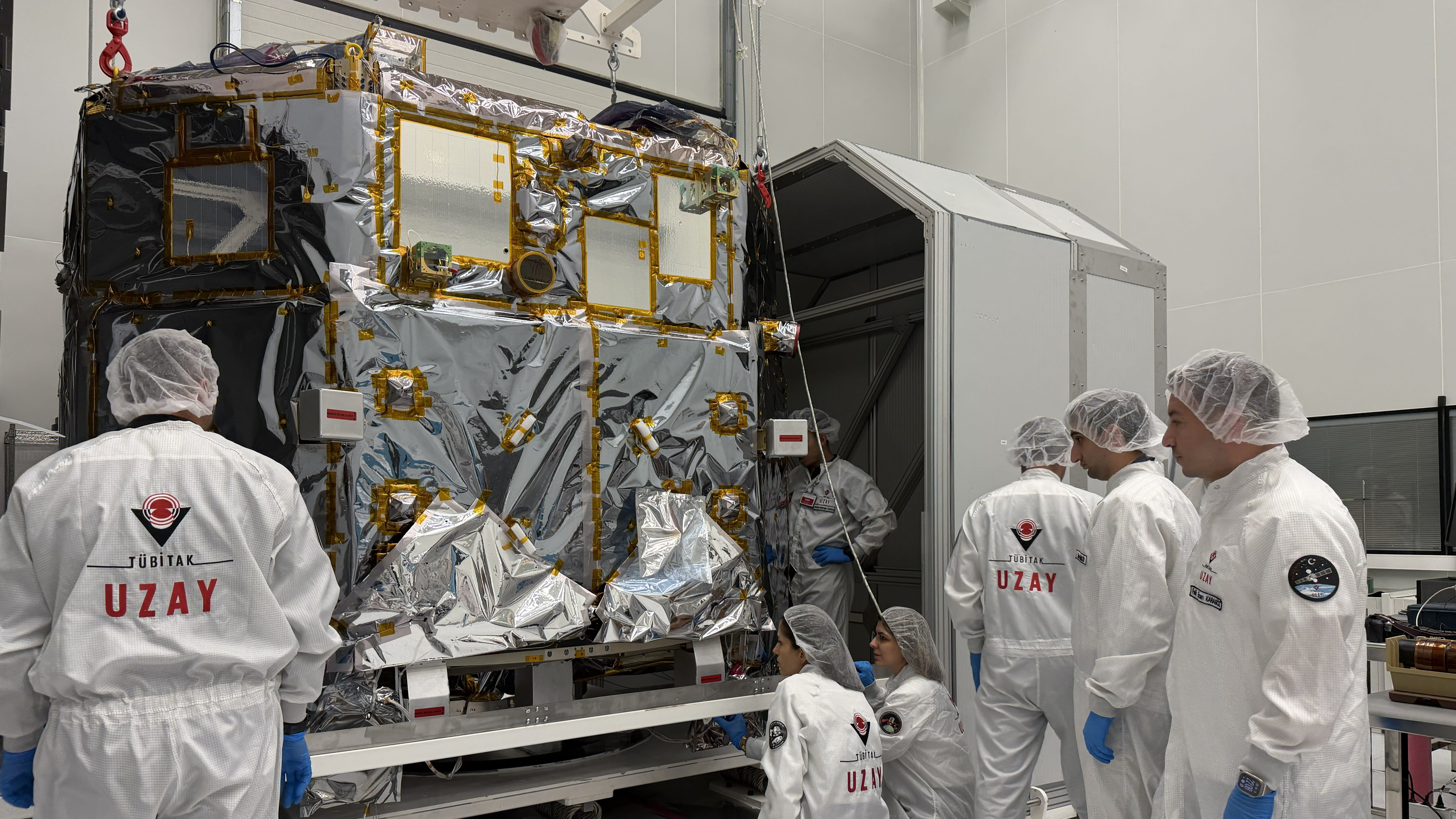
Having showcased its grand plans earlier this month at the 77th International Astronautical Conference in Antalya, southern Turkey, Ankara has made great efforts to emphasise that it plans to get to the Moon using technology manufactured largely at home.

The first phase of the mission, targeted for 2027, aims to send a spacecraft into deep space, place it in orbit around the moon for up to a year and a half, and then attempt a controlled landing on the lunar surface.
A second phase aims to achieve a soft landing and deploy a rover to conduct surface research on the Moon.
Both missions will be launched from Florida, onboard a SpaceX rocket.
If Turkey succeeds, it will join a small and exclusive group of nations that have landed on the Moon.
Technological sovereignty
Yet the road to 2027 is paved with complex engineering challenges and ambitious goals.
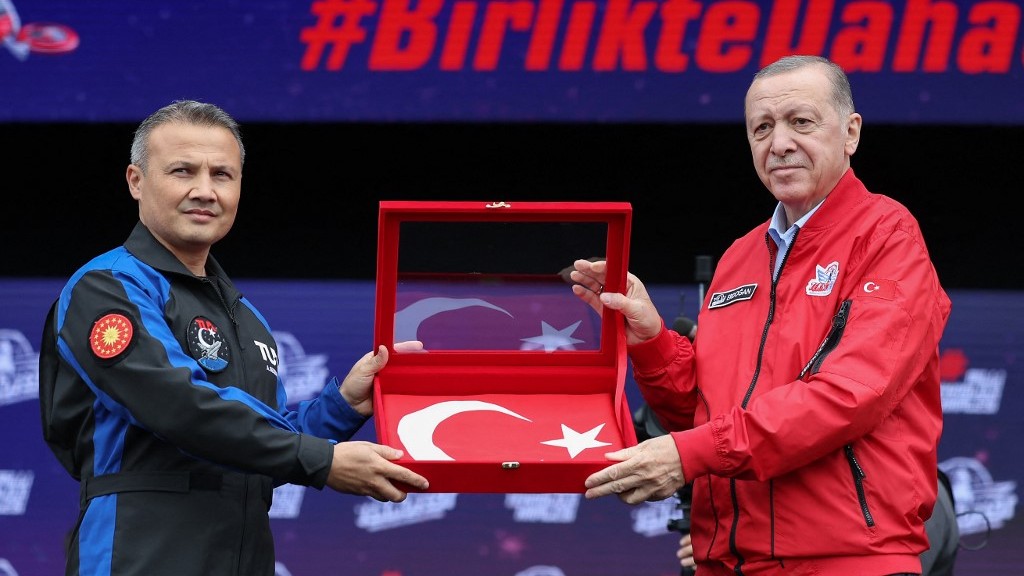
Turkey has spent the last two decades building up its satellite industry, sent its first astronaut to space and become a formidable player in drone warfare, reshaping battlefields and geopolitics alike.
But building a spacecraft capable of going to the Moon requires surviving extreme thermal shifts, intense radiation belts, and deep-space communication gaps - realities that routinely trip up emerging space programmes.
Turkish officials who spoke to MEE, on and off the record, stressed that the aim is not simply to reach the Moon, but to reduce reliance on foreign suppliers and establish greater control over the systems needed to operate in space.
Turkey is banking on a dual strategy: targeted international partnerships alongside aggressive localisation of critical hardware like avionics and radiation-hardened microchips.
For Ankara, the lunar probe is more than a scientific milestone; it is seen as a way to demonstrate Turkey’s ambitions to establish its own technological sovereignty beyond the earth’s atmosphere.
Stepping stones to deep space
Deep-space missions are not built overnight, and Nefes stresses that the road to reach this stage has taken nearly two decades for Tubitak Uzay.
That journey began in 2001 with the Bilsat satellite, an Earth-observation satellite developed through international cooperation. This enabled engineers to build ground stations and cleanrooms while developing Turkish-made components like the Gezgin unit - an on-board image processing and compression subsystem developed in Turkey.
A decade later, Turkish engineers built the country’s first Earth observation satellite, Rasat, adding domestic flight computers and advanced transmitters.
This feat laid the groundwork for the establishment of the Turkish Space Agency (TUA) in December 2018, which was tasked with coordinating Turkey’s space vision.
Soon after, Turkey launched IMECE, its first high-resolution Earth observation satellite, in 2023. Its deployment marked another forward step as Turkey mastered low Earth orbit (LEO), the region of space relatively close to Earth’s surface at 2,000km.
Building the IMECE satellite demonstrated Turkey’s growing ability to design and manufacture advanced space-grade hardware domestically.
Turkey's next major milestone came with Turksat 6A, its first communications satellite, which operates at a much higher altitude in geostationary orbit (GEO) at 35,786km above the equator. GEO is widely used for telecommunications and broadcasting.
"By going step-by-step from LEO to GEO, we mastered long-distance communications, thermal protection, and autonomous flight software," Nefes noted.
"Using our own propulsion technologies and flight-proven subsystems, the lunar mission is simply the next natural step."
Operating in GEO required Turkey to develop capabilities to handle space radiation, communicate over greater distances, and manage complex propulsion systems.
These capabilities laid the foundation for lunar exploration, but missions beyond Earth’s orbit bring additional challenges.
Mehmet Fatih Kacir, Turkey’s minister of industry and technology, is optimistic about Ankara’s chances of reaching the moon and believes his country’s advances in the private and public sector have prepared it for this next step.
Speaking on the sidelines of the IAC, Kacir said “87 per cent” of the lunar mission’s equipment was developed domestically, adding that Turkey’s space achievements have been “stepping stones” toward reaching the moon.
“Communications technology, aviation, materials sciences and propulsion systems are all interconnected, and for the last two decades we have developed considerable experience here and in the space domain,” remarked Kacir.
“Humanity’s interest in the moon is increasing, and Turkey is joining that effort.”
Navigating US and China
Turkey has shown its intent by signing the United States’ Artemis Accords, a US-led international framework designed to govern civil space exploration, data sharing, and peaceful operations on the moon and beyond. The accords now have 77 countries, although China and Russia remain outside the US-led initiative.
Yet Ankara has been careful not to tether its ambitions exclusively to Washington and has applied to join the China-led International Lunar Research Station (ILRS) project, seeking to become the first Nato member to join Beijing’s alternative lunar exploration framework.
That balancing act, however, has political consequences.
Several signatories of the Artemis Accords from countries with significantly smaller space programmes privately told MEE that aligning with the accords carries undeniable weight in Washington, particularly when those programmes are associated with rival powers.
Nasa deputy administrator Matt Anderson, however, denied those claims and said the accords were created to promote peaceful, cooperative space exploration for all participating nations. He added that the accords provide a forum for smaller nations to discuss emerging issues, like space debris.
For countries seeking technology, investment and expertise, space partnerships can be as much a diplomatic decision as a scientific one.
Turkey’s approach is to preserve its options as competition over space intensifies.
"We are trying to maintain a balance in our international relationships. Our diplomatic approach is very important,” explains Yusuf Kirac, who heads the Turkish Space Agency (TUA).
“Turkey is a member of Asia-Pacific Space Cooperation Organisation, which includes countries such as China and Pakistan. We are also involved in the International Astronautical Federation and the Artemis Accords."
Peace in space
But Ankara’s efforts to position itself as an independent player face a wider challenge: the same technologies that enable scientific exploration can also have military applications.
Satellites are already essential to military communications, navigation and surveillance.
The war in Ukraine recently exposed the risks of relying on privately controlled satellite networks after Starlink, operated by Elon Musk’s SpaceX, imposed restrictions on the service, disrupting Ukraine’s military operations.
But last month, governments became further concerned about the use of weapons in space, after the United States publicly confirmed for the first time in its history that it has a space weapon in orbit.
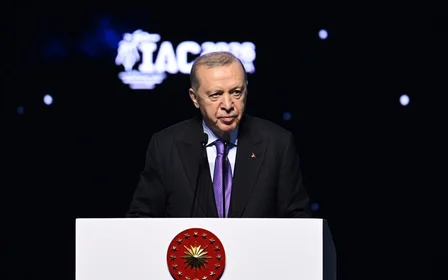
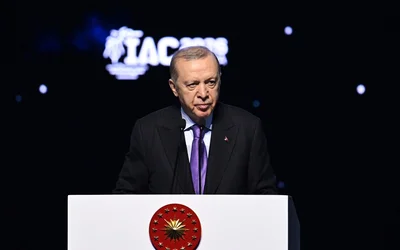
Erdogan used his opening remarks at the IAC to become the first Nato leader to condemn the proliferation of weapons in space without naming the United States or other potential actors.
Ankara also tried to use its position as the IAC host to spearhead the Antalya Declaration on Space for Peace, an initiative endorsed by 21 countries that calls for space to remain a peaceful, cooperative domain free of weapons.
“This is the first time a host country has initiated a common declaration, with many other countries endorsing our initiative for a peaceful space environment,” Kacir explained.
“The idea is that space should continue to be a platform for peace. It should not reflect the divisions and blocs that exist on Earth.”
But to Ankara’s dismay, the IAC did not formally adopt the Antalya declaration at the conference’s ministers’ meeting.
The Somali launchpad
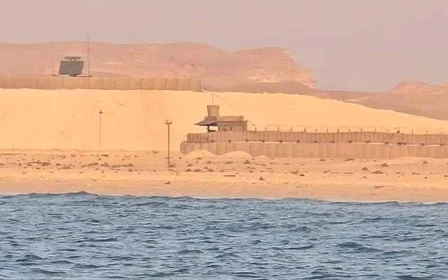
The need to reduce its reliance on international partners has led Ankara to launch an ambitious programme to build a spaceport in Somalia.
While Somalia might seem an unconventional choice for aerospace infrastructure, the country has a space heritage that includes Nasa using Berbera Airport as an emergency landing site for its Space Shuttles between 1980 and 1991 before the start of the Somali civil war.
Building the port in Warsheikh, a coastal town 70 kilometres north of Somalia’s capital, Mogadishu, allows Turkey to take advantage of Somalia’s location near Earth’s equator.
'For me, success is about the journey and building capacity... This is not intended to be a one-off mission'
- Mehmet Nefes, Tubitak Uzay director
This location will enable Turkey to launch rockets or charge countries and companies a fee to launch with significantly less fuel and carry heavier payloads into orbit. Its location on the Indian Ocean also lets rockets fly safely over water instead of populated land.
Turkey’s plan to build a launch site in Somalia mirrors France’s setup at the Guiana Space Centre in French Guiana, which is also near the Earth’s equator, and makes reaching space easier and cheaper.
Satellite images taken by DW News already show that Ankara has begun constructing the space port, with Turkey deploying F-16 fighter jets to protect its investments near Warsheikh.
“If you want to launch a satellite today, you might have to wait two years to get a launch date from a provider like SpaceX,” said Yusuf Kirac, President of Turkey’s Space Agency (TUA).
“Having independent access to space is therefore important for Turkey and many other countries.”
The project also serves as a soft-power instrument in East Africa and coincides with continued instability in the country as the federal government struggles in its fight against Al-Shabaab and grapples with the consequences of Israel’s recognition of Somaliland in the country’s north.
While Al-Shabaab remains active in the surrounding region, experts, however, caution against viewing the security environment as a major barrier towards the spaceport, arguing that safeguarding a specific, high-value facility is far more achievable than establishing regional security.
Faisal Ali, a researcher and journalist who focuses on East Africa, points to Warsheikh being located along a largely government controlled coastal corridor north of Mogadishu.
"Somali forces, supported by international partners, have demonstrated an ability to hold strategically important locations, even as Al-Shabaab remains active in the surrounding region," Ali told MEE.
The analyst instead warns that Ankara's close identification with the current federal administration could risk drawing it to Somalia's internal political struggles, noting that it could "become a vulnerability for its longer-term projects if a less sympathetic government comes to power in Mogadishu."
"The concern, however, is the lack of transparency surrounding these arrangements," said Ali, pointing to unresolved details over land allocation, airspace access, and how revenues and responsibilities will be divided.
"Somalia's parliament has limited oversight capacity...Projects of this magnitude need broader political legitimacy, otherwise their promise risks becoming overshadowed by political contestation."
Abdinoor Dahir, a researcher who focuses on Somalia's relationship with Turkey, echoed Ali's concerns but sees this project as an opportunity to move beyond the image of Somalia being a failed state.
"Hosting a space-launch facility indicates that Somalia can contribute to advanced science and technology rather than remaining on the margins of global technological development," said Dahir.
"The project presents Somalia with both an opportunity and a test of statehood. Somalia has something that Turkey needs: favourable geographical positioning, an Indian Ocean coastline and proximity to the equator.
"Turkey has technological expertise, financial resources, engineering capabilities and a developed space and defence industry. There is therefore a basis for a mutually beneficial partnership."
Rejecting a purely extractive presence, Kacır emphasised local capacity building: “I told my team that the first employee at our spaceport should be a Somali citizen who has studied aerospace in Turkey… This project is not just for Turkey. It is also about our friendship and brotherhood with Somalia.”
Looking ahead, Nefes remains optimistic.
By building its own hardware, engineering novel propulsion systems, and developing independent launch infrastructure in Somalia, the scientist believes his country is taking the right steps.
"For me, success is about the journey and building capacity... This is not intended to be a one-off mission,” said Nefes.
“It is a multi-stage programme in which we develop our capabilities step by step."
Middle East Eye delivers independent and unrivalled coverage and analysis of the Middle East, North Africa and beyond. To learn more about republishing this content and the associated fees, please fill out this form. More about MEE can be found here.