Who are Palestine Action?

Palestine Action has won a legal challenge over the group's ban as a terrorist organisation on two grounds with the UK High Court ruling that the proscription is "unlawful" and should be "quashed".
Justice Victoria Sharp said in a ruling on Friday that the ban was disproportionate as it interfered with the Human Rights Act, specifically the freedom of expression and freedom of assembly.
She concluded that "a very small number of Palestine Action's activities amounted to acts of terrorism" as defined by terror legislation, and that the ban unlawfully interfered with fundamental rights to free speech and freedom of assembly.
The ban was introduced in July by then-Home Secretary Yvette Cooper. It made membership of and public support for the group punishable by up to 14 years in prison under Britain’s terrorism laws.
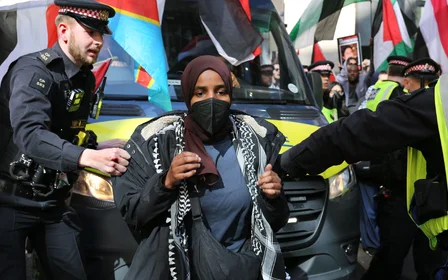
Since then, thousands of people have been arrested for terrorism offences for holding signs in support for the group in silent vigils across the UK.
New MEE newsletter: Jerusalem Dispatch
Sign up to get the latest insights and analysis on Israel-Palestine, alongside Turkey Unpacked and other MEE newsletters
Friday's ruling follows a judicial review of the proscription following a challenge brought by Palestine Action co-founder Huda Ammori. Its outcome could mean that thousands of arrests of the group's supporters could now be void.
So what exactly is Palestine Action, and what does this ruling mean?
Who are Palestine Action?
Palestine Action was founded in 2020 after activists broke into and spray painted the London headquarters of Israel’s largest arms firm, UK-based Elbit Systems.
Its network of activists have subsequently used tactics, including direct action, to target what it says are the “corporate enablers of the Israeli military-industrial complex," often breaking into offices and factories to spraypaint or damage equipment they say is used to commit war crimes in occupied Palestine.
Elbit Systems is the group's primary target, prompting multiple companies to sever ties with the defence contractor, and costing the company “billions” in lost contracts and divestments, according to Palestine Action.
Barclays, which owned 16,000 shares in Elbit Systems, divested from the contractors in October, while the UK's Ministry of Defence cancelled £280m worth of contracts with the company.
Many of its activists have previously been acquitted by juries, on the grounds of "defence of necessity", namely that the damage to property was justified as it was intended to prevent deaths.
But these defences have been systemically removed, using anti-protest legislation which has expanded police powers to crack down on peaceful protest, and impose increasingly severe sentences for those activists found guilty.
Earlier in February, six defendants were acquitted on charges of aggravated burglary in connection with the alleged break-in at a factory owned by Israel's largest weapons supplier, Elbit Systems, near Bristol in August 2024.
The Crown Prosecution Service subsequently announced that it would seek a retrial, as jurors failed to return verdicts on charges of criminal damage and violent disorder.
Defendant Zoe Rogers told Middle East Eye that the acquittals "have shown proscription for the farce that it is".
How has the ban impacted rights to freedom of expression and assembly in the UK?
In her 46-page judgment, Justice Sharp concluded that the group’s proscription "did result in a very significant interference with the right of freedom of speech and freedom of assembly".
Since the ban came in force, thousands have been arrested for terrorism offences at vigils across the UK for holding signs reading: “I oppose genocide, I support Palestine Action.”
Home Office statistics published in December revealed a 660 percent rise in terrorism arrests in the year ending September 2025 compared to the previous year.
Of those, 86 percent were linked to support for Palestine Action. It also noted a "demographic shift" driven by the Palestine Action arrests, with those linked to the group having an average age of 57 compared to 30 for others.
The ban has prompted warnings from human rights experts and campaign groups that it could have a “chilling effect” on free speech in the UK.
In July, UN human rights chief Volker Türk warned that the proscription constitutes “an impermissible restriction” on the rights to freedom of expression, peaceful assembly and association, “that is at odds with the UK’s obligations under international human rights law”.
Does Palestine Action meet the threshold for proscription?
Sharp’s ruling found that the ban was “disproportionate” and that "a very small number of Palestine Action's activities amounted to acts of terrorism" as defined by terror legislation.
An assessment provided by the government's Joint Terrorism Analysis Centre (JTAC) to government ministers, found that the vast majority of Palestine Action’s activities were lawful, and that only three of its 385 actions would meet the statutory definition of terrorism.
In July, UN experts expressed concern that UK domestic counter-terrorism legislation contains a broad definition of terrorism which includes “serious damage to property”.
They said this flies in the face of international standards which state that “acts of protest that damage property, but are not intended to kill or injure people, should not be treated as terrorism”.
Kelly's Solicitors, which specialises in political and protest-related work, and represents Palestine Action, argued in a letter to Cooper that a “significant number” of the group’s activities have employed “entirely conventional campaigning methods such as marches, rallies and demos”.
Laura O’Brien, head of the protest team at Hodge Jones & Allen Solicitors, told MEE: “Palestine Action isn’t a membership organisation, really it's a campaign. And the people that become involved in what are generally expressive forms of protest have often never been in trouble before.
“Many of the actions carried out under the banner of Palestine Action don’t include significant damage, some of them include damage which is low value, often as simple as throwing red paint which is washed away.
“When people are charged with criminal damage, and we go to court, a lot of those damages which are put forward aren’t in fact criminal damage - they’re consequential losses,” solicitor Simon Pook, told MEE.
“The costs that are initially put forward when the case opens are subsequently substantially reduced."
Cooper stated that the assessment of damage caused by the group's actions over the last five years had been based on “a robust evidence-based process, by a wide range of experts from across government, the police and the security services”.
A Channel 4's Dispatches episode which aired days before the ruling interrogated the government’s justifications for the proscription of Palestine Action - including alleged links with Iran - questioning whether these claims were used to obscure the fact that the actual basis for the ban was criminal damage.
Jonathan Hall KC, the government’s independent reviewer of terrorism legislation and a member of its proscription review group, told Dispatches journalist Matt Shea that the press briefings about Palestine Action’s alleged ties to Iran were “wrong”.
Is the ban still in force, and what happens next?
Justice Sharp emphasised that while the court found Palestine Action’s ban unlawful, it still remains in place pending the outcome of an appeal launched by the Home Office.
Home Secretary Shabana Mahmood said she was "disappointed" with the court's decision and intended to fight it.
'The only cases that they're really keeping in the criminal courts by pursuing this appeal are the 3,000 'grannies' standing with placards awaiting trial on terrorism charges'
- Audrey Cherryl Mogan, barrister
"The court has acknowledged that Palestine Action has carried out acts of terrorism. It concluded that its actions are not consistent with democratic values and the rule of law," Mahmood said, adding that the ban "followed a rigorous and evidence-based decision-making process".
Rather than being a statutory de-proscription process, which would have involved the group being removed from a list by the home secretary, the ruling found that the ban was unlawful in the first place.
In a statement, London’s Metropolitan Police said that they "recognise these are unusual circumstances," adding that they will "focus on gathering evidence" of offences where support for the group is being expressed "to provide opportunities for enforcement at a later date".
Campaign group Defend Our Juries reported that protestors holding signs in support of the group outside the court were not arrested, despite there being a large police presence.
Barrister Audrey Cherryl Mogan said that the quashing of the ban will not impact the ongoing criminal cases of Palestine Action-linked activists, including the defendants facing charges in connection with a raid on an Elbit Systems plant and a break-in at RAF Brize Norton airbase.
"The only cases that they're really keeping in the criminal courts by pursuing this appeal are the 3,000 'grannies' standing with placards awaiting trial on terrorism charges," Mogan told MEE.
“They need to explain the pursuit of 3,000 grannies with placards to the taxpayer,” she added.
Middle East Eye delivers independent and unrivalled coverage and analysis of the Middle East, North Africa and beyond. To learn more about republishing this content and the associated fees, please fill out this form. More about MEE can be found here.