
Turkey, Russia agree to speed up aid delivery to Syria

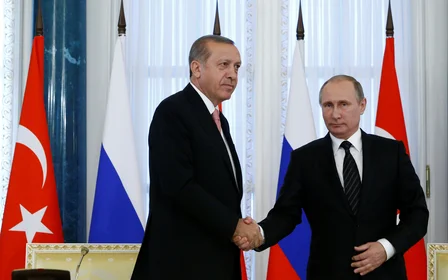
President Recep Tayyip Erdogan and Russian leader Vladimir Putin have agreed on efforts to speed up delivery of humanitarian aid to Syria, according to Turkish presidential sources.
Both men also agreed to hold bilateral talks at a forthcoming G20 summit to be held on 4-5 September in Hangzhou, China, the source - speaking anonymously - added.
The Turkish and Russian leaders held a phone conversation on Friday in which they discussed bilateral relations and cooperation on regional issues and humanitarian crises.
The call was the latest sign of improving relations between Moscow and Ankara, after a deal in June normalising ties in the wake of the crisis sparked by Ankara's shooting down of a Russian warplane last year.
Erdogan shared information about the ongoing Euphrates Shield military operation against the Islamic State (IS) group in northern Syria. Both leaders pointed to the importance of maintaining cooperation in the fight against IS and other militant groups in the region, it said.
The Kremlin confirmed the telephone talks.
"The leaders held a thorough exchange of views on the situation in Syria. They noted the importance of joint efforts in line with the fight against terrorism," it said in a statement.
According to a Middle East Eye report on Friday, Turkey and Russia are still at odds over the fate of Syrian President Bashar al-Assad, but the two leaders agreed to not return to hostilities.
“The issue of Bashar is not solved,” a senior Turkish government source told Middle East Eye. He added that Turkey and Russia are not yet at a consensus on Assad’s role in a transitional government.
However, both parties agree that US foreign policy in Syria is not working.
Middle East Eye propose une couverture et une analyse indépendantes et incomparables du Moyen-Orient, de l’Afrique du Nord et d’autres régions du monde. Pour en savoir plus sur la reprise de ce contenu et les frais qui s’appliquent, veuillez remplir ce formulaire [en anglais]. Pour en savoir plus sur MEE, cliquez ici [en anglais].