
Israel-Palestine live: Israel and Palestinians agree to truce, hostage deal

Mises à jour du direct
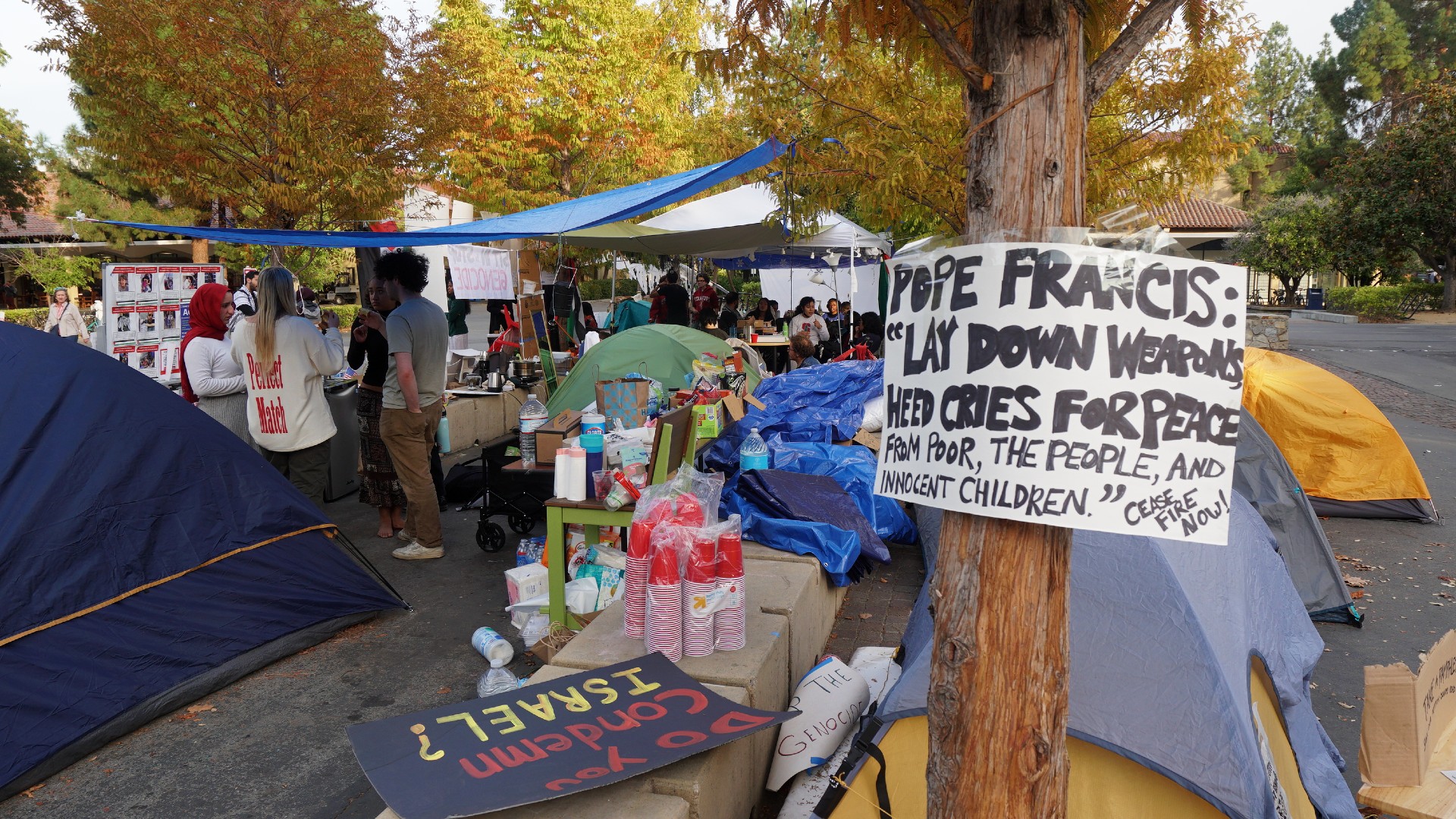
Protestors calling for a ceasefire to the war in Gaza clashed with police outside the Democratic National Committee in Washington, D.C.
Capitol Police said they had to "keep back" 150 people who were "illegally and violently" protesting outside the DNC.
The Jewish Voice for Peace lobby group however accused police of violently suppressing peaceful protesters calling for a ceasefire to the war in Gaza.
"Within moments tonight in Washington DC, police violently assaulted peaceful anti-war protestors calling for a #CeasefireNOW," the group said.
“Cops are assaulting peaceful anti-war protesters in front of @TheDemocrats HQ,” one person wrote on social media platform X.
The demonstration coincided with a meeting of a group of seven members of Congress inside the headquarters, including minority leader Hakeem Jeffries. On social media, Democratic lawmakers said the protestors had trapped them inside.
Democratic Congressman Brad Sherman accused the protestors of pepper spraying police officers and attempting to storm the building. He said on social media platform X that he had to be evacuated by police.
Congressman Sean Casten said he was “evacuated” from the Democratic Congressional Campaign Committee office after the building was surrounded by protestors “who had blocked all modes of ingress and egress”.
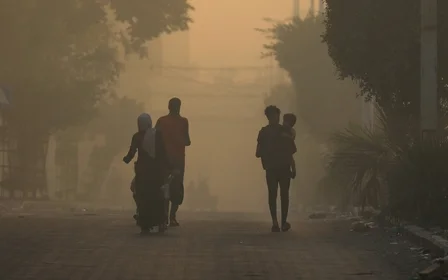
Palestinians fleeing northern Gaza have reported seeing dead bodies in the streets, as the humanitarian crisis in Gaza intensifies.
Palestinians are fleeing the north as the UN reports that only one out of 24 hospitals with in-patient capacity in the area is open and admitting patients.
In its latest report, the UN Office for the Coordination of Humanitarian Affairs said that three hospitals have shut down in the last three days alone.
Meanwhile, the Palestine Red Crescent Society reported that it has been unable to respond to hundreds of calls to assist and evacuate people wounded or trapped under the rubble after Israeli strikes.
As of 10 November, about 2,700 people, including some 1,500 children, remain missing and presumed to be trapped or dead under the rubble, according to Palestinian health officials.
An up-to-date death toll remains unavailable for the fifth day because communications and services at hospitals in the north have collapsed.
Palestinians fleeing the war have also been subject to beatings and strip searches, the UN said, citing “anecdotal and eyewitness reports”.
On 14 November, Palestinians reported that the Israeli military had established an unstaffed checkpoint where people are directed from a distance to pass through. A surveillance system is thought to be installed and Palestinians are being forced to undergo what appears to be a facial recognition scan.
Over 1.5 million people in Gaza are now internally displaced, the UN said, including about 813,000 who are sheltering at 154 overcrowded UN shelters.
The UN said the deteriorating conditions are leading to the spread of disease, including acute respiratory illness and diarrhoea, raising environmental and health concerns.
President Joe Biden suggested Israel faces little pressure from the US to rein in its invasion of the Gaza Strip on Wednesday, saying the war will stop “when Hamas no longer maintains the capacity to murder, abuse and just do horrific things to the Israelis.”
Speaking at a solo press conference in California after meeting with Chinese President Xi Jinping, Biden provided clear support for Israel in the face of pressure from some in the Democratic party to call for a ceasefire and signs of frustration with how Israel is waging the war amongst officials in his administration.
Biden doubled down on comments from US officials that Washington had intelligence backing up Israel’s claim that Hamas had a military headquarters at al-Shifa hospital, but refused to say what that intelligence was.
He said the US asked Israel to be 'incredibly careful' in its raid on the hospital.
Hamas has denied operating in the hospital and accused Biden of giving Israel a ‘green light’ to raid the medical facility.
Biden also provided insight into his thinking on the war amid signs of some divergence between the US and Israel over mounting civilian casualties in Gaza and Israel’s ‘day-after plan’ for the enclave.
Middle East Eye reported previously that US officials were growing frustrated with the high number of civilian casualties Israel is inflicting, with one US official telling MEE that Prime Minister Benjamin Netanyahu was acting in defiance of the US.
Read more: Massive civilian death toll forcing split between US and Israel
But Biden said Hamas intends to attack Israel again: “They’re not kidding about it. They’re not backing off. And so I just ask a rhetorical question: I wonder what we would do if that were the case?”
Biden, however addressed two points where the US and Israel have diverged.
He said that he was opposed to Israel occupying the Gaza Strip and said he “made it clear “ to Prime Minister Benjamin Netanyahu that the “only ultimate answer” to the conflict was a two-state solution.
Netanyahu said Israel will maintain an indefinite security presence in Gaza and has shown no willingness to restart talks on a two-state solution.
Biden also said he was "mildly hopeful" that there would be a deal to free hostages held by Hamas.
"I don't want to get ahead of myself here because I don't know what's happened in the last four hours, but we have gotten great cooperation from the Qataris," he said when asked about progress on freeing hostages taken on 7 October.
Biden appeared to suggest some movement from Israel on a potential deal noting the "pause the Israelis have agreed to" before cutting off his thought and saying "I'm going to stop. But I am mildly hopeful."
He said no US troops woud be sent to free the hostages.
A hostage deal between Israel and Hamas has hit an impasse over the number of days Israel will allow a ceasefire in the enclave and other matters, according to Axios.
The Axios report says Qatar has passed along two ceasefire proposals from Hamas to Israel.
The first would see Hamas release 18 hostages, including women and children, in exchange for a three-day ceasefire.
Israel rejected the proposal on the grounds it could not agree to a pause in fighting for more than 24 hours in exchange for the release of so few hostages.
In the second proposal, Hamas offered the gradual release of a larger number of hostages over several days in exchange for a five day pause. Israel doesn't want to offer more than three days.
Hamas will release 50 women and children it is holding as part of this proposal. It will continue to release 10 hostages per day for the remainder of the ceasefire. A lapse in the release of hostages would trigger the resumption of fighting.
The negotiations have hit other roadblocks.
Hamas doesn’t hold all the hostages, and it must coordinate with Islamic Jihad and at least one armed group in Gaza identified as “Al-Shabiha" that hold some hostages, according to Axios.
In addition to a ceasefire, Israel must release Palestinian women, children and elderly people held in its prisons. Israel would also agree to allow more fuel into Gaza in coordination with the UN and would commit to allowing 200 aid trucks into Gaza each day via Egypt.
Israeli and US officials told Axios it’s unclear if a deal can be reached in the next few days.
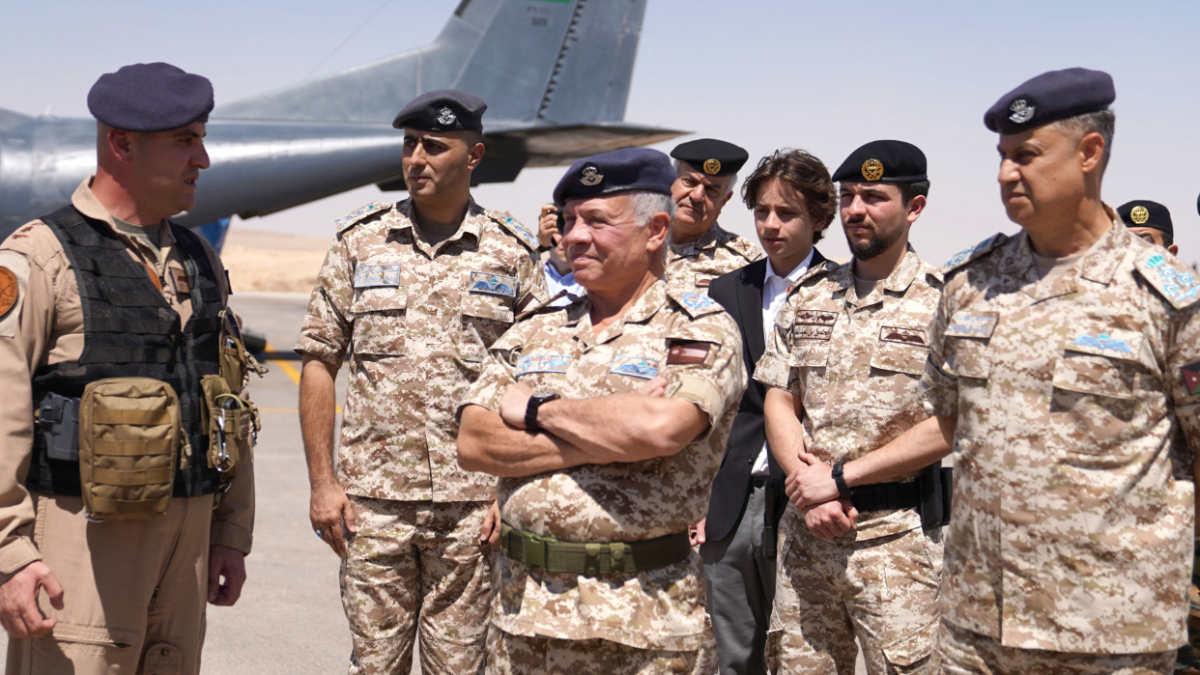
Seven staff members of a Jordanian run hospital in the Gaza Strip were injured by an Israeli strike as they rushed to treat wounded Palestinians.
The strike came just as hospital workers were rushing to the emergency section as they saw Palestinians carrying wounded people, “as our staff got to the emergency room they got hit,” Jordanian foreign minister Ayman Safadi told CNN.
“The attack happened as they were trying to provide help to wounded people,” Safadi added.
Safadi said it was “incomprehensible that people trying to offer the medical help to wounded people get hit as well.”
He estimated that “tens" of Palestinians have been killed and hundreds more wounded.
The Jordanian army manages the hospital in Gaza, which is one of the last functioning medical facilities in the enclave. Jordan has taken the rare step to airdrop supplies to the hospital.
Jordanian and Western officials previously told Middle East Eye that Israel had avoided strikes in the area of the hospital, pointing to it as a sign that communication and cooperation between Israel and Jordan was holding up despite the war.
The strike marks an escalation in tensions between the two. Jordan and Israel have a peace treaty, but Jordan has condemned Israel’s invasion of Gaza and recalled its ambassador from the country.
Read more: Jordan's US-allied king faces 'nightmare scenario' as Gaza invasion looms
The Israeli military has installed facial recognition cameras and electric gates in the courtyard of al-Shifa hospital after raiding its radiology, surgical and emergency buildings, according to Palestinian news agency, Wafa news.
The military also interrogated doctors, patients and displaced people. Some were subjected to strip searches, and a number of people were subsequently arrested, according to Wafa.
Israeli military bulldozers have also reportedly been caring out excavation work around the hospital.
The Palestinian health ministry said Israeli bulldozers had destroyed parts of the hospital’s southern entrance.
About 50 people were killed and dozens more injured by an Israeli strike that hit a mosque in the Al-Sabra neighborhood of the central Gaza Strip, according to Palestinian news agency, Wafa.
Meanwhile three people were killed and dozens more injured after an airstrike hit the Malaysian school in the Nuseirat camp in the central Gaza Strip, Wafa reported.
Israel has told Palestinians in Gaza to flee northern Gaza to avoid fighting as the bulk of its operations focus on the north.
More than two dozen Palestinian cancer patients, who had crossed from Gaza into Egypt, arrived in Turkey for treatment in the early hours of Thursday, Turkey's Anadolu agency reported.
Two planes carrying the patients, many of them children, landed at Ankara airport early Thursday morning.
Turkey has sent a ship loaded with material for field hospitals, ambulances and generators to Egypt to treat civilians who have been able to flee Israel's invasion of the enclave.
Turkish Health Minister Fahrettin Koca said 27 patients had been flown to Turkey from Egypt, along with 13 companions, without specifying whether these were doctors or family members.
He added that the cancer patients had been able to cross from Gaza into Egypt via the Rafah border crossing.
Israeli opposition leader Yair Lapid said Prime Minister Benjamin Netanyahu should resign on Wednesday evening, the first time the opposition has publicly called for his ouster amid the war.
“This government isn’t functioning, we need change, Netanyahu cannot continue to be prime minister, we cannot allow ourselves to conduct a prolonged [military] campaign with a prime minister that the public has no faith in,” Lapid told Israeli Channel 12.
The comments are the most high-profile sign of fissures within Israel over Netanyahu’s continued rule.
A poll earlier this week found less than 4 percent of Israelis said that they trust Netanyahu as a reliable source of information on the war.
“Security-wise and on the society level, we cannot have a premier who has lost the trust of the public,” Lapid said.
Netanyahu formed a unity government with National Unity party leader Benny Gantz after Hamas’ 7 October attack. He sits on the war cabinet with Defense Minister Yoav Gallant, Gantz and National Unity member Gadi Eisenkot.
Lapid refused to join the government at the time, saying it would only provide cover for Netanyahu’s failed governance.
Israel has slammed a United Nations Security Council resolution that called for “extended humanitarian pauses” to fighting in the Gaza Strip.
Israel’s ambassador to the UN, Gilad Erdan, in reacting to the resolution, said, “The decision is disconnected from reality and holds no significance. Israel already operates in Gaza according to international law, while Hamas terrorists will ignore the decision and certainly not act in accordance with it.”
“Israel will continue its actions until the destruction of Hamas and the return of the kidnapped,” he added.
While the resolution falls short of calling for a ceasefire, it is the first one passed by the UN Security Council since Hamas launched its attacks on 7 October, which killed 1,200 people, and the subsequent Israeli retaliation on Gaza, which has killed more than 11,000 people over the last five weeks.
Good evening,
It’s just past midnight in Gaza, and here is your latest round-up on an eventful evening on the global stage as countries voted on whether to call for a ceasefire.
Late on Wednesday, the United Nations Security Council passed a resolution calling for “extended humanitarian pauses” after weeks of debates on whether to call for a ceasefire or not.
This resolution is the first one passed by the UN Security Council since Hamas launched its attacks on 7 October, which killed 1,200 Israelis and saw over 200 taken as hostages. The subsequent Israeli retaliation on Gaza has killed more than 11,000 people over the last five weeks.
Twelve countries voted for the resolution, with three countries, Britain, Russia and the United States, abstaining on the motion.
Elsewhere, in the United Kingdom, British members of Parliament voted against a proposal which supported a ceasefire in Gaza.
The Scottish Nationalist Party proposed an amendment to the King’s Speech, which called for a ceasefire in Gaza. Parliamentarians voted down this amendment.
But despite voting down the proposal, the vote forced MPs loyal to Labour leader Keir Starmer to break ranks and vote for a ceasefire in Gaza.
Twelve Labour Party MPs resigned from the party’s front bench to vote for a ceasefire. The most senior Labour rebel to defy Labour leader Keri Starmer was Jess Phillips, who represents a Birmingham constituency with a sizeable Muslim population.
In Gaza, Israel claimed to have found weapons belonging to Hamas in the al-Shifa hospital after Israeli forces stormed the medical facility in the early hours of Wednesday morning.
Hamas denied the claims, with Palestinian medics in al-Shifah saying Israeli soldiers had retreated to the outskirts of the hospital after interrogating its medical staff and arresting several technicians who helped run critical equipment.
American public support for Israel’s war in Gaza has reached a new low, with a fresh poll showing that less than a third of respondents support the war, and the majority of those polled think that Israel should call for a ceasefire to the conflict.
The findings of the Reuters/Ipsos poll released on Wednesday show that 32 percent of respondents said “the US should support Israel” when asked what role Washington should take in the war. This is down from the 41 percent in October.
Meanwhile, 68 percent of respondents in the poll said they agreed with a statement that “Israel should call a ceasefire and try to negotiate.”
READ MORE: US public support for Israel's war on Gaza reaches new low, polling shows

Further background on Wednesday's UN Security Council resolution vote which led to Malta's resolution passing:
- Twelve countries voted for the motion, which called for 'extended humanitarian pauses' in Gaza.
- Three nations abstained on the resolution, including Russia, the United States and the United Kingdom.
- The council's stalemate centred on whether to call for a humanitarian pause or a ceasefire. A pause is considered less formal and shorter than a ceasefire, which the warring parties must agree on.
- Malta's resolution does not condemn Hamas - a point of contention for Israel's allies, the United States and Britain.
- Wednesday's meeting is the fifth time the council attempted to take action since Hamas attacked Israel on 7 October, killing 1,200 people and taking over 200 people hostage.
- It was the fifth Security Council attempt to take action since Hamas fighters attacked Israel and the war began. Over 11,000 Palestinians have been killed in Israel's bombing campaign
The United Nations Security Council has adopted Malta's resolution, which called for extended humanitarian pauses.
Twelve members voted for the resolution, with three members, including Russia and the United States, abstaining on the resolution.
Malta's ambassador to the United Nations, Vanezza Frazier, is introducing its resolution to the UN Security Council, which calls for "extended humanitarian pauses" and falls short of calling for an outright ceasefire in Gaza.
"This draft resolution we have in front of us today seeks to offer hope in this dark hour," Frazier said.
"[This draft resolution] aims to ensure respite from the current nightmare in Gaza and give hope to the families of all victims”.