
Israel-Palestine live: Israel and Palestinians agree to truce, hostage deal

Mises à jour du direct
Abu Ubaida, the spokesperson for Hamas’s armed wing, the Izz al-Din al-Qassam Brigades, said Israel requested 100 women and children be released from Hamas custody.
In return, the al-Qassam Brigades offered the exchange of 200 Palestinian children and 75 women held in Israeli custody, a five-day ceasefire, and entry of humanitarian aid to the entire besieged Strip.
The al-Qassam spokesperson said that Israel is stalling on a response to their offer and that Qatar is facilitating the talks.
There are currently 200 Palestinian children and 75 women in Israeli custody. Around 239 hostages are reported to be in Gaza after the Hamas-led attacks on Israel, but it is unclear how many are still alive after Israel’s heavy bombardment of the Gaza Strip.
Former British Prime Minister Tony Blair is open to a role as Israel’s “humanitarian coordinator” in Gaza, a suggestion first put forward by Benjamin Netanyahu.
A spokesperson for Blair said he was “discussing the situation” but no offer had yet been accepted, according to media outlets.
According to Israeli news site Ynet, Netanyahu wants to address international concerns about the humanitarian crisis unfolding in the besieged Palestinian territory, as Israel presses on with its bombing campaign.
Israeli sources told Ynet that while the proposed role had not been defined, it could entail ensuring the provision of medicines, medical treatment, and the evacuation of the wounded from the area.
Blair has longstanding ties in Israel, a relic of his role serving as a special envoy for the Middle East Quartet, a block made up of the UN, US, Russia, and the EU, which was aimed at mediating talks between the Palestinian Authority and Israel.
Read more: Blair open to becoming Israel’s ‘humanitarian coordinator’ in Gaza
Dozens of Israeli cities and towns saw a barrage of rockets emanating from Gaza. One rocket hit a home in southern Israel, according to the Israeli media outlet, Haaretz.
There have been no reported casualties. The rockets came a few minutes after Israeli Defence Minister Yoav Gallant alleged on Monday that Hamas had lost control of Gaza and that it was no longer able to stop the Israeli army.
It took 30 days, from the start of the Israel-Palestine war on 7 October, for the number of Palestinians killed in Gaza to pass 10,000.
The graph below illustrates the daily tally of fatalities up to and including 5 November, as well as the cumulative number.
The average number of people killed each day during that 30-day period was 336 - or one person every four-and-a-half minutes.
The worst day for fatalities was 24 October, when 756 Palestinians were killed amid heavy Israeli bombardments. This figure included at least 30 people in Khan Younis, killed when their four-storey apartment building was levelled.
The death toll across Gaza has since risen to 11,078 Palestinians killed as of 12 November.
That figure includes the deaths of 4,506 children, defined as under 18, and 3,027 women. These two groups account for 68 percent of the total number of Palestinians killed in Gaza since 7 October.
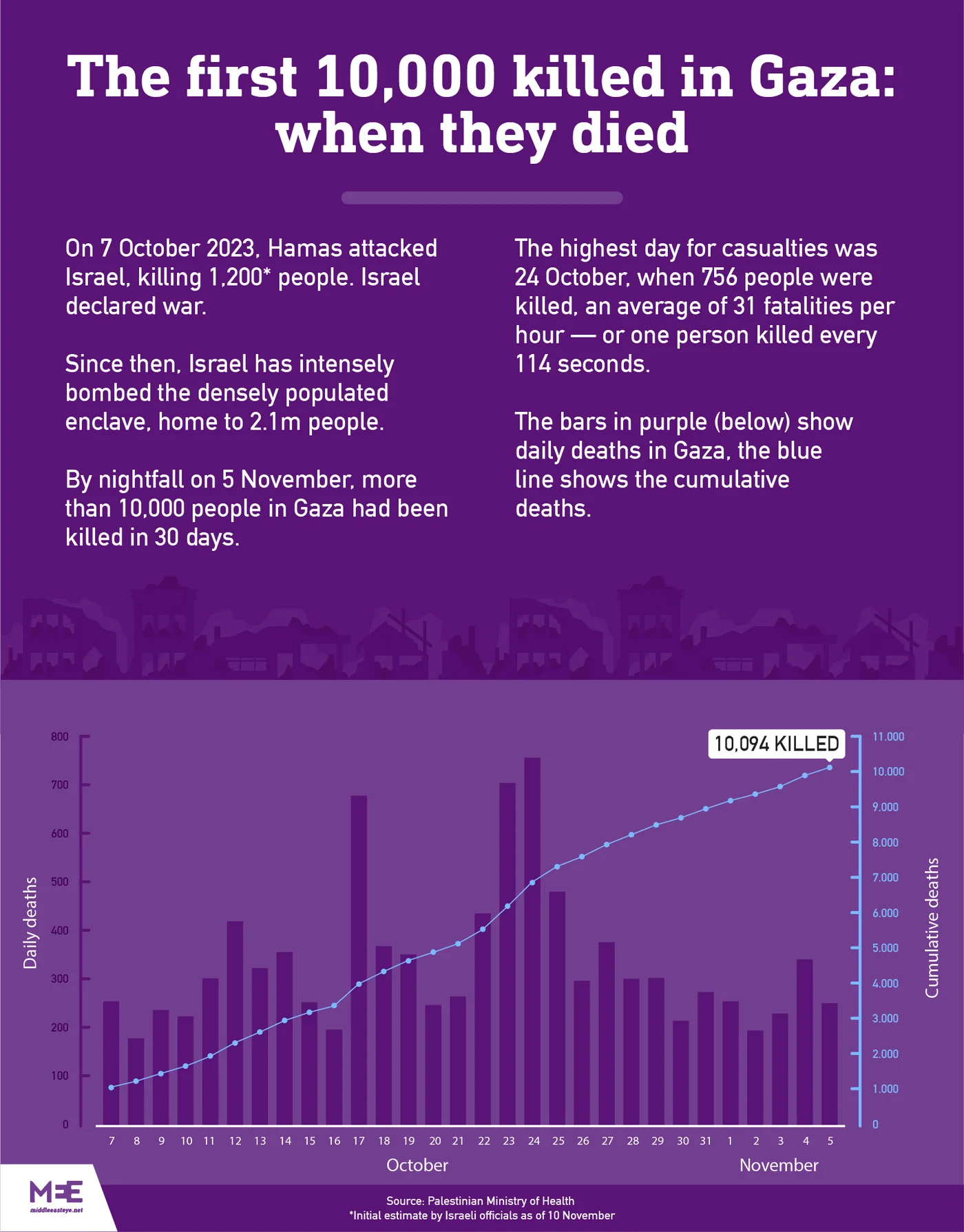
It took 30 days, from the start of the Israel-Palestine war on 7 October, for the number of Palestinians killed in Gaza to pass 10,000.
The graph below illustrates the daily tally of fatalities up to and including 5 November, as well as the cumulative number.
The average number of people killed each day during that 30-day period was 336 - or one person every four-and-a-half minutes.
The worst day for fatalities was 24 October, when 756 Palestinians were killed amid heavy Israeli bombardments. This figure included at least 30 people in Khan Younis, who were killed when their four-storey apartment building was levelled.
The death toll across Gaza has since risen to 11,078 Palestinians killed as of 12 November.
That figure includes the deaths of 4,506 children, defined as under 18, and 3,027 women. These two groups account for 68 percent of the total number of Palestinians killed in Gaza since 7 October.
The Euro-Mediterranean Human Rights Monitor says it has documented reports of the execution of dozens of Palestinians by Israeli army forces during their displacement from northern Gaza to central and southern parts of the Strip, even though they did not pose any threat.
The group did not give an exact number of "executions" but said it received hundreds of reports.
The Euro-Mediterranean Observatory said there were reports that Palestinians were targeted by live bullets and sometimes artillery in premeditated killings during their attempt to flee at the request of the Israeli army to the area south of Wadi Gaza.
The Observatory received reports from displaced people reporting killings at military checkpoints set up by the Israeli army as part of its designation of a “safe corridor” along the main traffic artery, Salah al-Din Road, between 9:00 and 16:00 local time during the day.
The group has called on the United Nations and the International Criminal Court to open an independent investigation into the matter.
Egyptian security officials said around 500 foreigners and dual nationals, as well as wounded Palestinians, left the besieged enclave on Sunday.
"Five hundred foreign nationals from 15 different countries entered Egypt,” an Egyptian security official told AFP on condition of anonymity. The Rafah crossing is the only intermittently operational crossing in and out of Gaza.
The Israeli bombardment of Gaza since 7 October has killed 11,240 Palestinians, including 4,630 children and 3,130 women, the government media office in Gaza said on Monday.
The figures are accurate as of 4.50pm GMT on 13 November.
Around 29,000 people have been wounded, 70 percent of them women and children.
More than 3,000 people are still missing, including at least 1,500 children. The vast majority of these people are believed to be dead and buried under rubble.
Israeli Foreign Minister Eli Cohen said on Monday that his country may have up to three weeks to continue its bombardment of Gaza before pressure for a ceasefire ratchets up.
“From a political point of view, we recognise that Israel has come under more pressure,” Cohen said.
“The pressure is not very high, but it is increasing.”
He added that “in conversations I hold with foreign ministers, they emphasise the humanitarian issue [in Gaza], the aspect of their identification and shock from the October 7 massacre is reduced. There are also those who request - not publicly - to work towards a ceasefire.”
The only remaining operational hospital in the north of Gaza is delivering up to 20 babies per day despite running out of fuel, ActionAid International has said.
Al-Awda hospital “has had no electricity or fuel for the last three days yet is continuing to operate against the odds, relying on batteries”, the charity said.
A senior doctor at Al-Awda, speaking to ActionAid over the weekend, said: “We received many patients - pregnant women from Gaza City - because the hospitals are closed. We delivered 16 caesarean sections today (Sunday) in Al-Awda Hospital. We are now receiving about 18-20 newborn deliveries every 24 hours.”
According to ActionAid, 22 of Gaza’s 35 hospitals - including two of its biggest medical facilities, Al-Shifa and Al-Quds - are no longer operational because of the bombings or from having run out of fuel.
Riham Jafari, coordinator of advocacy and communication for ActionAid Palestine, said: “Thousands of women in Gaza are risking their lives to give birth, undergoing caesareans and emergency operations without sterilisation, anesthesia or painkillers.”
Much of the focus on day 39 of the Israel-Palestine war has been on Israeli attacks close to hospitals, most notably al-Shifa, from which people have been unable to flee and outside which dead bodies lie uncollected.
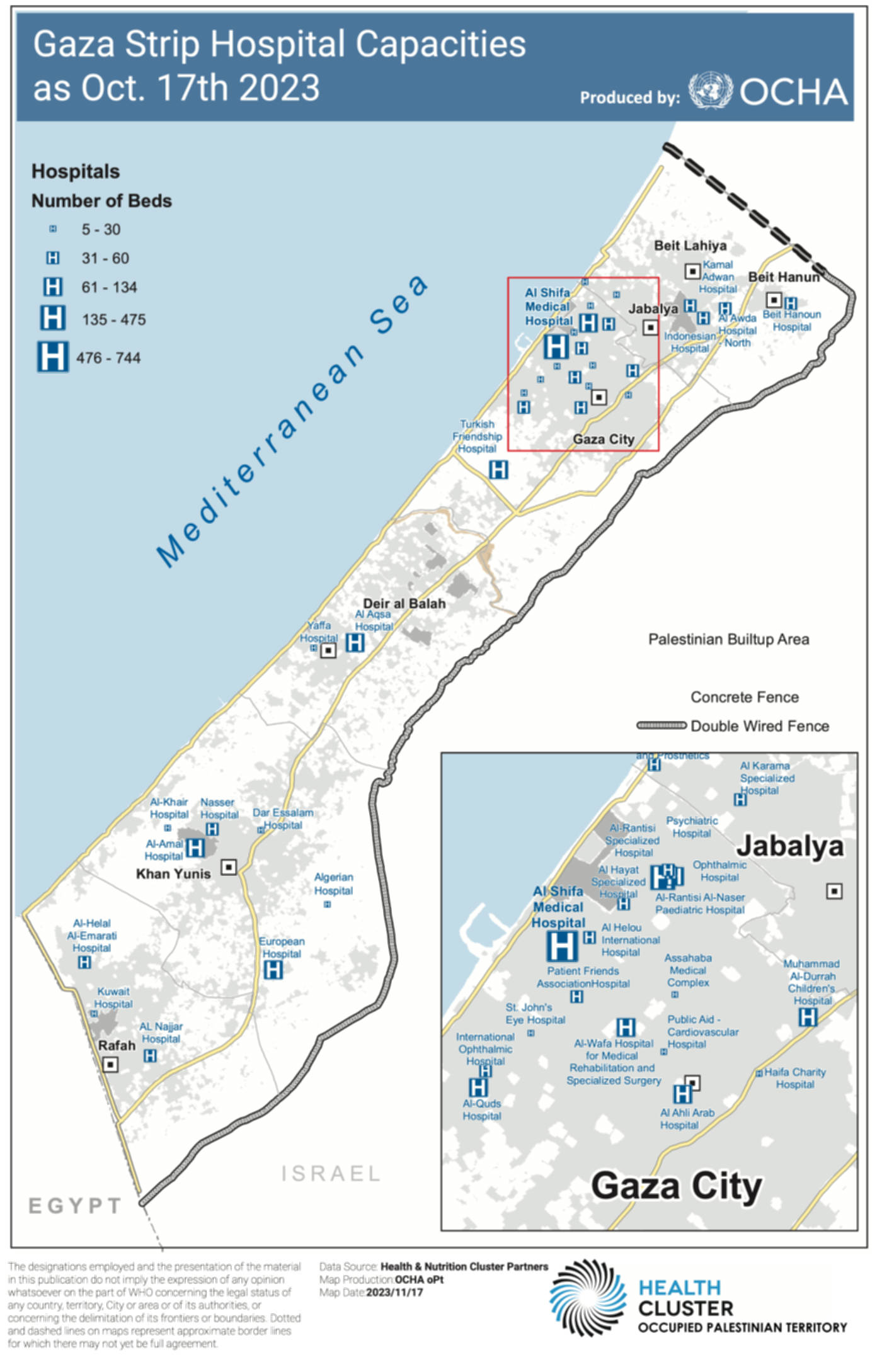
This map, produced by the Office of the United Nations High Commissioner for Human Rights, sets out Gaza's hospital facilities on 17 October 2023, 10 days into the conflict.
It's important to note that more than half of these medical centres and facilities have now been destroyed or no longer function. Those that survive, including al-Shifa, the enclave's largest hospital, and al-Quds, have stopped admitting new patients and are without oxygen, the most basic medicine, and power.
The Israeli government's security cabinet on Monday approved emergency measures to shut down the operations and broadcast of Beirut-based Al Mayadeen TV in Israel and the occupied West Bank.
The cabinet said in a statement that it had taken action against the channel for "making wartime efforts to harm [Israel's] security interests and to serve the enemy's goals".
The decision was taken after a proposal by Communications Minister Shlomo Karhi to block foreign broadcast networks and channels, close their offices, and block their websites, to prevent them from undermining Israel's security.
"Immediately upon the cabinet approval this morning, I signed the first order to block the internet sites of Al Mayadeen in Israel," Karhi wrote on his Facebook page.
Read more: Israeli government blocks Al Mayadeen TV
A spokesman for the Palestine Red Crescent in Gaza spoke to Al Jazeera about the situation in Gaza’s hospital.
Mahmoud Basal said that al-Ahli hospital was the only hospital still providing services in the besieged enclave.
He said that near Al-Quds hospital Israeli forces had separated men and women, before arresting all the men.
Basal added that communication was cut from the Gaza Strip, and that medics relied on the sounds of explosions to identify the locations of the dead and wounded.
“There are no resources to deal with the nature of the injuries among citizens,” he said. “We are living in a painful and difficult reality. We have more than 100 wounded among our crews and have lost half of our equipment.”
Meanwhile, the director of Al-Shifa hospital said eight patients had died since Monday morning at the facility.
Journalists have been targeted by Israeli strikes on the southern Lebanese village of Yaroun, according to local reports.
Al Jazeera said its photographer Issam Mawasi was lightly wounded and his vehicle damaged as a result of the attack.
Lebanese channel Al Jadeed News was broadcasting live from Yaroun when a bomb landed metres away from its reporter.
The broadcaster called it an "intentional Israeli attack targeting the whereabouts of a number of journalists".
An Israeli electrical worker was killed by an anti-tank missile fired from Lebanon, his employer said on Monday.
Shalom Abudi, 56, was killed on Sunday night "by Hezbollah fire during his work in the Dovev area", a northern Israeli town on the border with Lebanon, according to the Israel Electric Corporation.