
Ismail Haniyeh killing unlikely to shift Hamas' stance on peace talks

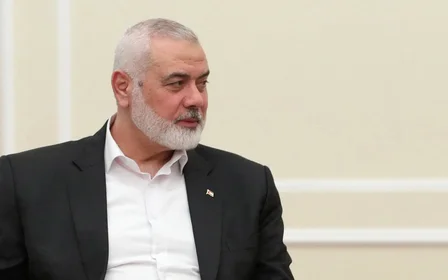
Ismail Haniyeh played a crucial role in efforts to negotiate a ceasefire in Gaza, but his assassination is unlikely to shift Hamas’ approach to peace talks, sources familiar with the movement told Middle East Eye.
On Wednesday, obituaries described Haniyeh as the pragmatic, public face of the Palestinian movement, suggesting he was one of the officials most likely to establish peace.
Those who knew him do not disagree. They say he was a calm, contemplative leader who listened more than he spoke. He was a consensus man and an important interlocutor with Egypt and Qatar, the mediators in the ceasefire talks.
However, Azzam Tamimi, a British-Palestinian academic, activist and historian of Hamas, said the assassinations of nearly a dozen Hamas leaders since 1993 have forced the movement, including its negotiating unit, to organise itself around this reality.
“Haniyeh was one of a team. It wasn’t Haniyeh. Everybody was involved,” Tamimi told MEE.
Tamimi explained that Hamas formed a committee focused on negotiations, which included top leaders such as Haniyeh. “They usually check every detail with Gaza,” he said.
“There is a mechanism. There is a process,” Tamimi added. “There is no personality cult.”
Not the detail man
A well-informed Israeli source, who declined to speak on the record due to the sensitivity of the topic, said Haniyeh was not handling the details of the negotiations.
“It is clear that he pushed for a deal, but others claim that he did not really have an effect on the content,” said the source who is in direct contact with Israeli negotiators.
Hours after Haniyeh’s assassination in Tehran on Tuesday night, Qatari Prime Minister Mohammed bin Abdulrahman bin Jassim Al Thani suggested that Haniyeh’s killing could jeopardise the talks.
“Political assassinations and continued targeting of civilians in Gaza while talks continue lead us to ask, how can mediation succeed when one party assassinates the negotiator on the other side?” he wrote on X.
“Peace needs serious partners and a global stance against the disregard for human life.”
Tamimi said he interpreted the comment as a reflection of Israel’s lack of serious commitment to negotiations, not a suggestion that Hamas’ position would change or talks would collapse without Haniyeh.
"I expect that this will not affect them, regarding the negotiations," he said.
Middle East Eye propose une couverture et une analyse indépendantes et incomparables du Moyen-Orient, de l’Afrique du Nord et d’autres régions du monde. Pour en savoir plus sur la reprise de ce contenu et les frais qui s’appliquent, veuillez remplir ce formulaire [en anglais]. Pour en savoir plus sur MEE, cliquez ici [en anglais].