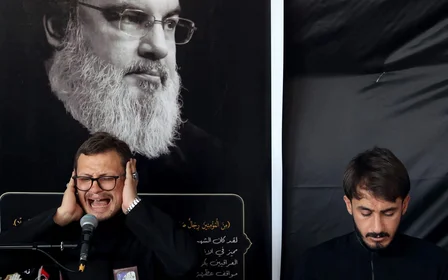

Nasrallah, Netanyahu agreed to a truce before Israel assassinated Hezbollah leader: Report

Lebanese Foreign Minister Abdallah Bou Habib said in an interview with CNN that both Hezbollah leader Hassan Nasrallah and Israeli Prime Minister Benjamin Netanyahu had agreed to a temporary truce just before Israel killed Nasrallah in a massive air strike in Beirut.
"[The US] also agreed on the Biden-Macron statement that calls for the implementation of a 21-day ceasefire," Bou Habib told CNN's Christine Amanpour.
"And they told us that Mr Netanyahu agreed on this. And so we also got the agreement of Hezbollah on that. You know what has happened since then," he added.
Bou Habib, who is currently in New York following September's UN General Assembly, said the agreement to the truce was confirmed before Israel launched a massive air strike on Beirut's southern suburbs, killing Nasrallah and wiping out entire buildings.
Before Israel killed Nasrallah, the US and France said last Wednesday they were releasing a statement urging for a 21-day temporary truce between Hezbollah and Israel, after a week of Israel launching escalatory air strikes on Lebanon.
US officials said that both parties had been communicating regarding the statement, and were confident a truce would be reached. However, the next day Netanyahu publicly rejected the truce and on Friday Israel killed Nasrallah.
The revelation from Bou Habib could provide insight into how Israel killed Nasrallah, who has survived multiple Israeli assassination attempts over the decades.
Another report from Reuters published on Wednesday said that Iran's Supreme Leader Ali Khamenei sent a messenger to warn Nasrallah that Israel was planning to assassinate him. That messenger, senior Iranian commander Abbas Nilforoushan, was also killed in the Israeli strike on Friday 27 September.
You can watch my full interview with Lebanese Foreign Minister Abdallah Bou Habib here -- we spoke a few hours before Iran's strikes on Israel on Tuesday. pic.twitter.com/kNYt1WjQ17
— Christiane Amanpour (@amanpour) October 3, 2024
The comments from Bou Habib also cast further doubt as to whether Israel has ever wanted to seek peace since the war on Gaza began in October 2023.
In July, Israel also assassinated Hamas's political leader, Ismail Haniyeh, in Tehran. Haniyeh was leading the negotiations over a possible ceasefire with Israel.
Since the assassination of Nasrallah, Israel launched a military invasion of Lebanon that was marred with setbacks after Hezbollah fighters killed eight Israeli soldiers and Hezbollah claimed additional Israeli casualties and the destruction of several tanks.
Despite the US putting together the attempt to seek a truce in the fighting between Hezbollah and Israel, the Biden administration has supported Israel's killing of Nasrallah and its invasion of Lebanon.
The US also condemned Iran's recent attack on Israel, which targeted several Israeli military bases.
Israel has vowed to respond to the attacks, risking a wider and direct war between Israel and Iran.
Middle East Eye propose une couverture et une analyse indépendantes et incomparables du Moyen-Orient, de l’Afrique du Nord et d’autres régions du monde. Pour en savoir plus sur la reprise de ce contenu et les frais qui s’appliquent, veuillez remplir ce formulaire [en anglais]. Pour en savoir plus sur MEE, cliquez ici [en anglais].