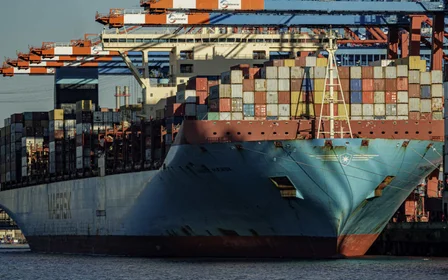

Maersk temporarily halts operations at Israel's Haifa port after Iran strikes

Danish shipping and logistics behemoth Maersk has temporarily halted operations at Israel's Haifa port, amid the country's escalating conflict with Iran.
In a statement released on Friday, Maersk said it decided to suspend operations after “careful analysis of threat risk reports in the context of the ongoing conflict between Israel and Iran, specifically regarding the potential risks of calling Israeli ports and the ensuing implications for the safety of our vessel crews”.
Maersk said it was in close contact with customers "impacted by this decision and are working to provide alternative transport solutions to minimise disruption".
The company said it was continuing to operate at Ashdod and that it had not experienced any other issues in its other operations in the region.
Israel and Iran have been locked in conflict since Israel launched unprovoked air strikes against Iran on 13 June, in what is widely being seen as an attempt to derail an Iranian nuclear deal with the US and exercise regime change in Tehran.
More than 639 people have been killed in Iran, with Israel hitting residential areas and hospitals, along with strikes on military sites.
In Israel, the cities of Tel Aviv and Haifa have also incurred heavy damage following Iran's retaliatory missile strikes.
Escalating tensions
Mearsk has been under pressure from pro-Palestine activists to suspend all business ties with Israel, given its role in transporting weapons from the US to Israel for the war effort in Gaza.
More than 55,000 Palestinians have been killed as a result of Israel’s war on Gaza, which several countries, as well as many international rights groups and experts, now qualify as an act of genocide.
Despite the efforts to push for Maersk to stop being involved in what critics call the "supply chain of death", the company has refused to halt operations with Israel.
Maersk's decision to halt operations in Haifa came days after Bazan, Israel's largest oil refinery, stopped work in Haifa after it was hit by an Iranian-fired ballistic missile. Three workers were killed in the strike.
Following escalating tensions, Maersk issued a statement on Monday, advising teams to work remotely as a precautionary measure.
However, Adani Ports and Special Economic Zone Ltd, which has a majority stake in Haifa Port, said operations were still moving smoothly despite the missile strike at the nearby oil refinery.
Shrapnel from the missile strike was reportedly found at the port.
Adani's purchase of the Haifa Port in 2023 is seen as integral to transforming it into a major international port, as part of the India-Middle East-Europe Economic Corridor (IMEC).
IMEC aims to build a new trade passage from India to Europe, via the United Arab Emirates, Saudi Arabia, Jordan and Israel as a counter to China's Belt and Road Initiative.
Haifa Port handles about 20 million tons of cargo annually, which makes it among the busiest ports in Israel.
Adani Ports did not immediately reply to Middle East Eye's request for comment.
Middle East Eye propose une couverture et une analyse indépendantes et incomparables du Moyen-Orient, de l’Afrique du Nord et d’autres régions du monde. Pour en savoir plus sur la reprise de ce contenu et les frais qui s’appliquent, veuillez remplir ce formulaire [en anglais]. Pour en savoir plus sur MEE, cliquez ici [en anglais].