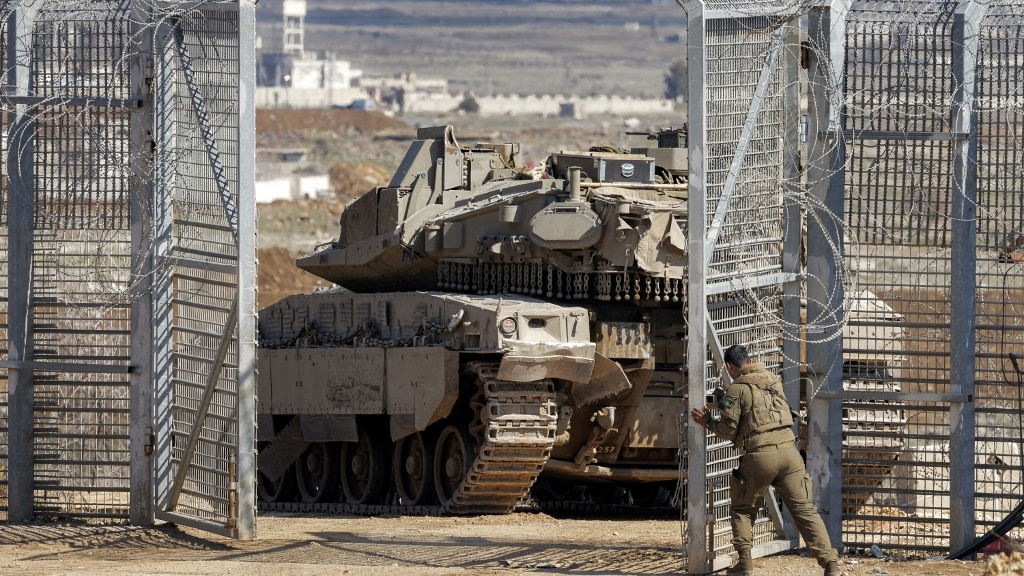
Syria-Israel talks: Why the Golan Heights must not be a bargaining chip

Recent reports that Syria’s interim government is engaging in discussions with Israel on a security deal, which could determine the future of the occupied Golan Heights and the recently expanded Israeli “buffer zone”, demand careful scrutiny.
Any such deal must be firmly grounded in the legal status of the occupied Golan Heights, while acknowledging the profound human costs of decades of conflict. Disregarding these fundamental considerations would not only undermine international law, but also exceed the limited mandate of Syria’s unelected transitional authorities.
The status of the Golan Heights under international law is unambiguous. The territory, seized by Israel during the 1967 war, remains occupied Syrian land.
UN Security Council Resolution 242 (1967) called for the withdrawal of Israeli armed forces from territories occupied during the conflict, a principle reaffirmed by Resolution 338 (1973) and explicitly reinforced by Resolution 497 (1981), which declared Israel’s unilateral annexation of the Golan Heights “null and void and without international legal effect”.
The continued Israeli presence in the Golan Heights, alongside the imposition of its laws and expansion of its settlements, constitute clear violations of international law, including the Fourth Geneva Convention, which prohibits the occupying power from transferring its civilian population into occupied territory.
Read more: Syria-Israel talks: Why the Golan Heights must not be a bargaining chip