
Israel-Palestine live: Biden urges Egypt, Qatar to press Hamas for hostage deal

Live Updates
Al Jazeera is reporting via its correspondent in Gaza that at least five people were killed and others wounded, including women and children, in an Israeli bombing north of Rafah.
Israeli Prime Minister Benjamin Netanyahu asked Israel's top court to defer a 31 March deadline for the government to come up with a new military conscription plan addressing the exemptions granted to members of the ultra-Orthodox community.
While the Supreme Court did not immediately respond to the request, it ruled separately that state subsidies for military-age ultra-Orthodox men studying in seminaries, rather than serving in uniform, be suspended as of 1 April.
The politically powerful ultra-Orthodox community make up roughly 13 percent of Israeli society. They receive exemptions from military service if they are studying full-time in a religious seminary.
The exemptions, along with the government stipends the students receive, have caused anger in the wider Israeli public amid the ongoing war in Gaza.
Doctors Without Borders said that an Israeli strike on Wednesday struck near one of its clinics in Rafah.
"Several people reportedly were killed in the attack. No MSF staff or patients were hurt," MSF said on X.
Ziyad al-Nakhalah, the political leader of Palestinian Islamic Jihad (PIJ), met with Iran’s Supreme Leader Ayatollah Ali Khamenei in Tehran on Thursday.
Khamenei told Nakhalah that Palestinians will "see final victory of the people of Gaza".
"The people of Gaza and resistance forces are adamant on standing their ground till final victory, and through God’s grace final victory will be realised in the not-so-distant future," Nakhalah said.
Khamenei went on to criticise the leaders of other Muslim-majority countries for their "passivity and lack of action".
A Manchester theatre has been forced to cancel a show featuring Palestinian poetry, after a pro-Israel Jewish group accused the featured author of antisemitism.
The Voices of Resilience show was due to take place in the Manchester city centre on 22 April and was set to be an evening of poetry and writing by Palestinians living in Manchester and in Gaza.
Prior to the announcement of the cancellation, a letter seen by MEE was sent to the venue by the Jewish Representative Council of Greater Manchester (JRC), calling for it to be cancelled.
The JRC accused the featured author, Atef Abu Saif, of engaging in "shocking and antisemitic Holocaust denial".
The claims brought in the letter fall under the highly controversial International Holocaust Remembrance Alliance (IHRA) definition of antisemitism, which states that any comparisons made between the actions of Israel and Nazi Germany are antisemitic.
Saif, who has served as the Palestine Authority's culture minister since 2019, recently published a book about his eyewitness account of seeing his family killed in Israel's war on Gaza.
The event venue, HOME, said in a statement that the event space was a "politically neutral space".
"Our concern for the team at HOME, our audiences and artists, and their safety is paramount. In the face of recent publicity around Voices of Resilience, we have cancelled this event," the statement said.
Politico is reporting that the Pentagon is in "preliminary conversations" about a proposal to help fund either a multinational peacekeeping force or a Palestinian peacekeeping team in Gaza in a post-war scenario.
The options, according to the report, would not involve any US troops on the ground in Gaza.
The report comes ahead of a planned visit by an Israeli delegation, which will meet at the White House to discuss the potential Israeli military invasion of Rafah.
"We've had a number of conversations with both the Israelis and our partners about key elements for the day after in Gaza when the time is right," an administration official told the news outlet.
Speaking to a visiting US congressional delegation, Israeli President Isaac Herzog said that the bonds between the US and Israel are "unbreakable" and "irreplaceable".
"Israel has no greater friend than the United States, and the United States has no greater friend than Israel," he said.
The comments come amid a rift between the Biden administration and the government of Prime Minister Benjamin Netanyahu, who recently cancelled a delegation to Washington.
That trip, however, was rescheduled for a later date.
The Kuwaiti state news agency Kuna reported that Kuwait handed its annual $2m contribution to Unrwa.
Unrwa said on Tuesday that it had sufficient funds to run its operations until the end of May. Many donors suspended funding to the agency after Israel accused Unrwa staff members of participating in the 7 October attacks on southern Israel.
It's an image that has provoked shock and outrage.
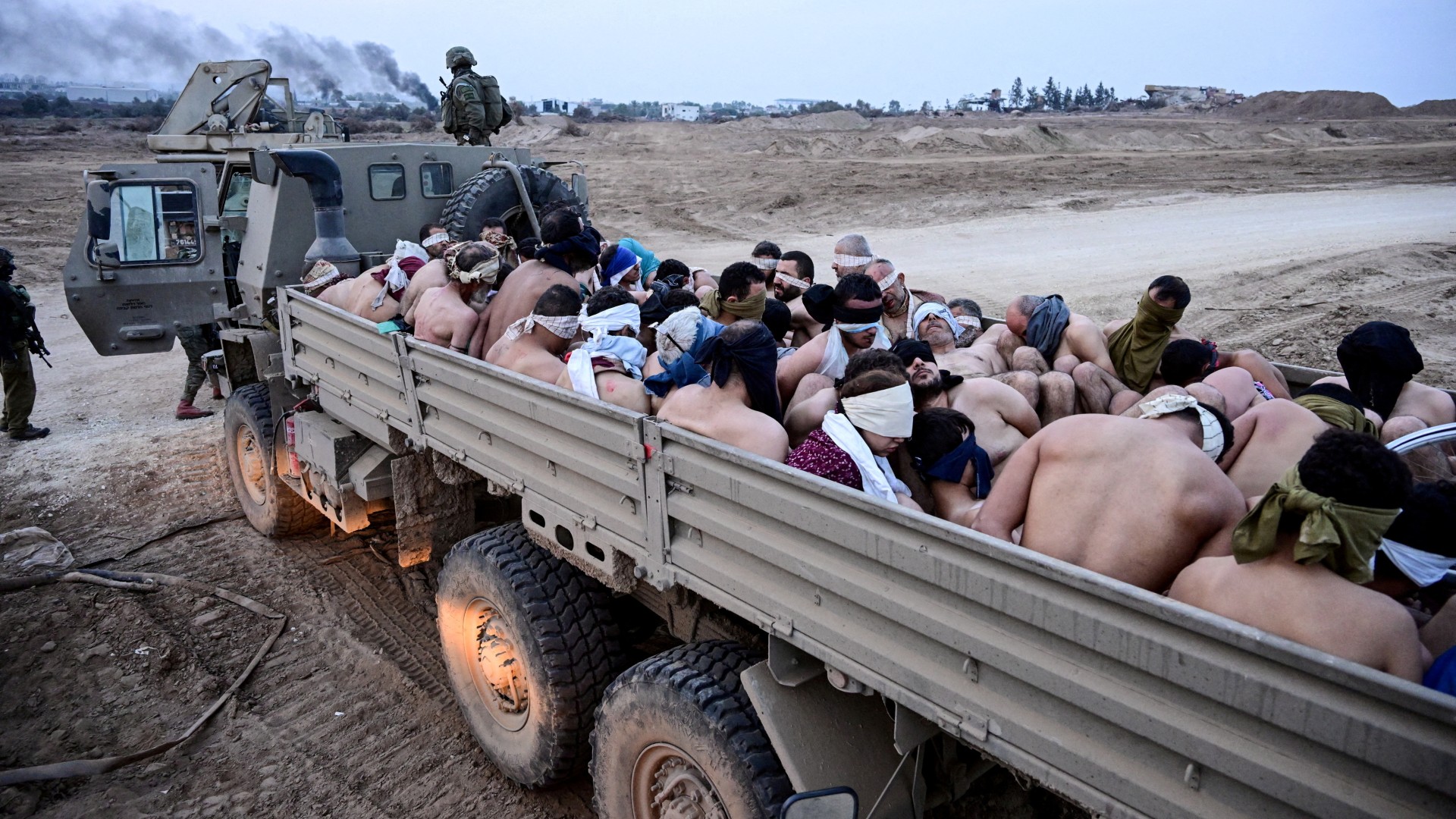
Dozens of Palestinian men, bound, blindfolded and stripped to their underwear, crammed in an open-top Israeli truck in the besieged Gaza Strip.
The photo showed shellshocked Palestinians looking cold, hungry and traumatised amid the chilly and rainy December winter weather.
But just to the right of the centre of the scene, one person stood out.
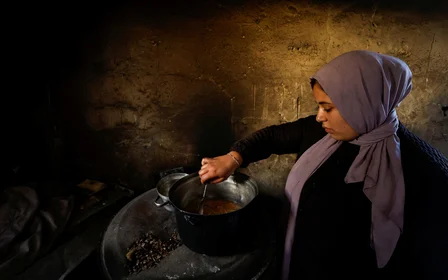
Hadeel al-Dahdouh, a mother of two, is the only woman known to have been abducted by Israeli soldiers when they stormed the Zaytoun quarter of Gaza City late last year.
Speaking to Middle East Eye in Rafah after her lengthy detention, she said that she, along with her husband, in-laws and neighbours, were injected with unknown substances and subjected to prolonged and violent interrogations and even mock executions while in Israeli captivity.
Choking back tears, Dahdouh, who is still wearing the same "prayer dress" from when she was first detained, is overcome with grief when recounting the degradation she endured.
Her testimony, which is drawn from her detention in parts of occupied Gaza and Israel, appears consistent with that of other former detainees abducted by Israeli forces following the 7 October attacks.
Israel's conduct of its war against Hamas in Gaza is already the subject of an International Court of Justice case in which it stands accused of genocide and an ongoing war crimes investigation by the International Criminal Court.
Read more: Beaten, tortured and buried alive: What happened to the woman on the Israeli truck

On the crest of a hill in the occupied West Bank, five Red Angus cows chomp sombrely on some straw. Around them, a group of Israelis look on in anticipation.
If all goes to plan, these cows could herald the end of the world as we know it.
According to Jewish tradition, the ashes of a perfectly red heifer cow are needed for the ritual purification that would allow a Third Temple to be built in Jerusalem.
That temple, say radical Jewish groups, must be constructed on the raised plateau in Jerusalem’s Old City known as the Temple Mount, where al-Aqsa Mosque and the Dome of the Rock shrine stand today. Some believe this will herald the arrival of the messiah.
On Wednesday, a few dozen Israelis gathered at a conference on the outskirts of Shilo, an illegal Israeli settlement near the Palestinian city of Nablus, to discuss the religious importance and imperative of the cows, and catch a glimpse of them too.
“This is a new moment for Jewish history,” Chaim, a 38-year-old Israeli settler, told Middle East Eye as he prepared to take his seat.
For years, members of the Third Temple community, led by the Jerusalem-based Temple Institute, which organised the conference, have been searching for a red heifer that fits the description of those used for purification in the Torah.
Perfect cows must not have a single blemish, not a stray white or black hair. They can never be placed under a yoke or put to work.
“These cows were brought all the way from Texas and were reared in special conditions to maintain their purity,” said Yahuda Singer, a 71-year-old from the Mitzpe Yericho settlement and the translator of a pamphlet on red heifers.
“The cows can’t even have someone lean on them,” said Singer’s wife Edna, 69. “You can make them impure by just placing your jacket on their back.”
Read more: In a West Bank settlement, Israelis tend red cows and plan the Third Temple
Palestinian Prime Minister Mohammad Mustafa has formed a new cabinet, in which he will also serve as foreign minister, according to Palestinian news agency Wafa.
A longstanding adviser of Palestinian President Mahmoud Abbas, Mustafa was tapped by his boss for the role of prime minister earlier this month. Abbas, who has led the Palestinian Authority for nearly two decades and who remains in overall control, announced the new government in a presidential decree on Thursday.
The government will have 24 ministers, including five from Gaza and four women - one of whom is from the Armenian community. Mustafa, who has promised to create a technocratic government in Gaza, has replaced Riyad al-Maliki as foreign minister.
According to Reuters, the stated priority of the government will be the restoration of the Gaza Strip, including a plan to increase access to humanitarian aid, as well as the stabilisation of the economic situation of the Palestinian Authority.
These aims - and the composition of the cabinet - face opposition from different parts of Palestinian society, including Hamas.
Mohammed al-Abssi is one of thousands of Jordanians who have been surrounding the Israeli embassy in Amman for the last four days.
He is clear about their intentions. “Our protests will continue until the war on Gaza comes to an end,” he told Middle East Eye. “The protests are expanding to other cities and governorates. We will call for demonstrations in multiple locations.”
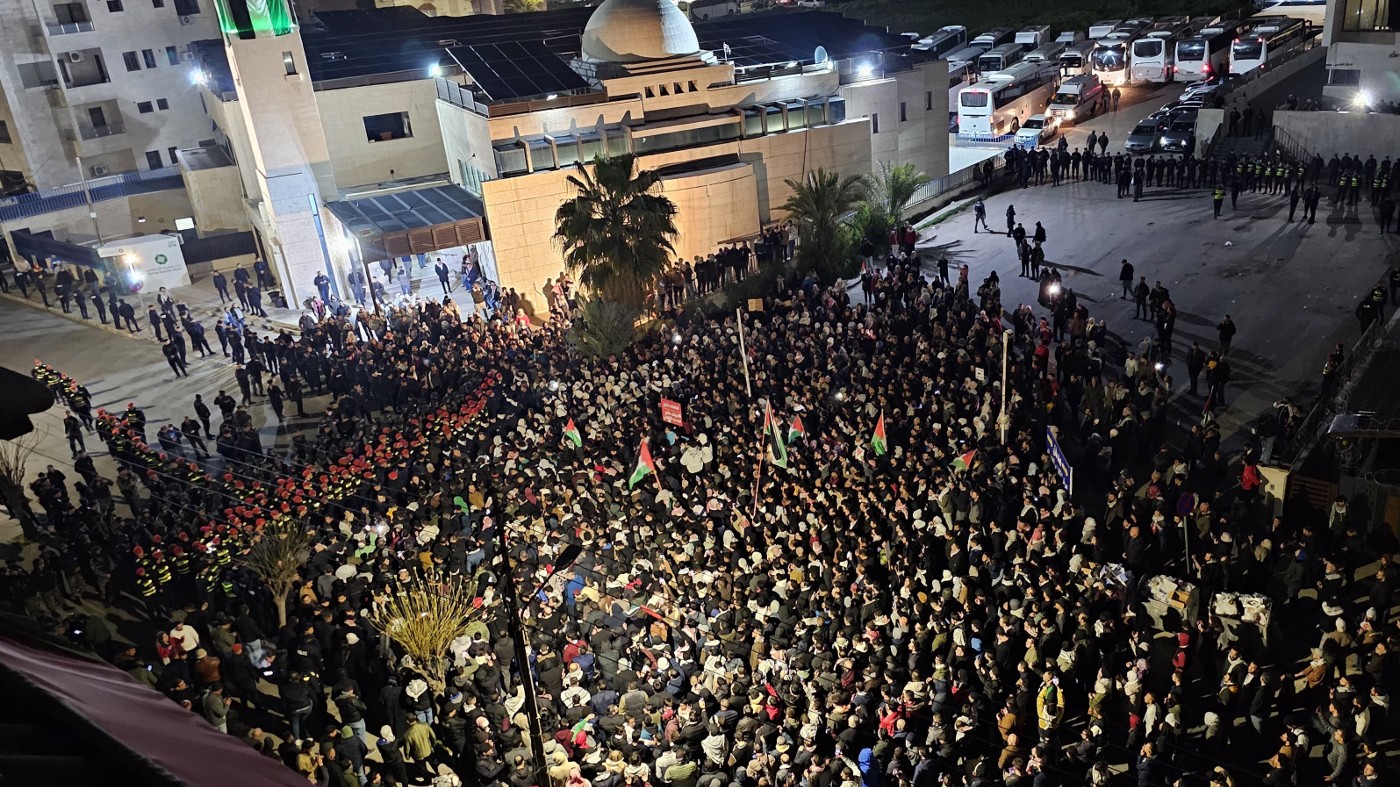
Yesterday marked the fourth consecutive day that thousands of protesters have come out on to the streets of the Jordanian capital to surround the Israeli embassy, demanding its closure. Young demonstrators tried to breach the security cordon established around the complex by Jordanian security forces, resulting in the arrest of approximately 200 protesters.
While the embassy is currently without a diplomatic mission, after Israel’s ambassador left Amman in October and Jordan recalled its ambassador in November in protest at the ongoing war in Gaza, al-Abssi said that protesters “have heard that the embassy has partially resumed operations”.
Jordanian security forces and gendarmerie have forcefully prevented protesters from reaching the embassy compound in the Rabia neighbourhood of Amman. Demonstrators have gathered in the vicinity of the square next to Kalouti Mosque, approximately two kilometres from the embassy, and other areas close by.
Protests have escalated significantly since the onset of Israel's war on Gaza. The National Forum for Supporting Resistance, a coalition of political parties and activists, has been one of the organisers.
Al-Abssi, a participant in the protests and a member of the Ataharrak movement against normalisation with Israel, said the siege of the embassy is part of a series of Jordanian protests that have not ceased since 7 October.
“The siege of the embassy has intensified in response to the blockade of the Shifa complex and al-Aqsa Mosque,” he said.
Read more: Thousands of protesters surround Israeli embassy for fourth consecutive day
The United Nations agency for Palestinian refugees, Unrwa, has warned that the clock was "ticking fast towards famine in Gaza".
The agency renewed calls for removing Israel-imposed restrictions preventing its aid convoys from reaching northern Gaza.
"Northern Gaza is the epicentre of famine. We simply need to have access to get food supplies in," said Jonathan Fowler, Unrwa's senior communications manager.
Hamas condemned the Israeli killing of two unarmed civilians holding white flags before burying them with bulldozers.
Footage of the killings, described by Hamas as "cold-blooded", was aired by Al Jazeera Arabic Wednesday.
"It is further evidence of the scale of fascism and criminality that governs Zionist behaviour, in the context of the brutal war of extermination against our people in the Gaza Strip," Hamas said in a press statement.
"We call on the United Nations and all international judicial institutions, especially the International Criminal Court, to take urgent action to stop the systematic killing of our people, and to take the necessary measures to hold this rogue entity and its war criminal terrorist leaders accountable for the crimes they commit against children and defenceless civilians."
A Palestinian boy, six, died from malnutrition in the northern Gaza Strip, where the population is at risk of famine caused by Israel's ongoing blockade on aid.
The death of Muhammad Naeem Al-Najjar was announced by Kamal Adwan hospital, according to journalist Emad Ghaboun, who is reporting from northern Gaza.