Live: Israel ramps up strikes on Gaza after Iran attack

Live Updates
The Israeli military said on Sunday that more than 20 Hezbollah members were killed in the strike that assassinated leader Hassan Nasrallah in Beirut on Friday.
According to the statement, Ibrahim Hussein Jazini and Samir Tawfiq Dib, who were "among Nasrallah's closest associates", had been killed. Other key figures named by the Israeli military include Abed al-Amir Muhammad Sablini and Ali Naaf Ayoub.
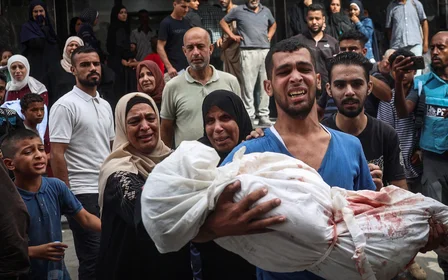
Israeli air strikes across the Gaza Strip have killed at least 11 Palestinians, health officials reported on Sunday.
Israeli planes bombarded multiple areas in northern, central and southern Gaza.
A school sheltering displaced Palestinians in Beit Lahiya, in the northern Gaza Strip, was among the buildings hit. Four people were killed and several others were wounded, according to medics in Gaza.
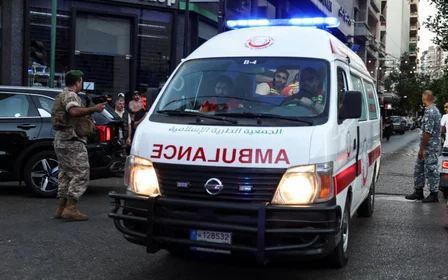
A new wave of Israeli air strikes targeted Beirut’s southern suburbs, an area colloquially known as Dahiyeh, on Sunday, according to Lebanese media reports.
Lebanon's state-run National News Agency reported a "violent raid carried out by Israeli warplanes" and ambulances rushing to the area.
AFP and Reuters confirmed the reports, citing a security official and eyewitnesses. One witness told AFP that a building collapsed instantly after being struck by a rocket.
غارتين على الضاحية الجنوبية لبيروت pic.twitter.com/bV3c0SYEko
— Ali Bk (@Bk_Hanas) September 29, 2024
Hezbollah has confirmed that its senior leader, Ali Karaki, was killed in an Israeli strike that also targeted other high-ranking members of the group, including leader Hassan Nasrallah, in Lebanon, Reuters reported on Sunday.
Hezbollah leader Hassan Nasrallah's body was recovered intact from the site of an Israeli air strike on Beirut’s southern suburbs, according to a medical and security source, as reported by Reuters on Sunday.
Hezbollah confirmed Nasrallah's death in a statement on Saturday but did not provide details on how or when he was killed, nor did it announce plans for his funeral.
The two sources said that while there were no visible external injuries, Nasrallah likely died from blunt trauma caused by the impact of the blast.
Israeli attacks may have forced up to 1 million people to flee parts of Lebanon, potentially triggering the worst displacement crisis in the country's history, Prime Minister Najib Mikati said on Sunday.
"The estimated number is very high and may reach 1 million," Mikati explained, noting that this would account for roughly one-sixth of Lebanon's population. "It is the largest displacement movement that may have happened in Lebanon."
When asked about efforts to de-escalate the situation, Mikati said Lebanon had "no option but the diplomatic option".
At least 41,595 people have been killed and 96,251 wounded in Israeli attacks on Gaza since October of last year, according to the Palestinian health ministry.
Children in northern Gaza came together to collect donations in support of Lebanon, singing songs of solidarity and waving Lebanese flags, Palestinian journalist Mahmoud Abusalama reported.
Since Sunday, Israeli air strikes on Beirut's southern suburbs and other parts of Lebanon have killed more than 700 people, including many women and children.
Around 1 million Lebanese have been displaced, according to
Lebanese environment minister Nasser Yassin.
Good morning, Middle East Eye readers,
Here are the latest updates from Israel's wars in Gaza and Lebanon:
-
The Israeli army said senior Hezbollah official Nabil Qaouk was killed in a Beirut air strike last night.
-
An Israeli air strike killed at least 11 people in the town of Ain, located in Lebanon's northeastern Bekaa Valley, after it hit a house, according to the National News Agency.
-
The Islamic Revolutionary Guard Corps (IRGC) confirmed that its deputy commander, Abbas Nilforoushan, was killed alongside Hezbollah leader Hassan Nasrallah.
Three explosions have been heard in the Al Bukamal area on the Iraq-Syria border, according to Al Jazeera.
Eyewitnesses said that airstrikes caused the explosions, according to Haaretz and Al Mayadeen.
US President Joe Biden has said it is "time for a ceasefire now" in response to questions over whether an Israeli ground incursion is inevitable.
However, earlier on Saturday he defended Israel's assassination of Hezbollah leader Nasrullah as a "measure of justice for his many victims, including thousands of Americans, Israelis, and Lebanese civilians."
He added that the US "fully supports Israel's right to defend itself against Hezbollah, Hamas, the Houthis, and any other Iranian-supported terrorist groups."
Meanwhile, UN Secretary-General Antonio Guterres has said "this cycle of violence must stop now".
Israel has launched new strikes in the area of Choueifat in the southern Beirut suburb of Dahiyeh, according to Sky News Arabic.
Haaretz has reported that the Israeli military wants operations in Lebanon to continue and has endorsed a ground operation.
Explosions have been heard at a US forces base in Syria, according to Al Jazeera.
The base is stationed in a Conoco gas plant and field in Deir Ezzor, in northern Syria.
Israel decided to kill Nasrallah after concluding that he would not accept a diplomatic solution to end the fighting on the Israel-Lebanon border that was not dependent on Israel ending the war in Gaza, an Israeli official has told NBC News.
"What we found after over 11 months is that Nasrallah is persistent in tying himself — and the hijacked Lebanese state that he took over — to whatever’s going on in Gaza," the official said.
"He declined every diplomatic effort. He declined messages to stop connecting himself to Gaza. And he continued to fire at Israel, and in the past few weeks or months, even expanded the range and velocity of attacks against Israel."
"This led us to understand that he cannot be part of the game anymore."
The Lebanese health ministry has said that 33 people have been killed and 195 wounded in Israeli strikes on Lebanon on Saturday.
Israel's aerial attacks on Beirut's southern suburbs and other areas of Lebanon since Sunday are estimated to have killed more than 700 people, including scores of women and children.
Around one million Lebanese have also been displaced, according to Nasser Yassin, the minister coordinating Lebanon's crisis response.
Lebanon has a total population of around 5.5 million people.