Live: Israel ramps up strikes on Gaza after Iran attack

Live Updates
The escalation of Israel’s aggression against Lebanon this week appears to have ushered the country into a new phase of conflict, after Hezbollah’s nearly year-long war of attrition.
Israel signalled its preparedness for a broader and more comprehensive conflict in late July, with the killing of Hezbollah commander Fuad Shukr.
This month, by blowing up communications devices across Lebanon and killing hundreds of people - including women and children - in a series of air strikes, Israel’s objectives appear to have expanded significantly beyond the mere containment of Hezbollah along the border.
This war is no longer just about dissuading Hezbollah from taking action to support Palestinians in Gaza. Rather, Israel wants to dismantle Hezbollah entirely.
This strategic shift is unfolding in a context where Israeli public opinion is largely in favour of military action against Lebanon, while Lebanese society remains divided over the war.
In the wake of Shukr’s assassination, as Hezbollah grappled with a precarious calculus on how to retaliate without inciting an all-out war, Israel interpreted this hesitation as indicative of Hezbollah’s military frailty and lack of strategic clarity.
This month’s pager attacks abruptly concluded a tumultuous summer, paving the way for a campaign of terror this autumn.
Read more: After a difficult summer, a campaign of terror begins by Wissam Saade
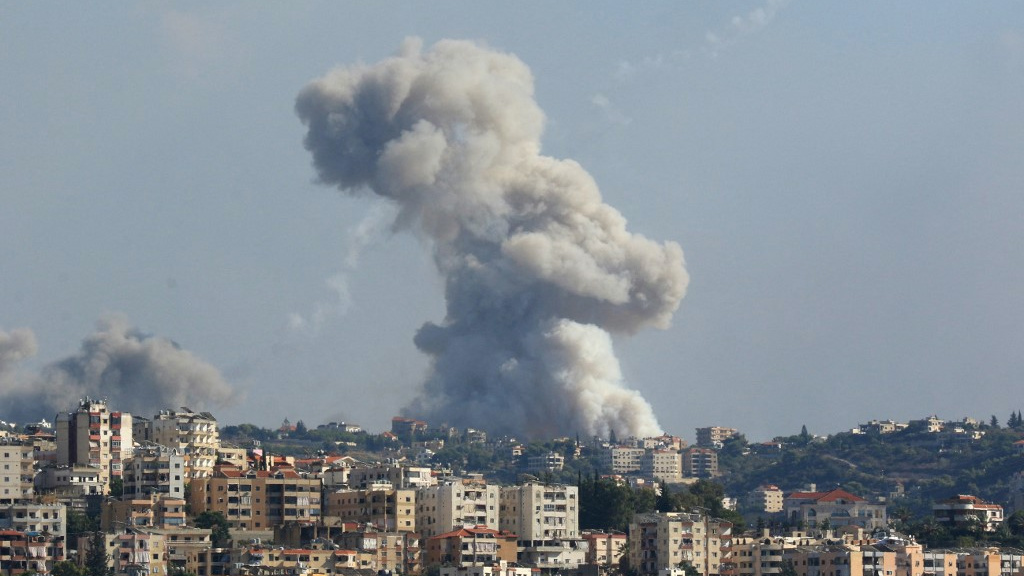

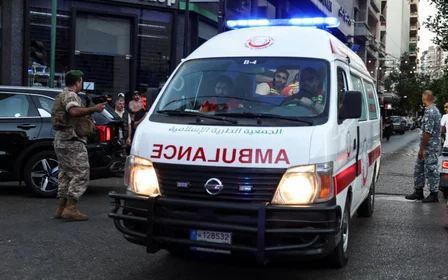
The death toll from the Israeli strike on Tuesday in Beirut’s southern suburbs, an area colloquially known as Dahiyeh, has killed six people and wounded 15 others, the Lebanese civil defence has said.
Hezbollah said the strike killed a senior member of the group's military branch, Ibrahim Mohammad Qubaisi.
The foreign ministers of Egypt, Jordan and Iraq said Israel was pushing the region "towards all-out war" in a joint statement on Wednesday, condemning "the Israeli aggression on Lebanon".
The three Arab ministers met on the sidelines of the United Nations General Assembly in New York and discussed the Israeli attacks in Lebanon and Gaza.
They also reaffirmed that de-escalation begins with stopping the Israeli aggression in Gaza.
اجتمع وزراء خارجية كل من المملكة الأردنية الهاشمية وجمهورية مصر العربية وجمهورية العراق بتاريخ ٢٤ أيلول ٢٠٢٤ على هامش أعمال الدورة ٧٩ للجمعية العامة للأمم المتحدة في نيويورك.
— وزارة الخارجية وشؤون المغتربين الأردنية (@ForeignMinistry) September 25, 2024
وبحث الوزراء مسار العمل في إطار آلية التعاون الثلاثي، وذلك تحضيراً للقمة الثلاثية المرتقبة على مستوى… pic.twitter.com/X1KgGPzdlk
Good morning Middle East Eye readers,
Here are the latest updates from the Israeli wars in Gaza and Lebanon:
-
Hezbollah fired a single ballistic missile at Tel Aviv suburbs on Wednesday morning for the first time since hostilities began nearly a year ago. The rocket was intercepted by Israeli air defence systems and there were no injuries.
-
The Lebanese group said the intended target was the Mossad's headquarters, the agency it says was responsible for the pager and radio device blasts as well as the assassination of senior Hezbollah leaders.
-
Israeli Prime Minister Benjamin Netanyahu delayed his departure to New York to attend the UN General Assembly after the attack on Tel Aviv, according to Israeli media.
-
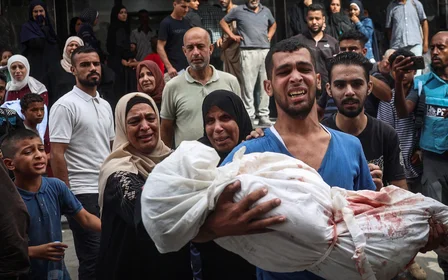
In Gaza, Israeli forces continued the daily killing of civilians unabated. A mother and her four sons were killed in an air strike on Rafah on Tuesday, according to local media. Many others were killed and wounded in attacks on the Nuseirat refugee camp, including the bombing of tents for displaced people.
Hello MEE readers. Since Monday, Israel's escalatory air strikes on Lebanon have killed at least 569 people, including 50 children and 94 women.
Hezbollah on Tuesday responded with a series of rocket attacks on several military sites in Israel, including one attack on a base in Atlit, which houses Israel's elite Shayetet 13 naval forces.
Tens of thousands of people in Lebanon have been forced to flee their homes, with many finding shelter in Beirut's schools, which have been converted to house those trying to escape Israeli bombings.
Meanwhile, in Gaza, Israeli air strikes continued to pound the enclave, killing more than 50 Palestinians over the past 24 hours.
Here's what else you need to know about today's developments:
-
Hezbollah released a statement on Telegram confirming that one of its senior military commanders, Ibrahim Muhammad Qubaisi, was killed in an Israeli air strike.
-
The Islamic Resistance in Iraq, an Iraq-based militia group, launched a drone attack on Israel near the Jordan Valley.
-
A large Israeli strike hit an area south of Beirut in the early hours of Wednesday morning. The attack struck an area between Jiyeh and Saadiyat, and the explosion could be heard in the capital.
-
Hezbollah attacked Israel's Dado base, located 29 km from Lebanon's borders, with 90 rockets in two different attacks.
-
At least five people were killed in an Israeli strike on a residential building in Lebanon's Beqaa Valley.
-
The UK called on its citizens to leave Lebanon and also advised against travelling to the country. It also announced a deployment of British troops to Cyprus.
-
The UN General Assembly also began on Tuesday, with the war on Gaza taking the central stage for several world leaders. Erdogan lambasted the international community for allowing Israel's destruction of Gaza to continue, and Qatar's emir said Israel was not trying to pursue a peace and an end to the war.
-
US President Joe Biden, meanwhile, reiterated Washington's belief that Israel has a right to defend itself against Hamas and against Hezbollah in Lebanon. You can read more about what world leaders said at the UN General Assembly here.
-
US Secretary of State Antony Blinken dismissed a USAID report stating that Israel was deliberately blocking aid to Gaza.
Hezbollah released a statement on Telegram confirming that one of its military commanders, Ibrahim Muhammad Qubaisi, was killed in an Israeli air strike.
The Lebanese movement did not say where Qubaisi was killed. Earlier, Israel's military said it killed Qubaisi in an air strike that targeted southern Beirut.
The US Agency for International Development (USAID) and the State Department’s refugees bureau concluded in April that Israel was deliberately blocking aid to Gaza, according to a report by the news site, ProPublica.
In a 17-page memo sent to US Secretary of State Antony Blinken, USAID documented several examples of Israel blocking aid into the besieged Gaza Strip - including Israel killing aid workers, destroying agricultural structures, bombing ambulances and hospitals, and flat-out turning away trucks filled with food and medicine.
The report was dismissed by Blinken who told Congress a month later that the US did not assess Israel was blocking US aid shipments to Gaza.
Read the full story by clicking below.
USAID, State Department bureau concluded Israel deliberately blocked Gaza aid: Report

The UK's Foreign, Commonwealth and Development Office called on its citizens to leave Lebanon and also advised against travelling to the country amid the recent escalation between Israel and Hezbollah.
It also announced a deployment of British troops to Cyprus.
"Around 700 UK troops will move to Cyprus in the coming hours, as the Government continues to prepare its contingency plans following significant escalation between Israel and Lebanon in recent days," the foreign office said.
The Islamic Resistance in Iraq, an Iraq-based militia group, launched an attack on Israel near the Jordan Valley, bordering the Kingdom of Jordan.
The group said it launched a squadron of drones at a target near the valley, without giving details.
Haaretz reported that hostile aircraft alerts were activated in southern Israel near the Jordanian border.
A large Israeli strike hit an area south of Beirut in the early hours of Wednesday morning. The attack struck an area between Saadiyat and Jiyeh, a small coastal town located about 30km from Beirut.
The explosion could be heard in the capital.
Lebanese Foreign Minister Abdallah Bou Habib said he was disappointed with US President Joe Biden's remarks about the escalation in the conflict between Israel and Hezbollah.
"It was not strong. It is not promising and it would not solve this problem," Habib said during an event hosted by the Carnegie Endowment for International Peace.
During his address at the UN General Assembly, Biden reiterated Washington's stance that Israel has a right to defend itself after Israel launched a major escalation in Lebanon with air strikes that have killed at least 569 people since Monday.
"I (am) still hoping. The United States is the only country that can really make a difference in the Middle East and with regard to Lebanon," Habib said.
In a statement released on its Telegram channel, Hezbollah said that it launched more than a dozen attacks on Israel, targeting several military bases and sites.
Those targets include:
-
The Megiddo Military Airport, west of Afula in northern Israel
-
The Ramat David base and airport, located in Haifa
-
The Amos base, near the town of Afula in northern Israel
-
An explosives factory in the Zichron area, located 60 km from the border with Lebanon
-
Logistical warehouses in the Naftali base, in northern Israel
-
Warehouses at the Nimra base, located in northern Israel
-
A base housing the Samson unit, a special forces unit in the Israeli military
The UN Security Council will meet at 6 pm (2200 GMT) on Wednesday to discuss the recent Israeli escalation in Lebanon.
The meeting was announced by Slovenia, which currently holds the presidency of the 15-member council for September.
Reporting by Reuters
Syrian army sources have told Reuters that the country's air defences intercepted suspected Israeli missiles targeting the Mediterranean port city of Tartous.
The Palestinian civil defence in Gaza has said that 52 people, mostly women and children, have been killed by Israeli bombing over the past 24 hours.
The bombings targeted eight residential buildings, the civil defence added, without specifying what areas were targeted.