Gaza live: Several dead including Hezbollah commander after Israeli strike on southern Beirut

Live Updates
Egypt told Israel that it violated the two's 40-year-old peace accords by showing a map of the Philadelphi Corridor as a military zone, Al-Araby Al-Jadeed news reported.
Prime Minister Benjamin Netanyahu used the map during a press conference on Monday, complaining that arms and military supplies had been travelling through the border between Egypt and Gaza, as he argued Israel needed to maintain control of the area.
Israel briefed Egypt ahead of the conference and said it would debate the status of the corridor in the future, but Cairo said it would only accept a pledge for Israel to withdraw.
Conditions in Tulkarm in the occupied West Bank are “catastrophic”, sources in the besieged camp have told Middle East Eye.
“The infrastructure is destroyed, electricity and water are cut off, there is no milk for children, no medicines, and no food supplies,” Faisal Salama, head of the camp's Popular Committee, told MEE’s reporter, Fayha Shalash.
Israel first attacked the camp last week as part of a wider offensive on the northern West Bank. For the last day and a half Israeli bulldozers have been destroying homes and several shops, while military vehicles have surrounded the entrances to the camp, Salama said.
The Popular Committee is trying to coordinate with the International Committee of the Red Cross and the Palestinian Red Crescent Society to deliver the necessary food supplies to residents, but the Israeli army has only allowed the entry of milk and diapers, Salama added.
Red Crescent crews and volunteers have been denied entrance to the camp, which is home to around 20,000 people.
President Abdel Fattah el-Sisi has said during his visit to Ankara that Egypt and Turkey reiterate their calls for "an immediate ceasefire" in Gaza.
Speaking alongside his Egyptian counterpart, President Recep Tayyip Erdogan, el-Sisi said that the situation in Gaza is an "unprecedented catastrophe," adding that both Turkey and Egypt reject "further escalation by Israel in the occupied West Bank."
He said that both countries were "taking tangible measures to live up to the aspiration of the Palestinian people for the establishment of an independent state based on 1967 borders with [occupied] East Jerusalem as its capital."
The family of a British aid worker who was killed in the Israeli strike on a World Central Kitchen food convoy has demanded an independent investigation into his killing.
James Kirby was killed, along with six other aid workers, in an Israeli attack on the convoy in April.
The family demanded a “proper, independent inquiry” into the attack.
“Whilst we have had much support, we are still struggling to find answers and accountability for what happened,” Kirby's cousin, Louise Kirby, said in a statement, adding that the family were “surprised” that they had not been contacted by Israel’s ambassador to the UK or any Israeli official.
“Any family of a loved one who has been killed needs closure. We need to understand how this disaster could have happened,” she said.
“This is not just about us. This is about how Britain looks after its own citizens and their families, when a British citizen has been unlawfully killed by another state.”
Turkish President Recep Tayyip Erdogan has said that states "providing unconditional support to Israel" are "accessories to its crimes".
"They are accomplices to their crimes in the massacres and pogroms perpetrated against the civilian population of Gaza," Erdogan said, adding that Israel must be "prevented from plunging the whole region into war".
He made the comments at a press briefing, alongside his Egyptian counterpart Abdel Fattah el-Sisi who is visiting Ankara.
UK Prime Minister Keir Starmer has said that the government's partial ban on weapons exports to Israel does not signify a shift in support for Tel Aviv.
On Monday, Foreign Secretary David Lammy announced a ban covering 30 of 350 arms exports licences.
Starmer told lawmakers during the weekly Prime Minister's Questions session in Parliament that the move was "a legal decision, not a policy decision," adding that "we will of course stand by Israel's right to defend itself".
Turkey's President Recep Tayyip Erdogan has said in a press conference during a visit from his Egyptian counterpart, Abdel Fattah el-Sisi, that for both countries, ending the war on Gaza remains a "top priority."
"We are doing all what we can to bring the bloodshed to an end and to continue to deliver the humanitarian aid into Gaza," he said in Ankara, alongside Sisi.
A funeral procession was held for the 16-year-old Palestinian girl who was killed by Israeli forces during their raid on Jenin, in the occupied West Bank, Reuters is reporting.
Lujain Osama Musleh was shot in the head in the town of Kafr Dan, a town near Jenin.
Musleh's father, Osama Musleh, said the teenager had been shot while she looked out the window at the sound of gun fire. He found her with a gun shot wound to the forehead.
“I tried to save her. I tried to do something, but I couldn’t,” he said.
“The army was surrounding our area. I called for an ambulance, and they arrived late because a sniper shot towards them.”
Israel has significantly stepped up its offensive in the West Bank since Wednesday, resulting in the killing of at least 30 Palestinians across Jenin, Tulkarm, Tubas and Hebron.
The operation included drone and sniper attacks, as well as the use of military bulldozers to destroy critical infrastructure and cut off communications and resources.
Western soft drink giants have been hit by consumer boycotts in the Middle East over US support for Israel's war on Gaza, Reuters is reporting.
Consumers in Muslim-majority countries have shunned brands like Coke and Pepsi, boosting sales of local soft drinks.
In Egypt, Coke sales plummeted, while exports of local brand V7 tripled compared to the same period last year.
According to market researcher NielsenIQ, western soft drink brands have suffered a 7 percent sales decline in the first half of 2024 across the Middle East.
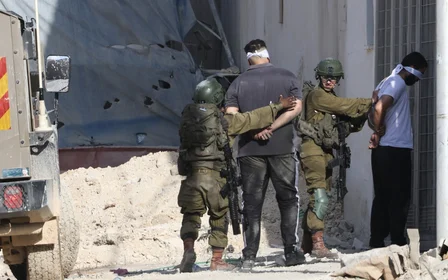
Palestinian prisoner advocacy groups are reporting that Israeli forces detained 10,400 from the occupied West Bank since 7 October.
The Palestinian Detainees and Ex-Detainees Affairs Commission, the Palestinian Prisoner's Society (PPS) and Addameer Prisoner Support and Human Rights Association, said in a statement that the figure includes 725 children, 400 women and 98 journalists.
They added that Israeli authorities had issued or renewed over 8872 orders since 7 October, including orders against women and children.
According to the statement, Israeli authorities have identified 24 detainees who died in custody since October, adding that many more were likely to have died in detention or by extrajudicial killing in Gaza, but the military does not disclose these figures.
The Israeli military has said that its forces killed 200 fighters and recovered weapons from "civilian structures" during its recent weeklong assault on Rafah.
The recent attacks on the southern city have killed a number of Palestinians. Yesterday, four women's bodies were recovered in al-Tannour neighbourhood.
Israeli forces have killed 33 Palestinians, including seven children, in their large-scale assault on the occupied West Bank in the last week, the Palestinian health ministry said on Wednesday.
Another 140 Palestinians were wounded in the incursion, according to the ministry.
The Swiss government has approved a draft law to ban Hamas and designate it a "terrorist organisation."
It said that violating the ban could incur a prison sentence or fine.
The new law, which must be reviewed by parliament, stipulates that Hamas, its successor groups, and any groups that act on its behalf, will be banned.
Israeli air strikes on a home in Nuseirat camp in central Gaza have killed at least one person, according to the Palestinian Civil Defence.
The civil defence reported that its teams have recovered one body and three injured people following the attack.
Israeli Prime Minister Benjamin Netanyahu doesn't want a deal and is using the Philadelphi corridor issue as a spin to torpedo the negotiations, a government coalition source told Haaretz newspaper.
The source, who was described as being "closely involved in and a part of the government", said that when the deal became possible weeks ago, Netanyahu "got nervous and did all he could to torpedo it".
"He figured out that by using the Philadelphi corridor, he could also draw the sane right to his side, and win some points with this group," the source said.
"The media fell for this spin and is consumed all day long with the question of yes or no to the Philadelphi, when the real question is really the fate of the hostages versus the fate of the coalition."