Live: Strike announced in Israel amid mounting anger at Netanyahu

Live Updates
Good morning Middle East Eye readers,
Here are the latest updates:
- An overnight Israeli strike on the Hammouda family home in Beit Lahia, northern Gaza killed 11 people, the Wafa news agency reports
- An Israeli strike on Maghazi, central Gaza killed at least six people, Al Jazeera reports
- The US military said the USS Abraham Lincoln aircraft carrier and accompanying destroyers have arrived to the Middle East, making it the second carrier to reach the region among the ongoing tensions
- PBS journalist Judy Woodruff has apologised for her on-air remarks in which she said Donald Trump lobbyed Israeli Prime Minister Benjamin Netanyahu against signing a ceasefire deal, saying she got that information from Axios and Reuters
- Palestinian activists are protesting the Democratic party's decision to not have any Palestinian speaker at the Democratic National Convention, while the parents of Israeli-American captive Hersh Goldberg-Polin were given the chance to speak on the main stage
Our live coverage from Gaza will shortly be closing until tomorrow morning.
Here are some of the day's key developments:
- The last 10 days have witnessed the largest forced displacement of Palestinians in the occupied West Bank since 7 October, according to the Norwegian Refugee Council (NRC)
- Egypt expressed deep scepticism over the prospects of a Gaza ceasefire, according to officials who spoke to the Associated Press
- Israeli intelligence chief Major General Aharon Haliva left his position after announcing his resignation in April
- All banks in the Gaza Strip have suspended operations, according to The Association of Banks in Palestine
- Israeli opposition leader Yair Lapid said Prime Minister Benjamin Netanyahu has "lost his soul", slamming his position on ceasefire talks
- Defense for Children International Palestine released a report alleging Israel has carried out a widespread policy of “detaining and torturing” Palestinian children in Gaza
- Arab mediators warn the “bridging proposal” put forward by the Biden administration went to “too far” to accommodate Prime Minister Benjamin Netanyahu’s positions, leaving the talks at an impasse, The Times of Israel reported
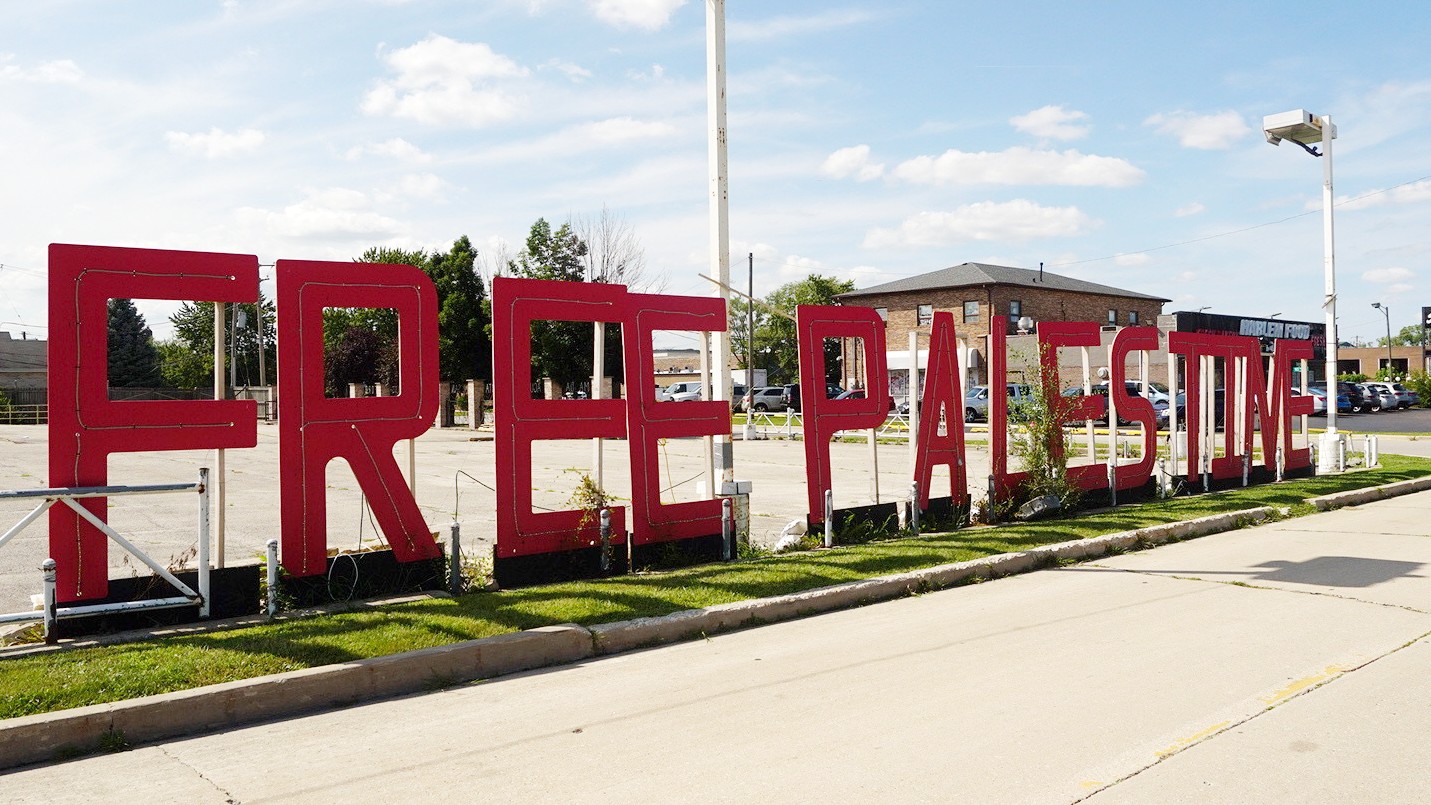
The ongoing Democratic National Congress in downtown Chicago may be blaring on every television channel with triumphant and celebratory pride, but in Little Palestine, just 15 miles away from the event the mood is different.
Middle East Eye visited Bridgeview, the southwestern suburb of Chicago, known colloquially as Little Palestine, to see how Israel’s war on Gaza is rippling across the home of the largest Palestinian-American community in the US.
In Little Palestine, symbols of the war being waged on the people of Gaza are everywhere.
They are on the lawn signs planted alongside the main thoroughfare. They are on the giant "Free Palestine" LED sign on Harlem Avenue. Palestinian flags, too, are everywhere. So too, are posters calling for a ceasefire.
"You know, as a community, it's been difficult because most of our students are Palestinian, and so they are very aware of what's happening. Some of them were directly affected. So either some who had lost family or have family that went missing,” Deanne Othman, a local high school teacher told MEE.
"We had some students that actually lived part of their life in Gaza, and so they had friends and family that were killed."
Read More: In Chicago's Little Palestine, signs of Israel's war on Gaza are everywhere

Defense for Children International Palestine (DCIP) has released a report alleging Israel has carried out a widespread policy of “detaining and torturing Palestinian children in the Gaza Strip”.
The report, which says some children have been used as human shields, cites children who say they have been subjected to systemic torture and abuse.
“They insulted us, slapped me on my face, and kicked me in my stomach and waist. I almost died from the beating,” Karim, a 12-year-old from Gaza said. “Then they made us walk in front of bulldozers and tanks in the streets so that the resistance wouldn’t target them.”
‘They stripped us of our clothes, blindfolded us, tied us up, and beat us over our heads.
Israel has not agreed to withdraw its troops from the Philadelphi Corridor along the border between Egypt and Gaza, Israeli Prime Minister Benjamin Netanyahu's office suggested in a statement on Wednesday.
"Israel will insist on the achievement of all of its objectives for the war, as they have been defined by the Security Cabinet, including that Gaza never again constitutes a security threat to Israel. This requires securing the southern border," Netahyahu's office said in a statement.
The statement comes after US Secretary of State Antony Blinken said Netanyahu had agreed to a US “bridging proposal” for a Gaza ceasefire. Later, an Israeli media report said Netanyahu had agreed to withdraw troops from the area.
A “bridging proposal” put forward by the Biden administration to try and seal a ceasefire in Gaza went to “too far” to accommodate Prime Minister Benjamin Netanyahu’s positions, leaving the talks at an impasse, the Times Of Israel reported citing two Arab officials from a mediating country and a third official involved in the talks.
The report said one Arab official believes there is no point holding another planned gathering of negotiators later this week in Cairo unless the US pressures Netanyahu to step back from his position of keeping Israeli troops in the Rafah and Netzarim corridors.
The second Arab official told TOI that he was surprised US Secretary of State Antony Blinken had repeatedly insisted Netanyahu backs the US bridging proposal, saying it created an inaccurate impression that Hamas is the party obstructing talks.
Israeli opposition leader Yair Lapid said Prime Minister Benjamin Netanyahu has "lost his soul", as ceasefire talks drag on.
Lapid said Netanyahu should travel directly to Egypt himself to negotiate a deal with Arab mediators and bring the war to an end.
"If Netanyahu is so sure of his negotiating skill, let him go to Egypt & sit there until he makes a deal. That is what a responsible PM who cares about his citizens' lives should do. The only reason he doesn't do it is because he no longer has a soul,” Lapid said on X.
A 21-year-old Palestinian man shot by Israeli soldiers in the occupied West Bank has died from his wounds, Palestinian news agency Wafa reported.
Jamal al-Saoudi from the Balata refugee camp was hit when an Israeli drone fired into a group of people in the camp on 15 August.
The UN said more than 600 Palestinians have been killed in the occupied West Bank since 7 October.
“More than 600 Palestinians were killed since October, the vast majority by Israeli forces, and at least 11 by Israeli settlers,” a UN spokesperson told reporters.
“At least 1,270 attacks have been perpetrated by Israeli settlers against Palestinians over the last ten months, causing deaths, injuries and damage to property.”
US President Joe Biden spoke with his Israeli counterpart Benjamin Netanyahu on Wednesday, amid flagging US efforts to secure a ceasefire in Gaza.
The White House said that Vice President Kamal Harris also joined the call.
Biden’s call to Netanyahu comes amid a flurry of news reports in which Arab officials have cast doubt on the viability of the US’s "bridging proposals" to achieve a ceasefire.
All banks in the Gaza Strip have suspended operations, according to The Association of Banks in Palestine, a group that represents banks in the occupied West Bank and Gaza.
The closure comes as Israel continues to pummel the enclave.
Like in the occupied West Bank, Gaza’s currency is the Israeli shekel, but Israel has for months been blocking the entry of fresh notes, along with aid and other goods.
Amid a breakdown of law and order, banks in Gaza have been subject to brazen robberies from armed gangs, that the UN estimates have totalled at least $120m.
Israeli intelligence chief Major General Aharon Haliva has left his position after announcing his resignation in April.
On Wednesday Haliva called for an investigation into the country’s failure to prevent the Hamas led 7 October attack on souther Israel, taking responsibility for the assault.
“The failure of the intelligence corps was my fault,” he said.
Haliva’s successor vowed to investigate the intelligence lapse further.
“Where we failed, we will need to investigate and improve; where we made mistakes we will learn and change," incoming chief of the Military Intelligence Directorate, Major General Shlomi Binder, said.
Egypt appears to be expressing deep scepticism over the prospects of a Gaza ceasefire, according to officials who spoke to the Associated Press.
One Egyptian official said the US’s latest bid to seal a deal is full of "promises, not guarantees”, adding that the agreement in its current form could leave Hamas exposed.
“Hamas won’t accept this because it virtually means Hamas will release the civilian hostages in return for a six-week pause of fighting with no guarantees for a negotiated permanent cease-fire.”
The AP story echoed an earlier report from Axios that said Egypt and Hamas would refuse to allow a continued Israeli troops presence on the Philadelphi Corridor between Gaza and Egypt.
The official added that Egypt warned it would continue to keep the Rafah border crossing closed as long as Israeli troops remain there.
UK Barrister Sam Fowles warned that the UK government and individuals inside it may be liable for war crimes as a result of the London’s continued weapons shipments to Israel.
“International law recognises that states and individuals who commit war crimes, crimes against humanity, and other wrongs often do not do so alone,” Fowles told The i paper.
“Where a state (or individual within a state) knowingly provides assistance which facilitates another’s wrong, then both states can be liable,” he added.
Israel’s offensive on the Gaza Strip has forced Palestinians into every square kilometre of the besieged enclave, the UN Agency for Palestinian Refugees (Unrwa) said.
Unrwa said tens of thousands of Palestinians are sheltering in parts of al-Mawasi in southern Gaza.
Today, around 30,000 people are packed into every square kilometre (0.4sq miles) of the area, whereas “before the war, there were only 1,200 per square kilometre,” Unrwa said.