
Live: Iran holds funeral for top military, nuclear figures killed in Israeli strikes

Live Updates
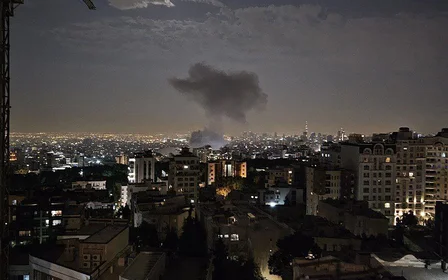
Iranian media reported on Sunday that part of the Fordow uranium enrichment facility as well as the Isfahan and Natanz nuclear sites were attacked, after Donald Trump said the US had bombed them.
"A few hours ago, after Qom's air defences were activated and hostile targets were identified, part of the Fordow nuclear site was attacked by enemy air strikes," Tasnim news agency reported, quoting Morteza Heydari, spokesperson for the Qom Provincial crisis management department.
Separately, Fars news agency said: "The air defences of Isfahan and Kashan began to work to counter hostile targets, and several explosions were heard simultaneously."
An Iranian official, cited by Tasnim news agency, has confirmed that part of the Fordow nuclear site was attacked by "enemy airstrikes".
Attacks were also witnessed near Isfahan and Nanantz nuclear facilities, another Iranian official said, according to Fars news agency.
However, according to an Iranian official cited by Irna news agency, the nuclear sites that were struck by the US did not contain materials that cause radiation.
Israel was in "full coordination" with Washington over its strikes on Iran's nuclear facilities, an Israeli official has told Israeli public broadcaster Kan.
Donald Trump has shared a post from an open-source intelligence account stating "Fordow is gone".
Fordow is the Iranian nuclear enrichment facility buried half a kilometre under a mountain near the city of Qom. Much of what goes on at the plant is shrouded in mystery.
Middle East Eye could not immediately verify the post shared by Trump.
The US president is known to often share posts with inaccurate information or unverified sourcing.
Donald Trump has announced that he will make an address from the White House at 10pm local time about "our very successful military operation in Iran".
"This is an HISTORIC MOMENT FOR THE UNITED STATES OF AMERICA, ISRAEL, AND THE WORLD. IRAN MUST NOW AGREE TO END THIS WAR. THANK YOU!" he wrote on Truth Social.
US B-2 bombers were involved in the strikes on Iran's nuclear sites which Donald Trump announced moments ago, a US official told Reuters on Saturday evening.
Reuters had reported earlier in the day the movement of B-2 bombers, which can be equipped to carry massive bombs that experts say would be capable of striking the sites.
Donald Trump has announced in a social media post that the US has "completed our very successful attack" on three nuclear sites in Iran.
"We have completed our very successful attack on the three Nuclear sites in Iran, including Fordow, Natanz, and Esfahan," Trump wrote on Truth Social on Saturday evening.
"All planes are now outside of Iran air space. A full payload of BOMBS was dropped on the primary site, Fordow," he said.
"All planes are safely on their way home. Congratulations to our great American Warriors. There is not another military in the World that could have done this. NOW IS THE TIME FOR PEACE! Thank you for your attention to this matter."
We are wrapping up this live page covering Israel’s ongoing war on Iran. Here’s a round-up of today’s major developments:
-
Israeli strikes on nuclear sites: Israel targeted Iran’s Arak heavy water reactor, claiming it was part of Tehran’s weapons programme. Iran denied this, saying the site was for medical purposes.
-
Ahvaz and Shiraz struck: Israeli air raids hit military areas in Ahvaz and Shiraz in Iran’s south, according to Iranian media.
-
Iran threatens to target military aid: Tehran warned that any country sending weapons to Israel would be considered complicit in aggression and would face retaliation.
-
Turkey slams Israeli actions: Ankara accused Israel of dragging the region towards “total disaster” and called for an end to its military campaign on Iran.
-
Iran condemns Israeli strike on nuclear site: Tehran accused Israel of targeting the under-construction Arak reactor, insisting the facility was meant for medical research, not military use.
-
Israel signals it may strike before US deadline: Israeli officials reportedly told Washington they might not wait for the two-week deadline set by US President Donald Trump and could launch further attacks on Iran independently.
-
US moves B-2 bombers to Guam: The Pentagon has deployed B-2 stealth bombers to its base on the Pacific island of Guam. US officials say the move comes as Trump weighs whether to back Israel’s war on Iran.
-
Houthis threaten to hit US ships: Yemen’s Houthi movement has warned it would target American naval vessels in the Red Sea if the US joins Israel’s assault on Iran.
-
Iran says Europe’s nuclear proposals unrealistic: A senior Iranian official dismissed European suggestions made in Geneva regarding Tehran’s nuclear activity, saying they lacked practicality and would block any chance of an agreement.
Iran has condemned Israel for bombing its under-construction Arak heavy water reactor, saying the site was intended for peaceful purposes.
-
Mohammad Eslami, head of Iran’s Atomic Energy Organisation, said the facility was “a centre that operates for radiopharmaceutical research,” producing materials used “in the fields of health and medicine”.
-
Israel claimed it targeted the site on Thursday to disrupt Iran’s alleged nuclear weapons development. It has provided no evidence to back that up.
-
Eslami said the attack has intensified Tehran’s distrust of international inspectors, accusing the IAEA of acting as a “tool of espionage” for Israel.
-
He added that Iran plans to take legal action against the IAEA for its failure to prevent or condemn Israeli strikes on its nuclear infrastructure.
-
“There is no cause of public concern,” he said, noting that no radiation leaks occurred during the recent attacks.
-
The IAEA’s Rafael Grossi, however, warned earlier that while there’s currently “no danger to the public,” the risk of radiological leaks remains.
Israeli officials have reportedly informed the Trump administration they may act against Iran before a two-week deadline set by the US president expires.
-
According to two sources familiar with the exchange speaking to Reuters, senior Israeli figures conveyed their stance during a tense phone call with US counterparts on Thursday.
-
The Israeli delegation on the call included Prime Minister Benjamin Netanyahu, Defence Minister Israel Katz, and military chief Eyal Zamir, said a security source.
-
Israel is concerned about delays in targeting the Fordow nuclear facility — a heavily fortified site buried within a mountain and regarded as the heart of Iran’s uranium enrichment programme.
-
US officials have been debating whether Washington should support or join an Israeli operation. The US military is the only force with bombs powerful enough to strike the deeply embedded Fordow site.
-
Reuters reported that B-2 stealth bombers capable of carrying 30,000-pound bunker busters have been deployed to Guam, a move that may signal US readiness to intervene.
-
A Washington-based source said Israel has warned that waiting two more weeks is too risky, though it is unclear if this position was shared during the high-level call.
Iranian state media reported on Saturday that Israeli forces had carried out air raids on the southern city of Shiraz, prompting the activation of local air defence systems.
According to the Mehr news agency, “Shiraz’s air defences have been activated in parts of the city and are responding to hostile targets and Zionist aircraft.”
Shiraz is home to several military installations, and the reported strikes come amid escalating tensions between the two regional rivals.
As tensions flare between Iran and Israel, old tweets from Supreme Leader Ayatollah Ali Khamenei’s official account are being shared widely across social media this week.
The posts, some over a decade old, are generating a mix of nostalgia, humour, and criticism as users delve into content few expected to see from Iran’s top cleric.
Read more: Social media dives deep into Khamenei’s old tweets as tensions rise with Israel

Israeli air raids have damaged a centrifuge manufacturing workshop in the central Iranian city of Isfahan, the International Atomic Energy Agency (IAEA) confirmed on Saturday.
According to the agency, the site did not hold any nuclear material, and the strike is expected to have no radiological impact.
The Israeli military stated earlier that its air force had targeted a nuclear facility in Isfahan overnight. The site, also struck at the start of Israel’s current operation, plays a role in uranium conversion — a key stage in the enrichment process.
Later, the Israeli army, according to the Israeli daily Haaretz, confirmed that the target was a facility inside the complex used to produce centrifuges, essential for uranium enrichment.
Iran’s armed forces have issued a warning that any country supplying military or radar equipment to Israel will be viewed as complicit in aggression and risk being targeted.
“If any nation sends military or radar equipment by sea or air to support the Zionist regime, it will be seen as taking part in the attack on Islamic Iran and will be treated as a legitimate target,” a military spokesperson said in a video message aired on state television on Saturday.
The suspension of Israeli gas supplies to Jordan, triggered by recent attacks on Iran, has reignited calls in Amman to cancel the gas agreement with Israel.
The production halt - resulting from disruptions at the Leviathan gas field - is being cited by the Jordanian National Campaign to Overturn the Gas Agreement with the Zionist Entity, known by its slogan "The Enemy's Gas is Occupation", as grounds to terminate the deal.
The campaign, a coalition of public figures, political parties and professional associations opposed to normalisation with Israel, views the current situation as a legal and political opportunity to annul the agreement under the force majeure clause.
This clause permits cancellation without financial penalties if unforeseen events prevent the fulfilment of contractual obligations.
Under the terms of the Israel-Jordan gas deal, force majeure refers to circumstances beyond the control of either party - such as natural disasters, armed conflict or political unrest - that render the implementation of the agreement unfeasible, they say.
Read more: Jordan urged to cancel Israel gas deal after supply halted amid Iran war