
Israel's War on Gaza Live: Israel pounds Rafah in overnight strikes

Live Updates
Turkish President Tayyip Erdogan's office announced on Monday that he had a telephone conversation with Qatar's Emir Sheikh Jassim bin Hamad al-Thani regarding heightened efforts within the Muslim world to halt Israel's attacks.
The two leaders talked about Israel's assaults on Gaza, the humanitarian crisis, as well as bilateral relations, regional, and global concerns, a statement posted on President Erdogan's office's social media platform X said.
According to the statement, Erdogan emphasised the urgent need to promptly restrain Israel and exercise common sense to prevent the escalation of tension throughout the region.
Canadian Foreign Minister Melanie Joly, addressing the situation after Israel repelled Iranian drone and missile strikes, stated on Monday that she had conveyed to her Israeli counterpart the importance of preventing the conflict from escalating throughout the region.
"We are clearly pushing for de-escalation and we need to make sure that the conflict doesn't extend to the region. So that is why I've been clear to my counterpart in Israel - please take the win, and make sure that we can work together to bring back peace in the region," she told reporters in Ottawa.
The White House labelled Iran's extensive aerial assault on Israel as a "spectacular and embarrassing failure" on Monday after US forces aided in intercepting the majority of the missiles and drones launched by Tehran.
"We've seen reporting that the Iranians meant to fail, and this spectacular and embarrassing failure was all by design," national security council spokesman John Kirby told a briefing.
"All of this is categorically false," he added.
Kirby also said that the US did engage in communication with Iran. However, there were never any messages exchanged regarding Iran's timeframe or targets for its weekend attack.
Israel’s military chief of staff announced on Monday that the country would retaliate against Iran’s missile and drone attack on its territory over the weekend.
“This launch of so many missiles, cruise missiles, and drones into Israeli territory will be met with a response,” chief of staff Herzi Halevi said, speaking from the Nevatim air force base in southern Israel, which sustained some damage in the attack.
Iran’s attack was retaliatory, following the deaths of seven Iranian officers in a strike on the Iranian consulate compound in Damascus on 1 April.
On Monday, President Joe Biden reaffirmed Washington's dedication to Israeli security prior to a meeting with Iraq's prime minister.
Standing alongside Biden, Iraqi Prime Minister Mohammed Shia al-Sudani acknowledged potential differences in their perspectives on regional events.
Sudani emphasised the critical juncture of the US-Iraqi relationship, expressing a desire to transition from a military alliance to a comprehensive partnership.
British Prime Minister Rishi Sunak said on Monday that he would hold discussions with Israeli Prime Minister Benjamin Netanyahu to address ways to prevent further escalation in the region, following Iran’s drone and missile attack.
Iran retaliated last week by launching explosive drones and firing missiles at Israel, citing an Israeli strike on its Damascus consulate on 1 April which resulted in the deaths of seven officers of the Islamic Revolutionary Guard Corps.
British military jets helped shoot down the drones.
On Monday, the Belgian foreign ministry announced that it had called in the Iranian ambassador to express condemnation for the attack on Israel carried out by Iran.
"This attack endangers regional stability and the population and takes us further away from peace. I call on all parties to exercise the greatest restraint", Belgian foreign minister Hadja Lahbib said in a statement.
"We store our sorrows in jars, lest the soldiers see them and celebrate the siege." Mahmoud Darwish, The Butterfly’s Burden.
Trauma and grief are deeply affected by the way the wider community responds. Denial, dissociation, or victim-blaming exacerbate trauma and intensify feelings of isolation.
Helplessness, lack of agency and silencing likewise remain key, as does the question of whether victims attain justice and perpetrators are held to account.
Amid the intense and accelerating suffering endured by Palestinians in Gaza, all these factors remain crucial to prospects for recovery.
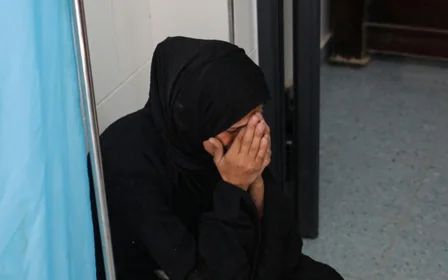
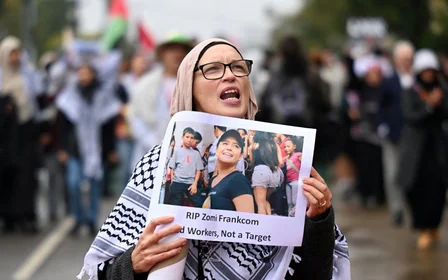
They are also relevant for the approximately 20,000 Palestinians living in the UK, many with families in Gaza. They either have suffered - or expect at any minute to suffer - unbearable loss; with as many as 40, 50 or more members of their extended families, including children and babies, killed.
Experiencing these horrors at one remove from a place of safety can bring about feelings of extreme impotence as well as guilt and shame at being safe, warm, sheltered and fed.
Helplessness includes being unable to do much beyond phoning and, if lucky, receiving the - never reassuring enough - reply: “We are alive… for now.”
Not having received the worst of news means dreading the moment when the phone’s "ping" heralds catastrophe.
Mourning for dead or missing family members is hardly even possible when in a state of such hyper-alertness about the fate of those still alive. Knowledge of the extreme privations they suffer through homelessness and accelerating levels of starvation and disease creates another level of agony, as does trying to bring family members to the UK, facing indifference and obstruction from the Home Office.
Read more: The loneliness of grief for Palestinians in the UK by Gwyn Daniel

A report by the Wall Street Journal said US and western officials are anticipating an Israeli response to Iran's weekend attack "as soon as Monday".
The report comes as Israel's war cabinet convened Monday to discuss the scope and timing of the response, according to the CNN.
A mass grave was discovered at al-Shifa Medical Complex after a deadly Israeli assault last month left the Gaza City hospital in ruins.
Several bodies were found Monday in the hospital's courtyard, including at least one person wearing underwear who appeared to have been "executed recently" according to an Al Jazeera Arabic reporter at the scene.
After Israeli forces withdrew from the hospital on 1 April, teams from several government ministries were deployed to al-Shifa to remove and identify bodies.
The searches were initiated after survivors said they witnessed the summary execution of Palestinians by Israeli forces during the two-week raid that started in mid-March.
Lebanon's Hezbollah claimed Monday it had detonated "explosive devices" targeting Israeli soldiers who the group said had crossed into Lebanese territory.
Israel's army said four soldiers were wounded overnight in an explosion "in the area of the northern border". Israeli media reports confirmed the incident happened on the Lebanese side of the frontier.
One of the soldiers was "severely injured" the army said.
Hezbollah fighters "planted explosive devices in the Tal Ismail area" inside Lebanon, detonating them after Israeli soldiers "crossed the border", the group said in a statement.
Reporting by AFP and MEE staff
The US Central Command said on Monday its forces destroyed four uncrewed aerial vehicles (UAVs) in Houthi-controlled areas of Yemen on 14 April, acting in self-defence.
Centcom added in a Red Sea update that the Yemeni movement launched an anti-ship ballistic missile toward the Gulf of Aden from a Houthi-controlled area in Yemen on Saturday and that there were no injuries or damage reported by US, coalition, or commercial ships.
Reporting by Reuters
Britain rejects an assertion by Iran that it provided advance notice before attacking Israel, a spokesman for British Prime Minister Rishi Sunak said on Monday.
Iranian Foreign Minister Hossein Amirabdollahian said on Sunday that Iran gave neighbouring countries and Israel's ally the United States 72 hours' notice it would launch the strikes.
"I would reject that chracterisation," Sunak's spokesman told reporters. "And more broadly we condemn in the strongest possible terms their direct attack against Israel."
Reporting by Reuters
UN experts today deplored Israel's reported use of AI and relative military directives in the Gaza Strip "leading to an unprecedented toll on the civilian population, housing, vital services and infrastructure."
"Six months into the current military offensive, more housing and civilian infrastructure has now been destroyed in Gaza as a percentage, compared to any conflict in memory," the experts said. "Homes are gone, and with that, the memories, hopes and aspirations of Palestinians and their ability to realise other rights, including their rights to land, food, water, sanitation, health, security and privacy (especially of women and girls), education, development, a healthy environment and self-determination. And this comes on top of systematic demolitions of Palestinian homes over decades of occupation and previous bombardments."
They say that the systematic and widespread destruction of housing, services and civilian infrastructure represents a crime against humanity, which they call a domicide, inlcuding numerous other "war crimes and acts of genocide" described by the UN Special Rapporteur on the Occupied Palestinian Territory, Francesca Albanese, in her latest report to the Human Rights Council.
Israeli authorities released dozens of Palestinians back to Gaza today, having arbitrarily arrested them at different points throughout the war.
One of them, Sofian Abu Saleh, had his leg amputated by Israeli forces during custody.
"My leg got infected [in custody], and [the Israelis] refused to take me to a hospital," he said. "After seven days, the infection spread quickly, like gangrene, they then took me to the hospital on did an operation."
Abu Saleh says he never suffered of any diseases that could have led to this infection.
"I went into [detention] with my two legs, and have returned like this," he said, alluding to this one remaining leg.