

Live blog: Gaza under attack

Live Updates
Rocket alert sirens in several towns near the Gaza Strip went off as the result of a false alarm a few minutes ago.
However, Israelis living in settlement areas remain on high alert: Israel's Kibbutz Movement reports that over 10,000 people living near the border will remain in the north until at least the end of the current 72-hour ceasefire.
Translation: [Nabil] al-Arabi and [Tony] Blair discuss the situation in Gaza, along with the efforts made by Egypt to reach a lasting truce
A poll published by Haaretz yesterday shows that 53 percent of Israelis would like their Prime Minister to engage in negotiations with Palestinian President Mahmoud Abbas and attempt to strengthen his position.
Only 26 percent of the 441 people polled agreed that the Israeli army had achieved all of its objectives during the operation.
Senior officials from Israel's Ministry of Foreign Affairs have instructed Israel not to co-operate with a UN Human Rights Council commission of inquiry into the operation in Gaza, reports Israeli news site Ynet News.
The UN Human Rights Council voted on 23 July to launch a commission of inquiry into "into purported violations of international humanitarian and human rights laws in the Occupied Palestinian Territory, including East Jerusalem," according to a UN statement.
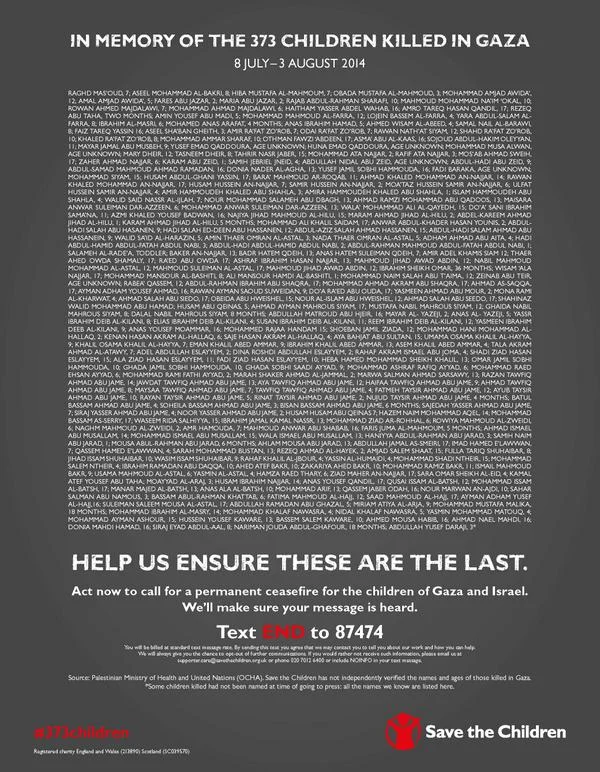
Save the Children UK has published full-page adverts listing the names of the 373 children reported killed in the Gaza Strip between 8 July and 3 August.
Contrary to earlier reports in the Egyptian press, a Palestinian official has told Anadolu that the Rafah border crossing is not on the agenda of today's indirect talks in Cairo.
Ali Jarbawi, a former minister in the Palestinian Authority, has published a commentary in the New York Times calling for a complete end to Israeli occupation as the only solution towards a lasting peace.
""Israel cannot continue to be the exception to the rule of international law and human rights. The international community must hold it accountable for its rhetoric and its actions, and begin to treat it like all other countries. It should not be allowed to continue to enjoy its state of exceptionalism and to use this to wreak destruction on the Palestinian people."
Egypt has promised to open the Rafah border crossing, on condition that the Palestinian Authority remains in charge of the frontier, according to a Palestinian official quoted by al-Hayat.
Disarming Gaza is reportedly not up for discussion at the talks, with a representative from the Popular Front for the Liberation of Palestine calling the suggestion "a dream."
Hamas representative Izzat al-Rishq said that the Palestinian delegation has "yet to receive an official response on the demands we presented to the Egyptians."
Egypt, which is brokering the current peace talks, has reportedly suggested extending the current 72-hour ceasefire to 120 hours.
Internet and telephone lines are back up in Rafah city, in the southern Gaza Strip.
Services had been cut for three days, reports al-Quds News Network, after communications cables were destroyed.
Translation: Since yesterday, the people of Rafah have had no electricity, no communications, no internet and no water #GazaUnderAttack
Early reports suggest that 134 factories in the Gaza Strip were destroyed during the four-week bombardment, reports Anadolu.
Halting of work at factories during the operation has meant the loss of an estimated $47m.
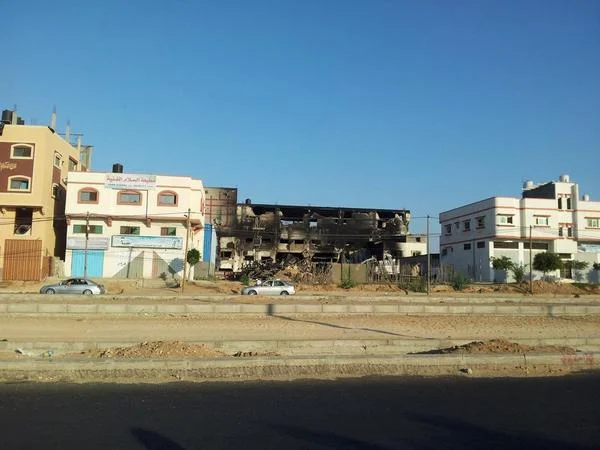
A factory in Deir al-Balah, run by al-Ewda, which used to supply sesame seed products.
Around 400 trucks carrying essential aid have crossed into the Gaza Strip after Israel opened the Kerem Shalom border crossing on Tuesday.
"The Israeli occupation has notified us about its decision to re-open the crossing so that we can enter the goods we have agreed upon earlier," Nazmi Mehanna, the head of the Gaza Border Authority, told Anadolu Agency on Tuesday.
"They have not told us though whether the crossing would remain open," he added.
The crossing, between Israeli territory and the southern Gaza Strip, has been closed since 25 July.
Border crossings into the Gaza Strip have been closed since the blockade began in 2007, though the Kerem Shalom crossings has been intermittently open, mainly for commercial purposes.