LIVE BLOG: Israeli Elections

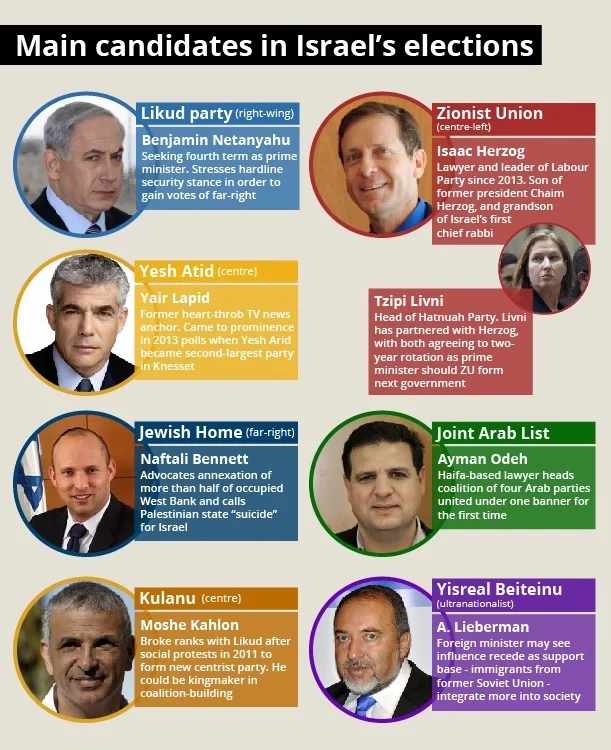
Israeli polls opened on Tuesday as voters determine whether Israelis still want incumbent Prime Minister Benjamin Netanyahu as leader, or will seek change after six years.
With final opinion polls giving centre-left Zionist Union, led by Labor head Isaac Herzog a 3-4 seat lead over Netanyahu, the election could be a nail biter - although whoever wins will depend entirely on the remaining Knesset members and their parties to form the next government.
It is unlikely that the make up of the next government will be clear for at least several days, potentially weeks, but polls have also predicted that the Joint List party, which includes many politicians who are Palestinian citizens of Israel who have been on the political margins for years, is likely to become the third-largest faction in the Knesset and bring the minority into the decision-making mainstream.
Some observers have noted that the focus on the elections has drifted from hard issues - like the economy and security - to focus squarely on whether voters want to keep Netanyahu or not.
Others accentuate the identity politics that underline the Israeli political scene and say that beyond social issues or a Netanyahu referendum, voters will be motivated by their religious and ethnic affiliations.
And then there are a whole segment of Palestinian citizens of Israel who are boycotting the election altogether, many telling Middle East Eye that they believe voting normalises a system of discrimination that does not see them as equal citizens of Israel in comparison to their Jewish Israeli neighbours.
Nearly 6 million voters will be able cast their vote until 8pm GMT. We'll be following developments here with commentary and news. Stay with us for updates throughout the day.
Live Updates
Israel uses a proportional voting system that has led to repeated failures to form stable government coalitions.
Instead of electing individual members of the 120-seat parliament, or Knesset, voters choose party lists, with seats distributed according to the percentage of the vote received.
Parties are only eligible for seats if they pass a threshold, which was raised last year from two percent to 3.25 percent.
That move was slammed by the opposition as an attempt to force Arab parties out of parliament, but it instead saw them join forces in a united list.
There are 25 lists battling it out for seats but opinion polls predict that only 11 are expected to enter parliament.
After official results are announced, President Reuven Rivlin will have seven days to entrust forming the next government to a party leader who says he or she is ready to do so.
The leader then has 28 days to build a coalition, but Rivlin can extend the deadline by another 14 days if necessary.
If a coalition still fails to emerge, he can assign another party leader to the task, again with a 28-day deadline.
If this bid fails as well, Rivlin can then assign the task to a third person. But if the person chosen is unable to form a government within 14 days then the president calls a new election.
In general, the leader whose party wins the most votes is tasked with forming a coalition, but this is not mandatory.
No party in Israel has ever been able to secure the necessary 61-seat majority to rule alone.
Twice -- in 1996 and 1999 -- Israelis voted directly for a prime minister as well as for a party list. In 2001, a special prime ministerial election was also held after then-Labour premier Ehud Barak was unable to win the Knesset's support.
Just six of the past 19 parliaments have been able to complete their four-year mandate.
About 13.75 percent of eligible Israeli voters cast ballots within the first three hours of Knesset elections, according to data released by the country's official electoral commission on Tuesday.
The data showed a 2.3-percent increase in voter turnout compared to the last poll two years ago.
In the 2013 election, only 11.4 percent of eligible voters had cast ballots as of 10am, although the figure had risen to 26 percent one hour later.
The electoral commission has put the number of eligible voters for the 20th Knesset vote stood at 5,881,696, who will cast ballots at 10,372 polling stations nationwide.
So far, according to the commission, around 794,000 people have voted.
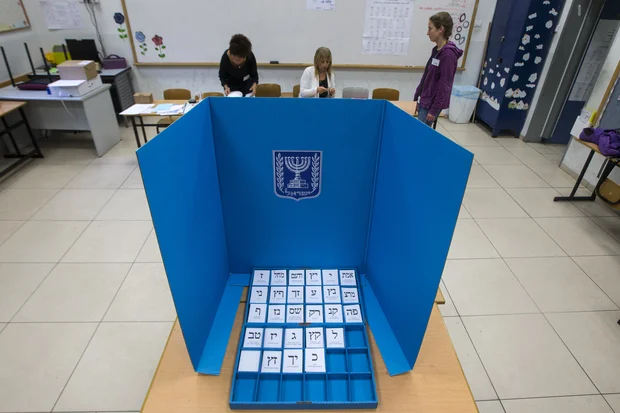
Palestinian citizens of Israel say they feel intimidated at polling stations in Arab villages, where there is a high presence of Jewish settlers whether in charge of the polling procedures or as voting monitors.
The voters of Palestinian origin complain that right-wing Israeli officials at the polling stations appear to be trying to slow down the voting process by taking long time in checking IDs and documents.
The alleged acts are taking place amid the highest expected presence of voters of Palestinian citizens of Israel, voting for the Joint List.
Israeli military police have arrested a soldier who made online threats against left-wing candidates vying in Tuesday's election, local media has reported.
The arrest came after the soldier wrote on Facebook that "if a leftist takes power, I promise and swear on my soul that I will be the next Yigal Amir" – a reference to the assassin of former Prime Minister Yitzhak Rabin, Yedioth Ahronoth reported.