LIVE BLOG: Latest from war in Syria

- UN report confirms use of chemical weapons by Syrian government
- Russia and America continue to hold negotiations in a bid to strike a deal to end the civil war
- Kurdish forces pushed back by Turkish army as it takes control of Syrian territory previously controlled by the Islamic State group
Live Updates
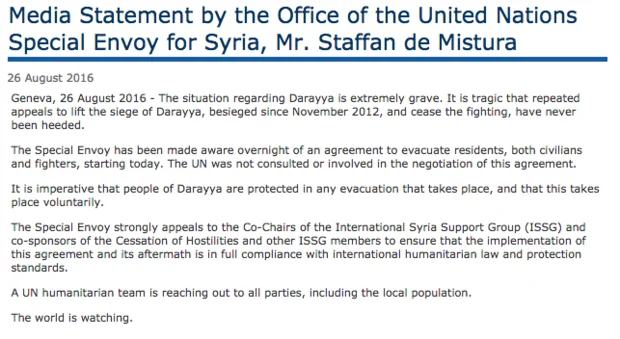
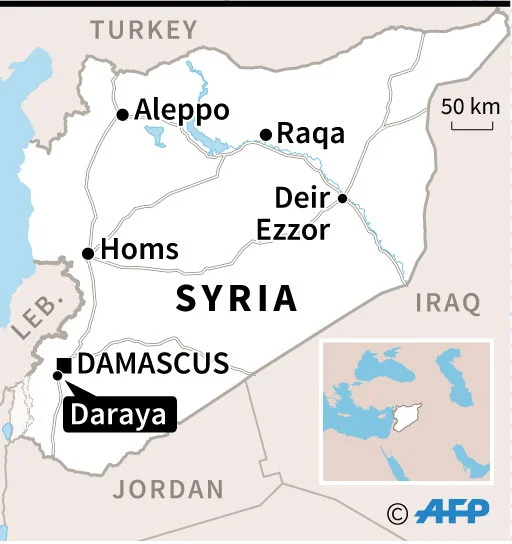
UN Special Envoy for Syria Staffan de Mistura has issued a statement about the evacuation of civilians and rebel fighters from the besieged Damascus suburb of Daraya, revealing that the UN was not consulted about the deal.
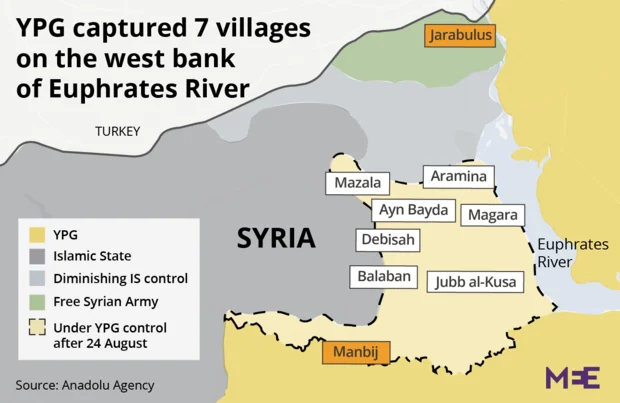
Turkish Prime Minister Binali Yildirim has denied that Turkey's invasion of northern Syria is primarily focused on targeting the pro-Kurdish People's Protection Units (YPG) and their allies.
"They either know nothing about the world, or else their job is to report a bare-faced lie," Yildirim said when asked to comment on claims the operation was not targeting Islamic State militants but Kurds. "Our soldiers' mission is to ensure our border security and the life and property of our citizens. The news apart from that is just a lie."
However, he told reporters on Friday that the operations would continue until Islamic State "and all other terror elements are cleared from the area".
"As Gazi [Republic founder Mustafa Kemal Ataturk] said during the War of Independence, 'Either independence or death'," said Yildirim. "We will give the necessary response to these villains who targeted the fellowship and unity of 79 million people."
Turkey on Friday sent four more tanks across the border into the Syrian city of Jarablus which was liberated by Ankara-backed rebels this week, an AFP photographer said.
The photographer saw additional tanks crossing the border and also heard the sound of explosions in Jarabulus, as the army continues clean-up operations after the town was freed from Islamic State (IS) militants.
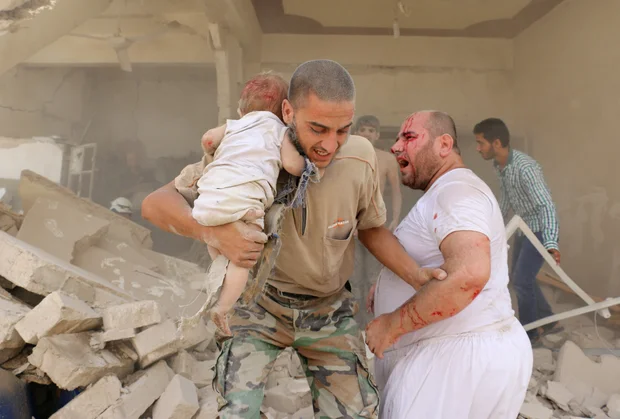
Eleven children were killed on Thursday in a barrel bomb attack carried out by government forces on a rebel-held neighbourhood of Syria's Aleppo city, a monitor said.
"Fifteen civilians, among them 11 children, were killed in a barrel bomb attack on the Bab al-Nayrab neighbourhood" in the south of Aleppo city, the Britain-based Syrian Observatory for Human Rights monitor said.
The group also reported eight civilians, including two children, were killed on Thursday in rebel fire on the government-held west of the city.
An AFP journalist in Bab al-Nayrab saw rescue workers and civilians digging through the rubble of collapsed buildings.
One man carried out the lifeless body of a baby no bigger than his forearm. Its eyes were closed and its body was white with dust except for speckles and smears of blood.
Nearby, a civil defence worker protected the face of another dead child as his colleagues scraped away the rubble encasing the rest of the child's body.
Thousands of rebel fighters and civilians are to evacuate the besieged town of Daraya near the Syrian capital under an accord struck on Thursday, state news agency SANA said.
"Seven hundred armed men with their personal weapons will leave Daraya to head to the (rebel-controlled) city of Idlib, while thousands of men and women with their families will be taken to reception centres," it said.
The rebel would have to surrender other armaments to the army.
A military source told AFP that the army would enter Daraya, which has been under a regime siege for the past four years, after the evacuation from the rebel-held town.
A rebel official in the town said the evacuation would take place on Friday.
"The civilians will go to regions under regime control around Damascus, rebels will go to Idlib "or sort out their situation with the regime", he said.
A convoy of trucks carrying food reached Daraya in June, delivering supplies to civilians for the first time since government forces laid siege to the town in late 2012.
Daraya was one of the first towns in Syria to erupt in anti-government protests. It is located just a 15-minute drive from central Damascus and is even closer to the regime's Mazzeh air base.
A Turkish official has told journalists that Turkey originally planned the offensive into northern Syria for June 2015 and that it had to be delayed it for three reasons:
1. The US didn't believe the plan was feasible at the time citing an insufficient number of rebel fighters.
2: The downing of the Russian jet in November 2015 meant air cover couldn't be provided.
3: What have now been revealed as Gulenist elements in the military, including the chief of special forces General Semhi Terzi, blocked proper planning by repeatedly saying the Turkish armed forces weren't prepared to carry out such an offensive.
Salman al-Ali, a 37-year old history teacher from Aleppo, told Middle East Eye that he thought Turkey was intervening in Syria to pursue short terms interests rather than fundamentally change the situation on the ground:
"They should have acted long ago! Why did they wait that long? They could have saved more lives in Syria, but they didn't.
"Now they are invading the town of Jarablus with their plan to re-assemble the Free Syrian Army with fighting IS as their priority, not fighting the regime and its militias.
"In my perspective they've been waiting until the situation in Aleppo was like it is now. The Kurdish situation as well in Hasakah is intense with regime and all these parties are exhausted.
"So they entered Syria without any expectation of any military reaction from the regime who is already busy with many battles.
"Turkey wants to make a no-fly zone. I think the plan in northern Syria, in the short term, is to change who is taking control in many areas.
"Many will retreat and other forces will vanish in one part and many things will happen! But I can't imagine how things will go in Aleppo. It's very complicated here!"
At least nine more Turkish tanks entered north Syria on Thursday as part of the military operation to drive Islamic State out of the border town of Jarablus, as well as stopping Kurdish militia fighters from seizing territory, according to the Reuters news agency.
A Turkish official told Reuters there are now more than 20 Turkish tanks inside Syria and that more would be sent as required.
“We need construction machinery to open up roads … and we may need more in the days ahead,” the official said on condition of anonymity. “We also have armoured personnel carriers that could be used on the Syrian side. We may put them into service as needed.”
The convoy of Kemal Kilicdaroglu, leader of Turkey's main opposition Republican People's Party (CHP), came under fire on Thursday as his convoy passed through the northeastern Turkish province of Artvin.
No casualties were reported. The identity of the gunman is so far unknown.
"Unlike the US, Turkey actively sought to remove Assad from power through granting support to multiple armed groups in Syria. It also initially saw in the rise of IS a potential opportunity to quickly get rid of Assad and in the Syrian conflict an excuse to crack down on the Kurdish Workers Party (PKK) in the south along the Syrian border.
However, its laissez-faire approach to its Syrian border, which allowed thousands of foreign fighters to cross into Syria from Europe and elsewhere to join IS and other groups, put Turkey under pressure from Europe as well as the US who began to label it as an agent of instability. Increased Turkish monitoring of the border came too late as IS had by then established presence on Turkish soil and began a series of terrorist attacks in different Turkish cities."
Read more here from Lina Khatib