

Live blog: Libya elections

Parliamentary elections are taking place in Libya today, against a backdrop of rising violence and deepening political divisions, with some hoping the vote can herald a renewed effort at building a more peaceful, democratic and unified country.
Live Updates
Dr Abdalaziz Agniea, a Libyan commentator based in London, told MEE what he sees as the way forward to overcome the current crisis in Libya:
"The current elections will not solve Libya's problems. With around half a million people barred from taking part in politics, because they were accused of being part of the former regime, and with deliberate gasoline shortages and power outages to discourage people from voting, little change is expected.
"The militias, who have never allowed any government to do its work, are intimidating people. Voters are divided according to areas, tribes and personal interests and the country's mufti, who is supposed to be neutral, is unashamedly taking sides.
"The only way forward is to have all the different political players – from religious extremists to Gaddafi loyalists – sit together in a conference sponsored by the UN, EU, AU and the Arab League and iron out their differences ahead of a more transparent general elections.
"The UN must ensure that all of those who have blood on their hands will not be allowed to travel freely nor should they be able to access their international bank accounts. That way you can enforce accountability and people will be more careful about their actions."
A Libyan woman living Tripoli, who asked not to be named, spoke to MEE about the elctions:
It is election time once again. It should be a happy moment and one of the most important events in Libya. However, a fair number of Libyans were quite hesitant to go and participate in the election, due to the previous disappointments experienced with those who were previously elected.
It seems like getting a position in the government is more important than really fulfilling the public's needs. There have been rumours that some of those elected have used public money for their personal use and I guess it's true since everyone knows everyone here in Libya.
Furthermore, all the current problems that are taking place in Benghazi and in Libya in general have left the public disappointed. In addition to that, the lack of gasoline and electricity cuts have added to the frustration and anger.
Negative comments about the election are noticeable - whether on Facebook or in public gatherings - but we really do wish that this time around we won't be disappointed.
Rawad al-Radwan, a Libyan who runs his own blog at www.rawad.info, spoke to MEE and explained the urgent need to replace the GNC due to past failures:
"Libya is going through a critical time and the country's democratic future is in danger due to the failure of the GNC.
"Since the GNC members were elected the situation in Libya has gone from bad to worse, their irresponsibe policies and support to militias are the reasons behind the political chaos and instability.
"These elections are the only hope, because we cannot handle more failure. The GNC must be replaced and I personally believe that electing the right people is the only way to stand against terrorists and all of the other militias that are fighting for power in eastern areas of the country."
Ahmed Addarrat, a Libyan who has voted today, spoke to MEE about his thoughts on the election and what needs to happen for Libya moving forward.
"These elections serve as more or less a reset button but their effectiveness depend on who is elected. But at the same time the politicians have to be put into the right atmosphere and right not the atmosphere is not that healthy.
“There needs to be a healthy atmosphere for them [politicians] to work in towards bridging the divides that exist. I’m one of those people who is on the more positive end of the totem pole, which is why I voted today.
“I’m always going to vote, I believe that if you don’t vote you don’t have the right to speak out against what’s going on. You got to do your part as a citizen.
“I think here in Libya people still don’t understand what it means to be a citizen, especially after 42 years of not really being one [under Gaddafi] and just being told what to do. As Libyan citizens we need to accept the responsibility of what is happening in our country and hold ourselves accountable before we hold the people in power accountable.
“A lot of people resented the GNC, and rightfully so as they didn’t perform well at all, but I always tell people we got to look at how we act in the street, how we treat each other and behave at home. We have to ask: is that how we want to treat each other? The GNC has been a mirror of what the Libyan society is.
“If you don’t like what they are doing [the GNC] then you got to change what you’re doing.
“A low turnout out this in vote will give more room for an argument that the parliament will lose legitimacy. People have election fatigue, some say there are elections after elections without any result, so people say: why the hell am I going to go vote if these guys don’t really do much for us?
“Although, I personally don’t think a low turnout will affect the legitimacy of the vote.”
248 out of 420 Turkish workers in Libya have returned home, after they were threatened with arrest by rogue general Khalifa Haftar.
The Turkish Embassy chartered two aircraft to fly the 420 Turks home from Libya's third city, Mistrata, airport spokesman, Mohamed Ismail told the state news agency, LANA.
On Saturday, a spokesman for renegade General Khalifa Haftar gave the Turks and Qataris 48 hours to leave the country, accusing them of being involved in espionage.
On Monday, Libya's Foreign Ministry distanced the government from Haftar's threats, and promised to protect foreign nationals.
"The transitional government is responsible for protecting foreigners staying in Libya," the ministry said in a statement.
Photos from the Turkish Anadolu Agency have shown Libyan women voting in Benghazi and Tripoli. More than 600,000 women have registered to take part in the election and 30 of the 200 parliamentary seats have been reserved for female candidates, a move rights groups have said will ensure women take part.
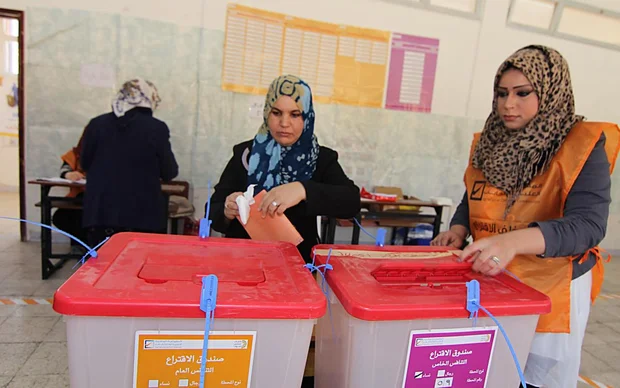
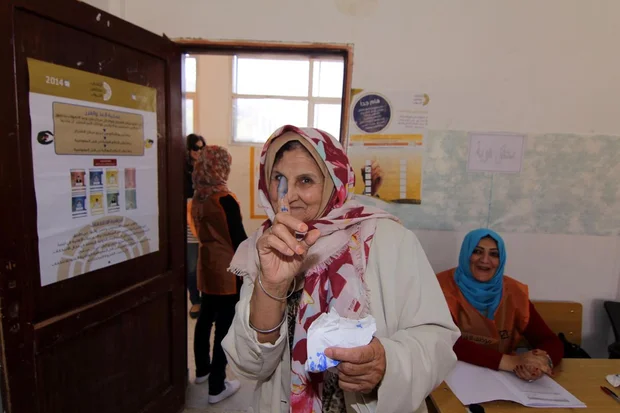
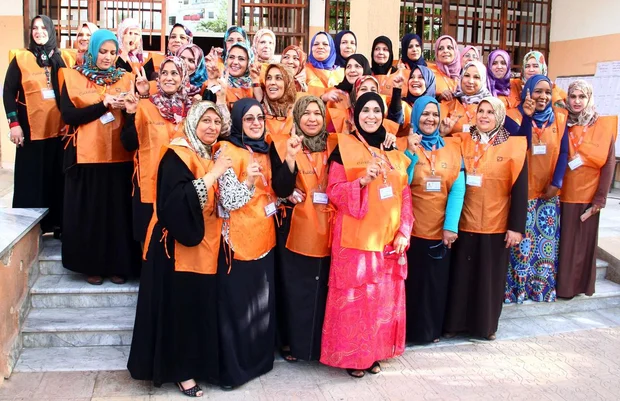
British Ambassador to Libya Michael Aron has reported few voters turning out to vote so far, suggesting that searing temperatures that are up to 40 degrees could be to blame.
American ex-pat living in Tripoli James Wheeler is out and around the voting centres, saying there are more monitors than voters so far, and seems to agree high temperature could be putting people off from turning out.
Libyans in the eastern town of Derna won't be taking part in today's elections, as all of its some 50 polling stations are closed due to a worrisome security situation.
Speaking to local daily Libya Herald, an anonymous town official said headteachers had refused requests from the electoral commission to use schools as polling stations. Their decision is thought to be related to an incident in February when five schools due to be used as polling centres for the constitutional referendum were bombed, killing one man, with the schools left to pay for repairs in the absence of government funding.
The unnamed official said there was little point in elections taking place in Derna, as candidates "were not known" while the government has "consistently refused to take responsibility for the town's problems". The eastern town has been racked with violence with various militias and extremist groups present, which has fuelled violence and instability in recent months.
A resident of town told the Herald that there had been no campaigning by candidates, as if they had attempted to they would "immediately become targets".
Speaking to Mary Fitzgerald in The Guardian, former army general Khalifa Haftar has announced his renegade forces have "broken the backbone of our enemies".
He says his "Operation Dignity" will be completed in six months, although he angled for external military help by saying aid could reduce the time needed for victory: "if we receive military supplies from friendly countries the time will be less," he told The Guardian, suggesting that suspected military supplies from Gulf States and Egypt has not materialised as yet. "We have not asked Egypt to conduct air raids in Libya, but if we need this we will ask for it without any hesitation," he added.
Haftar is leading a military campaign against "terrorism" in Eastern Libya. His non-government "National Army" attacked the restive city of Benghazi on 16 May, killing at least 79 people, and has been labelled an outlaw by the government who accuse him of attempting a coup.
He pledged to scale down his offensive to allow for the elections to take place and there are yet to be any reports of violence taking place during the early hours of voting today.
In effort to encourage Libyans to vote, the government employed New York based social enterprise Reboot to develop and implement the world's first mobile voter registration system.
Anyone can use the system, with any spec of mobile phone, which requires them to simply send a text message with their national ID and 5 digit electoral centre number into the Higher National Elections Commission. The Commission then replies with confirmation of registration, with the voter able to change their electoral system by sending in new details of where they would like to cast their ballot.
Reboot's Panthea Lee explains the system here, on Al Jazeera's The Stream:
The innovative tool is an attempt by the government to encourage voters to take part in the elections, although with only 1.5 million registered out of 3.4 million eligible there are fears of a low turnout.
Ex-Prime Minister Ali Zeidan has been shown casting his vote in the Libyan capital Tripoli:
63-year-old Zeidan fled the country in March after being sacked by parliament, but he has now returned to reassert his claim over the premiership. He has appeared on television to announce he still considers himself to be the country's rightful leader, dispute being dismissed for alleged corruption by the GNC.
In October last year Zeidan was briefly kidnapped by gunmen, who held him hostage for several hours at a Tripoli hotel. After his release Zeidan blamed the incident on his opponents, which emphasized political divisions that have only widened since then.
The Higher National Elections Commission announced Monday that 3,816 Libyans overseas had taken part in the parliamentary elections, making a 30 percent turnout among the 10,087 registered voters.
The busiest electoral station was in the British city of Manchester, where some 568 votes were cast. Conversely only 43 people took part at the Los Angeles polling centre.
Despite a low outcome, those who did take part appeared proud to share their political participation on social media:
Voting kicked off at 0800 (0600 GMT) this morning, with some 1.5 million registered voters able to cast their ballots in the parliamentary elections. Libyans will elect 200 parliamentarians to represent them in the country's General National Congress, or parliament, with 80 seats reserved for political parties and the rest up for grabs among independent candidates.
Some pin high hopes that these elections can spark dialogue among the various factious parties in Libya's embattled political scene, although analysts have highlighted the challenges facing potential new politicians if they are to achieve unity.
News Editor Simona Sikimic has written an overview of the trials and tribulations facing Libya, speaking to a number of analysts, including Jason Pack of Cambridge University who had this to say on the potential for politicians to bridge their divides:
“Libyan politics at the moment are conceived as a zero sum game between two or three larger factions," said Pack, who is researcher of Libyan history at Cambridge University and President of Libya-Analysis.com. "Until those factions are ready to negotiate behind the scenes and come to a grand bargain, it is not possible for there to be any unifying figures."
“However, if a grand bargain is somehow struck behind the scenes, the new House of Representatives may finally find itself empowered and acting at long last to reach into local communities and bring unity,” explains Pack, “If that miraculously happens, the elections will be a great success, and it won’t have mattered that turnout was low. If the body is empowered to act in a legitimate fashion, that will be amazing.”