

Live Blog: The struggle for Iraq

Live Updates
Two ISIL Bosnian fighters apparently captured on camera. Tweet by Charles lister of Brookings Institute Doha.
UNHCR video shows the influx of refugees and how aid teams are struggling to deal with the 500,000 Iraqis who are estimated to have fled their homes in the last few days.
Experts say that the Iraqi prime minister has made major mistakes over security, and that as the commander-in-chief of the armed forces and acting defence and interior minister, he must be held directly responsible.
"He's appointed every senior officer in the military currently serving, so issues like illegal arrests, torture, extraction of bribes to free detainees, etc. I'd lay at Maliki's feet," Kirk Sowell, a political risk analyst and publisher of the Inside Iraqi Politics newsletter told AFP.
"He is clearly incapable of running the mil itary in a competent manner," Sowell added.
Anthony Cordesman of the Centre for Strategic and International Studies, agreed.
Maliki "has spent the last few years... both corrupting the Iraqi security forces and putting people in (its) command chain (who) are loyal to him," Cordesman said.
And "he has used it systematically to repress the legitimate Sunni opposition."
Chatham House associate fellow Hayder al-Khoei who is currently in Baghdad tweets about the rise of Suni tribal militias that are fighting on the side of the government in what has otherwise been termed a sectarian conflict between Sunni and Shia.
Militants gained ground on Monday in a battle for a strategic Shiite enclave in northern Iraq that provides a corridor to Syria, officials and residents said.
Security forces insisted they had repelled an assault on Tal Afar, a Shiite Turkman-majority town in Nineveh province, but multiple officials and a resident said militants had entered it, with one saying they were in control.
"Armed groups managed to take control of Tal Afar," a Nineveh provincial government official told AFP, speaking on condition of anonymity.
"They clashed with security forces and [tribal fighters], who had to withdraw from the town."
Resident Mohammed Khalil said militants had taken several districts but not the entire town, and added that families were fleeing to nearby Sinjar between Tal Afar and the Syrian border.
Western embassies began evacuating staff from Baghdad Monday despite Iraq's claim it was repelling militants who have captured vast amounts of territory in a lightning offensive that has shaken regional stability.
Um Mustafa, an Iraqi originally from Mosul and now living in Britain, tells the MEE that the situation is not as clear cut as many believe and that ISIL is just part of a much bigger puzzle.
"I have been in constant communication with family and friends in Mosul and every single person I've spoken with says what is happening in Iraq is not about ISIL.
"The people of Mosul feel that their city is returning to their own control after [Iraqi Prime Minister Nuri al-] Maliki's army fled.
ISIL release photos on social media showing them executing people in Tikrit. The fighters say they have killed 1,700 Iraqi Shia air force recruits, sparking mass outrage by the international community.
While the numbers could not be independently verified, the photos are widely accepted as being legitimate.
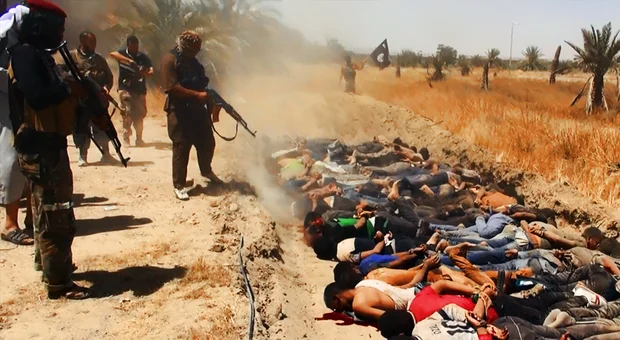
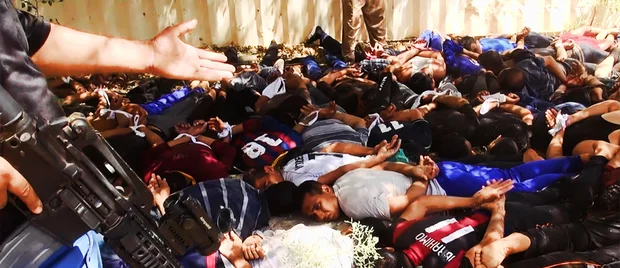
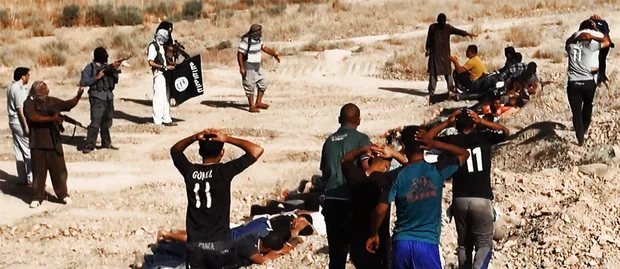
Saturday night saw some major developments on the ground in Iraq and internationally. We bring you a quick round-up of what has been going on:
· Medical staff in Mosul report on Sunday that they have received the bodies of 128 Iraqi security personnel, including army soldiers and police officers.
· Former Iraqi PM Ayad Allawi tells CNN it is "very likely" that Iraq is on the path to partition. According to Allawi, the ring around Baghdad has fallen, and any American intervention would only "add fuel to the fire."
· The US moves its aircraft carrier, George H W Bush, from the Arabian Sea to the Persian Gulf. It was expected to arrive late on Saturday, and has the scope to protect "American lives, citizens and interests in Iraq.”
· Iraqi government air strikes kill 6 Kurdish fighters near the eastern town of Khanqin on Saturday night. It remains unclear whether it was a targeted attack or a case of friendly fire.
· Lakhdar Brahimi, former UN envoy to Syria who resigned in May, says that the unrest in Iraq is a direct result of international “neglect” of the conflict in Syria. According to Brahimi, he warned the UN Security Council in November 2013 that ISIL is “ten times more active in Iraq than in Syria.”
The exiled governor of Mosul Atil al-Nujaifi, who has taken refuge in capital of Iraqi Kurdistan, called for US and Turkish air strikes to help the Iraqi army, who "cannot fight against ISIL" because they exploit sectarian issues.
Shelling that hit the northern town of Tal Afar, the largest northern town not under the control of militants, killed 10 people on Sunday, according to official sources quoted by AFP.
Iraqi security forces have killed 279 "terrorists" in the past 24 hours, as they push back against a major militant offensive, a security spokesman said on Sunday.
Qassem Atta, official spokesperson for Nouri al-Maliki as head of the armed forces, also told journalists that Baghdad is "100 percent safe", and there is no need for concern over the capital.
Permanent members of the Arab League condemned on Sunday "terrorism in all its forms", and announced its support for Iraqi efforts to combat it so far.
After an extraordinary meeting of the Arab League members in Jeddah, the Council of the Arab League, the body's primary institution, called for real and comprehensive dialogue in Iraq and the formation of a government of national unity.
Turkish Prime Minister Tayyip Erdogan told reporters that Iraq's struggle goes " far beyond an encounter with forces affiliated with ISIL", at a press conference in Trabzon on Sunday.
He warned that, under the current circumstances, it could evolve into a "sectarian conflict, or maybe even a sectarian war."