

Live Blog: The struggle for Iraq

Live Updates
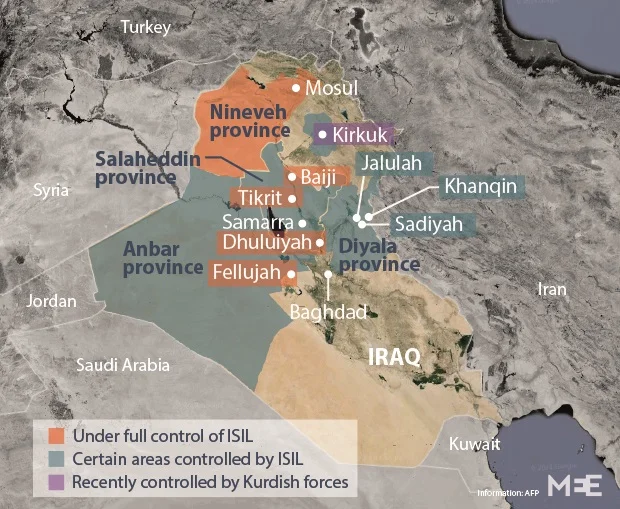
While Iraq is estimated to be some 20 percent Sunni, the Wall Street Journal map, is a good reference for how much land ISIL are trying to claim.
On Friday evening, CNS News reported that ISIL leader Abu Bakr al-Baghdadi had warned the US of his plans as early as January. While Baghdadi is known for his secrecy and rarely makes public statements, an audio message delivered on 26 January warned that the group, which already controlled parts of neighbouring Syria, intended to "be in the frontlines against the Shia, and march toward Baghdad and the South, keep the Shia busy in their own areas.
"Know that the entire Sunni population and the brothers in Syria are watching you,” he said in the statement.
The message also warned of impending attacks on the US.
“Our last message is to the Americans. Soon we will be in direct confrontation, and the sons of Islam have prepared for such a day,” he said. “So watch, for we are with you, watching.”
The message was first made known on 5 February when Brett McGurk, deputy assistant aecretary of State for Iran and Iraq, testified before the House Foreign Affairs Committee and presented ISIL's agenda to lawmakers.
Oil pipelines have been targeted for siphoning after the withdrawal of Iraqi forces from the oil-rich city of Kirkuk.
People have been puncturing the pipe, letting oil spill out onto the ground and then collecting it, reports Anadolu.
Crude prices have jumped to nearly $114 per barrel, their highest level in nine months, since the disturbances began.
Kurdish Premier Nechirvan Idris Barzani is addressing a conference, and is speaking about the recent conflict between Sunni militias including ISIL and fighters allied to Maliki.
"Prior to thinking of a military solution in Iraq, it is crucial to consider a political solution as well."
Forces loyal to Prime Minister al-Maliki recaptured the town of Ishaqi in Salah al-Din province on Saturday.
They found the charred bodies of 12 policemen in the town, according to a police colonel and a doctor who spoke to AFP.
Ishaqi, around 90 kilometres north-west of Baghdad, was reportedly the closest militia groups had come to the capital since the latest wave of their assault began in Mosul on Monday.
ABC news' Jon Williams lays out Obama's most likely military response. The US has ruled out boots on the ground but is mulling over other options with a full strategy expected in the next few days.
Ali Ansari, director of the Institute for Iranian Studies at the University of St Andrews tells MEE that for Shiite-majority Iran, the battle underway in Iraq is part of a wider sectarian struggle also playing out in Syria and a continuation of a proxy war the country has had with Sunni-majority Saudi Arabia "for some years now", said Ali Ansari.
"I think [the Iranians] see this as part of a broader struggle," Ansari said. "At the end of the day, they see the US behind all of this."
Further comments and analysis read: Iraq response, Iran and US could find rapprochement opportunity
Translation: Pictures of Saddam on the shoulders of rebels
Iranian President Hassan Rouhani has told a press conference that Iran is ready to provide assistance in the fight against "terrorism."
However, he said that so far Iraq has not requested any such assistance from Iran, and denied reports that Iranian troops are already on the ground.
The Guardian on Saturday morning cites senior Iraqi military officials as saying that there are already some 2000 Iranian troops deployed in Iraq.
Al-Arabiya reports that Prime Minister Nouri al-Maliki has threatened to close down its Baghdad offices, and to ban its correspondents and those of its sister channel al-Hadath from reporting in the country.
A contact on the ground in Mosul tells MEE that the internet has been cut off in the city of Mosul for the past three hours, and in Baghdad since 12am.
Britain is to provide an initial £3m in humanitarian assistance for those fleeing violence in Iraq, reports Sky News.
The UN's refugee agency estimated on Friday that 300,000 people have been internally displaced this week alone, as families flee fighting in northern Iraq.
Qassem Ata, head of Iraq’s intelligence services, calls on the BBC to “revise its media policy towards Iraq”, accusing them of “mendacious” reporting.
In a press conference broadcast on state television channel Al Iraqia, he accused the corporation and other unnamed media outlets of “fabrications”