

Live Blog: War against Islamic State

- Two senior IS leaders killed overnight in Kirkuk in Iraq
- UK parliament to vote on military action in Iraq (but not Syria) at 16:00pm GMT
- More oil refineries struck in Syria
Live Updates
Forces affiliated to Syrian President Bashar al-Assad were able to take control of 40 villages in northern Syria on Thursday, after a campaign of airstrikes targeting Islamic State sites caused them to withdraw somewhat from the area.
A state-run Syrian television station broadcast footage of the 40 villages which it claimed to have taken, according to Arabic news site Arabi21.
UK daily The Times also reported on Friday that Assad forces had been able to make significant gains in areas around the capital Damascus, while the world is distracted covering US airstrikes against IS sites further north.
In the wake of the government gains, Islamic Front spokesperson Abdel Rahman Saleh said that "the airstrikes have helped the Assad regime."
"Regime forces have begun implementing a military campaign in al-Hasaka", a far north-eastern governorate of Syria on the border with Turkey.
He said in a statement that US-led airstrikes in the area had enabled Assad's forces to make gains in the region.
Hours before UK parliamentarians voted with a huge majority to support the Prime Minister's motion to join airstrikes in Iraq, Forward Thinking urged politicians to take a markedly different approach.
Forward Thinking, a UK-based organisation working towards mediation in the Middle East, issued a press release calling for a more long-term approach.
"Most Britons, I suspect, share in common a sense of revulsion not only at the barbaric way in which the British aid worker, David Haines, and others were executed, but also at what’s happening to the Yezidi, Shia and Christian communities in those areas of the Middle East already under ISIS control."
" The need for decisive action to address the growing threat that ISIS poses for the stability and security of the whole Gulf, Middle East and North Africa region is real."
However, according to the statement, IS "cannot be defeated by words of condemnation or military action alone."
"The Islamic State movement is a symptom of the failure of Western policies in the region over the past hundred years, which have always put our own economic interests before our values. To secure the continuous flow of relatively cheap oil and lucrative trade deals, we have propped up oligarchies and turned a blind eye to the export of sectarian ideologies packaged in the name of religious piety."
"An ideology cannot be defeated by bombs – the need to understand the attraction of ISIS is more important."
The UK Parliament has voted to join airstrikes against Islamic State in Iraq.
524 parliamentarians supported the vote, versus 43 against.
Analyst Haydar al-Khoei called the vote "a landslide."
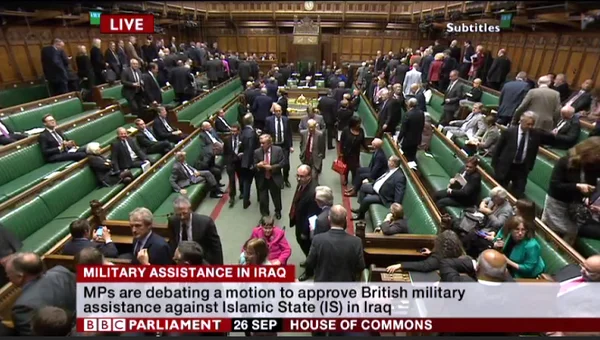
As the UK Parliament prepares to vote on a motion (the text of which is below) to allow the British air forces to start bombing IS sites in Iraq, MEE spoke to John Rees, a national officer with the UK-based Stop the War Coalition.
The UK joining in airstrikes will make things "suddenly and rapidly worse," Rees said.
"The Americans have been bombing for months now, and that doesn't seem to have improved the situation at all.
"The idea that the tiny UK contribution of more bombing would make any difference is simply not credible.
"All the evidence points to the fact that, as a result of US bombing, recruitment to IS has risen dramatically."
Should the UK join in with the bombing campaign, Rees says, it will be in "greater danger of revenge attacks.
"The Defence Secretary said in the debate that we are looking at a matter of years for this campaign, and the Prime Minister said he would only consult the House of Commons even if the bombing were extended to Syria after the event.
"This mission is creeping even before it has got started."
Salih Muslim Mohammed, who heads Syria's Democratic Union Party, has warned of "genocide" in Rojava, the word used by Kurds to describe Kurdish-majority areas in north and north-eastern Syria.
Mohammed was speaking via Skype to a conference being held in Washington DC entitled "The new Kurdish reality in the Middle East."
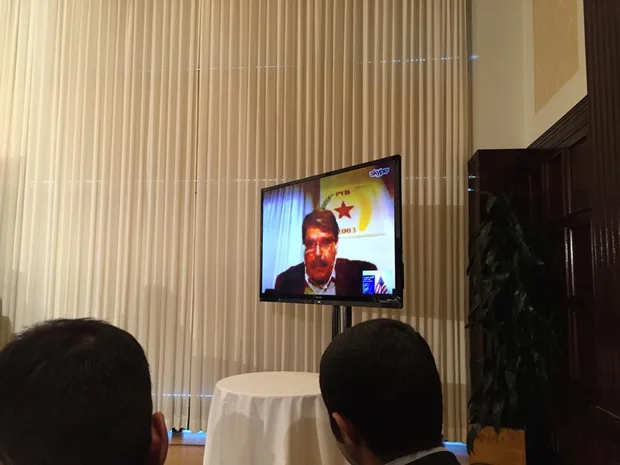
He had not been granted a visa to travel to the US to take part in the conference.
In his speech, he warned that a "massacre" had already begun in Kobane, the northern city on the border with Iraq known as Ayn al-Arab in Arabic.
He said that though there had been intense activity in the skies above Kobane, there had as yet been no airstrikes against IS in the area.
"We are open to everybody to co-ordinate and co-operate to defeat IS."
"We want a good relationship with the US and would like to convince them...to listen to us."
Bahrain's Foreign Minister, Khalid bin Ahmed Al Khalifa, is currently speaking live at the UN General Assembly.
He said that Bahrain is committed to continuing its participation against Islamic State in Iraq and Syria.
Khalifa announced that Bahrain is ready to combat terror "on all levels."
He also said that Hezbollah is a terrorist organisation, and that there is no difference between it and Islamic State.
He also demanded that Iran play a "clearer" role in the region.
Turkish President Tayyip Erdogan has just announced a "change" in his country's stance towards the fight against Islamic State, reports Sky News.
More details to follow as they come out.
There are reports that Syrian Kurdish fighters from the YPG, the Syrian Kurdish defence forces, have received heavier weaponry in their fight against Islamic State near the Kurdish border town of Kobane (known as Ayn al-Arab in Arabic.)
Charles Lister, a fellow at the Brookings Institute, published a video allegedly showing Syrian Kurdish forces fighting using French or German heavy weaponry, which had been sent to Kurdish Peshmerga forces to aid the anti-IS fight in Iraq.
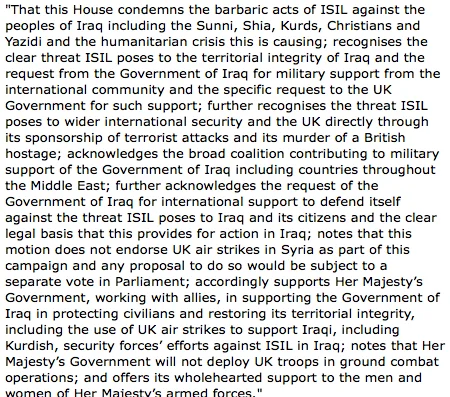
Mike Gapes, a UK member with the opposition Labour party, has urged the House of Commons during their debate over joining airstrikes in Iraq to provide greater support to the Kurdish peshmerga.
He told politicians, who at 16:00 GMT will vote on the motion to participate in the coalition strikes in Iraq only, that the Kurdish Peshmerga have fought bravely but are lightly-armed.
He praised the semi-autonomous region of Iraqi Kurdistan for being a "functioning democracy", and praised them for hosting 1.4m internally displaced people who fled to the region after the IS advance further south in Iraq.
Germany has today begun putting restrictions on travel for German nationals suspected of travelling to fight alongside Islamic State, reports Anadolu Agency.
It is unclear exactly what these restrictions are, or whether they will be imposed on people who have been charged with any crime or just on those suspected of planning to commit crimes.
The German Foreign Office also has enhanced travel warning in place for "a number of African, Middle Eastern and Asian countries", according to German newspaper Rhein Zeitung.
The warning posted on the body's website includes countries like Cameroon, Mali, Lebanon, Syria, Egypt, Iraq and Mauritania.
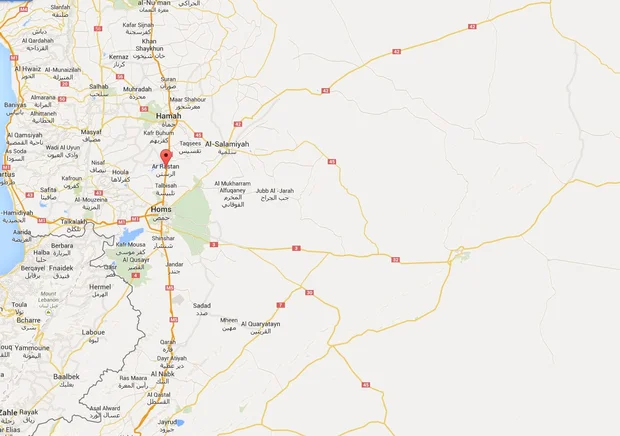
Al-Nusra Front leader Abu al-Baraa was killed today in a strike on a meeting of the group's leaders in Rastan, just north of Aleppo, reports Sky News Breaking.
Translation: Protests today attracted both critics of the international coalition and critics of the crimes of Islamic State. Rejecting the coalition does not mean lending legitimacy to the Criminal State [IS].
Some of the banners read:
"No terror is greater than the terror of [Bashar] al-Assad and Islamic State."
"Islamic State: the coalition dropping bombs on you does not mean that you are right."
Dominic Grieve, Conservative MP and former Attorney General, has said while he supports the intervention in Syra "a note of caution needs to be sounded about what we are trying to do.”
He said that, having spent the year “signing off on the prosecutions” of people returning from fighting with IS in Syria, he understood that IS were a real threat.
But there needed to be a “model of how people can co-exist peacefully” in Iraq.
“This country has a long history of international involvement."
As a barrister, he was certain that “so far as the legal framework is sound, I have not the slightest doubt that the legal framework exists” to deal with IS in Iraq and also suggested that "the preconditions for action in Syria are also present” under the "doctrine of humanitarian necessity.”
He also said that "the ability to intervene exists even if a UN security council resolution isn’t present."
But he warned that “just because the framework for legal intervention is present” does not mean it will meet the criteria of “lawfulness.”
He said he could understand the distinction between Syria and Iraq in that context.
“The fact that there are challenges whether they be legal or ethical is not a reason for doing nothing.”