

Live Blog: War against Islamic State

The United States and its Arab allies launched aerial raids against Islamic State in Syria on Tuesday morning.
A US official confirmed to media that five Arab states - Saudi Arabia, the UAE, Bahrain, Jordan and Qatar - took part in the bombing campaign.
The first bombs fell at around 10pm EDT (2am GMT), with the operation continuing for several hours.
Live Updates
Shashank Joshi, Senior Research Fellow at the Royal United Services Institute, has written in the Daily Telegraph that he doesn't believe the US strikes on the Islamic State will necessarily benefit Bashar al-Assad:
"There is, therefore, an implicit bargain between Obama and Assad. Assad stands down his defences, and he gets to survive. Obama is likely relieved he has had no need to “wipe out” this system, because it included Russian advisers and operators, and US bombs falling on Russian military personnel would probably go down badly in Moscow. But if this campaign stretches on for weeks or months, might Assad find it necessary to mount, at least, some symbolic resistance? The fact that Israel this morning shot down a Syrian fighter jet – the first such interception since 1989 – suggests that the regime may be getting edgy."
Iranian President Hassan Rouhani has condemned the US airstrikes on Syria, saying they are "illegal" as they were conducted without the permission of the Syrian government.
"This is clearly nebulous and ambiguous at best," he said. "This is a very confusing behavior and policy."
Speaking at a press conference on the White House lawn, US President Barack Obama acknowledged that the US had struck Islamic State targets in Syria, reiterating that he had "made clear that as part of this campaign we would take action against targets both in Iraq and Syria.”
He emphasised the importance of US allies in the region, including the input of Saudi Arabia and the new Iraqi government.
“This is not America’s fight alone," he said and also stated that the people of the Middle East were "rejecting" the Islamic State and their ideology.
He re-stated the US committment to train and arm the Syrian opposition and said he would "not tolerate safe havens for terrorists who threaten our people" also noting the US strikes on Al-Qaeda affiliate Khorasan.
A cross-partisan committment to the strikes in the US, with both Democrats and Republicans supporting, was also important, saying “America is always stronger when we stand united.”
He said the US would continue their campaign in Iraq and Syria “for the security of the country, the region and the entire world.”
US President Barack Obama is now talking about the Islamic State in a press conference.
Syrian President Bashar al-Assad said that he backs any international effort against "terror", reported state news agency SANA.
The United States did not give the Syrian regime any advance warning of the air strikes launched against Islamic militants early Tuesday, a senior US official said.
"We did not request the regime's permission. We did not coordinate our actions with the Syrian government. We did not provide advance notification to the Syrians at a military level, or give any indication of our timing on specific targets," State Department spokeswoman Jen Psaki said in a statement.
Australian Foreign Minister Julie Bishop said Canberra was treating as genuine a call by the Islamic State group for Muslims to indiscriminately kill Australians, issued after anti-terrorism raids foiled an alleged abduction plot.
The militants on Monday released a statement urging the deaths of citizens of all countries taking part in the US-led coalition against the jihadists. Australia was mentioned, along with the United States, Canada and France.
Bishop told national radio that Australia was clearly a target, just hours before the US and Arab allies unleashed bombs and Tomahawk cruise missiles on IS targets in eastern Syria.
"Our agencies are treating this threat as genuine and it's quite apparent that ISIL (Islamic State of Iraq and the Levant) is prepared to take on anyone who doesn't share its views," she said.
"So we are a threat, not because of what we're prepared to do to combat ISIL but because of who we are.
"ISIL is killing Shia, Sunni, Kurds, Christians; they're killing aid workers, journalists," Bishop added from New York, where she is attending UN meetings.
"So no-one is safe in their presence. That's why we're so committed to containing and degrading and destroying ISIL as far as we can in cooperation with other countries."
A coalition of human rights and humanitarian groups have called on all sides in the conflict in Syria to protect civilians.
The WithSyria coalition, which includes Save the Children and Amnesty International is urging world leaders, whoever they support in the conflict, to make clear that they are on the side of civilians.
Bahrain Tuesday confirmed its warplanes joined those of other Gulf monarchies in bombing militant positions as part of a US-led coalition against extremists in Syria and Iraq, an official said.
"A formation of Bahrain Royal Air Force aircraft, joining brotherly air forces from the Gulf Cooperation Council and other friendly and allied forces... bombed and destroyed" militant positions, the defence official said.
The move comes as "part of international efforts to protect regional security and peace", said the official, quoted by the state news agency BNA.
US-led air strikes killed at least 120 militants in Syria on Tuesday, a monitoring group said.
The dead included more than 70 members of the Islamic State (IS) group in the north and east of Syria, as well as 50 Al-Qaeda militants, according to the Britain-based Syrian Observatory for Human Rights.
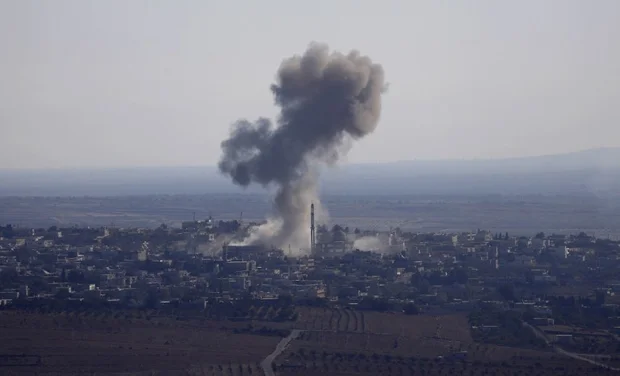
Smoke rises from the Syrian village of Jubata al-Khashab after it was bombed by a Syrian fighter jet, moments before a Syrian jet was shot down by the Israeli military over the Golan Heights.
President Barack Obama will speak from the White House Tuesday at 10 am (1400 GMT) in what officials said would be his first public remarks on US strikes in Syria.
The White House said Obama would speak before leaving for a UN General Assembly meeting in New York. The United States, supported by several Arab allies, launched strikes against Islamic State militants in Syria on Tuesday, opening a new front in the battle against the militant group.
American failure to take early, decisive action to prevent a power vacuum in Syria was a significant factor in the rise of ISIS. Such action could have been taken far earlier.
One of the main sources of U.S. reluctance to do so has been the fragmentation and radicalization of the armed Syrian opposition.
But this concern over acting in Syria mistakenly identifies the character of the opposition as the source of that fragmentation and radicalization.
The Syrian government said on Tuesday it had received a letter from US Secretary of State John Kerry delivered by the Iraqi foreign minister telling it the United States and its allies planned to attack Islamic State in Syria, reported Reuters.
"The foreign minister received a letter from his American counterpart via the Iraqi foreign minister, in which he informed him that the United States and some of its allies would target (Islamic State) in Syria," the foreign ministry said in a statement. "That was hours before the raids started."
In the statement read out on state TV, the Syrian government said it would continue to attack Islamic State in Raqqa and Deir al-Zor - areas of eastern and northern Syria that were hit in the US-led air strikes on Tuesday.
The Syrian government said coordination with the Shi'ite-led government in Baghdad was continuing at its "highest levels".