Israel-Palestine live: Israel’s response to South Africa’s genocide case at the ICJ ends

Live Updates
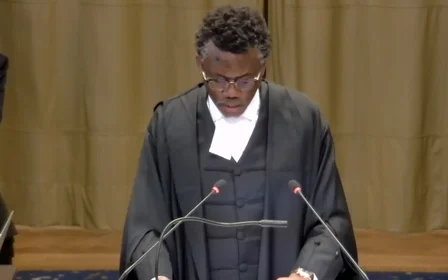
The hearing for South Africa’s genocide case against Israel has concluded for today.
ICJ president Joan Donoghue of the United States introduced South African Judge Dikgang Ernest Moseneke and Israeli Judge Aharon Barak, who will sit with the judges.
These are some of the main points the South African representatives made today:
- Vusimuzi Madonsela, South Africa’s ambassador to the Netherlands, opened the proceedings with the comments that his country “acknowledges that genocidal acts and permissions by Israel inevitably form part of a continuum of illegal acts perpetrated against the people, Palestinian people, since 1948”.
- “South Africa has recognised the ongoing Nakba of the Palestinian people through Israel’s colonisation since 1948,” added the ambassador.
- Ronald Lamola, South Africa's Justice Minister, said: “The violence and the destruction in Palestine and Israel did not begin on October 7 2023"
- “The Palestinians have experienced systematic oppression and violence for the last 76 years, on October 6 2023, and every day since October 7 2023," he added
- Adila Hassim, a lawyer representing South Africa, said: "South Africa contends that Israel has transgressed Article 2 of the convention by committing actions that fall within the definition of genocide. The actions show systematic patterns of conduct from which genocide can be inferred"
- Tembeka Ngcukaitobi, South Africa's second advocate, said: "Genocidal intent against the Palestinians in Gaza is evident from the way in which Israel’s military attack is being conducted"
- “Israel’s political leaders, military commanders and persons holding official positions have systematically and in explicit terms declared their genocidal intent," added Ngcukaitobi
- Professor John Dugard said that South Africa “watched with horror as Israel responded to the terrible atrocities committed against its people on October 7 with an attack on Gaza that resulted in the indiscriminate killing of innocent Palestinian civilians, most of whom were women and children"
- Professor Max du Plessis said: "Palestinians in Gaza, as a very substantial and important part of the Palestinian national, racial and ethnic group, simply, but profoundly, are entitled to exist"
- "Based on the materials before the court, the acts by Israel complained of are capable of being characterised as at least plausibly genocidal," added Du Plessis
- Blinne Ni Ghralaigh said: "There is an urgent need for provisional measures to protect Palestinians in Gaza from the irreparable prejudice caused by Israel’s violation of the genocide convention."
- Vaughan Lowe said the ICJ does not now “have to determine whether or not Israel has, or has not, acted contrary to its obligations under the Genocide Convention”
- Vusimuzi Madonsela made the following closing remarks on behalf of South Africa today, telling the ICJ that the court had a duty “to prevent genocide and to do so in the discharge of the international obligation that rests on South Africa and all other states under the convention”.
All of South Africa’s six representatives have now finished making their arguments.
The court will reconvene tomorrow to hear Israel’s oral arguments at 10am local time at The Hague, Netherlands.
Vusimuzi Madonsela, the last person to speak on behalf of South Africa today, told the ICJ it had a duty "to prevent genocide and to do so in the discharge of the international obligation that rests on South Africa and all other states under the convention.
“The consequences of not indicating clear and specific provisional measures and not taking steps to intervene while Israel disregards its international obligations before our eyes would, we fear, be very grave indeed," Madonsela said.
The consequences would be felt by the Palestinians in Gaza, who remain at "real risk of further genocidal acts", said the advocate.
Madonsela added that the "integrity of the [genocide] convention" was at stake and also the "reputation of this court, which is equipped with and must exercise its powers to afford an effective realisation of the rights under the convention”.
Vaughan Lowe, a new advocate representing South Africa, has just finished speaking.
Lowe said the court does not “have to determine whether or not Israel has, or has not, acted contrary to its obligations under the Genocide Convention”.
He says this can only be done “at the merits stage”.
Lowe does address why South Africa does not seek any court order against Hamas with the following comments:
- This case concerns Israel’s actions in Gaza, which is the territory that, three weeks ago, the UN Security Council stressed is “an integral part of the territory occupied in 1967” by Israel.
- As the court will understand, Hamas is not a state and cannot be a party to the Genocide Convention and cannot be a party to these proceedings.
- There are other bodies and processes that can address the questions of steps to be taken with respect to past atrocities against other actors.
- As a matter of law under the convention, South Africa cannot request an order from this court against Hamas.
Ni Ghralaigh, speaking to the ICJ, said there is a “public health disaster” unfolding in Gaza as “infectious diseases are spreading”.
She listed a number of figures illustrating her point:
- According to the World Food Programme, four out of five people in Gaza are in famine or a catastrophic type of hunger right now.
- Experts warn that deaths from starvation and disease risks are significantly outnumbering deaths from bombings.
- On average, 247 Palestinians are being killed and are at risk of being killed each day. They include 48 mothers each day, two every hour, and more than 117 children each day.
- At the current rate, which shows no sign of abating, at least three medics, two teachers, more than one UN employee and more than one journalist will be killed every day.
- Each day, an average of 629 people will be wounded. Some, multiple times over as they move from place to place, desperately seeking sanctuary.
- Each day, at least 10 Palestinian children will have one or both legs amputated … many without anaesthesia.
Blinne Ni Ghralaigh, another lawyer representing South Africa, has told the ICJ that:
- There is an urgent need for provisional measures to protect Palestinians in Gaza from the irreparable prejudice caused by Israel’s violation of the genocide convention.
- The UN secretary-general and its officials describe the situation in Gaza as ‘a crisis of humanity’, ‘a living hell’, ‘a bloodbath’, ‘a situation of utter deepening and unmatched horror where an entire population is besieged and under attack, denied access to the essentials for survival on a massive scale
- As an undersecretary general for humanitarian affairs stated last Friday, ‘Gaza has become a place of death and despair’
Du Plessis continues that UN bodies “have collectively considered the acts committed by Israel to be genocidal or at the very least warned that the Palestinian people [are] at risk of genocide”.
She also made the following points:
- Based on the materials before the court, the acts by Israel complained of are capable of being characterised as at least plausibly genocidal.
- The evidence of the specific genocidal intent is clear from the statements by Israeli government officials and soldiers towards Palestinians in Gaza and which may be characterised as at the very least plausibly genocidal. This at least plausible genocidal intent can also be deduced from the pattern of conduct against Palestinians in Gaza.
- It is also, again at the very least, plausible that Israel has failed to prevent or to punish genocide, conspiracy to commit genocide, direct and public incitement to genocide, attempted genocide and complicity in genocide.
Proceedings at the ICJ have resumed.
Professor Max du Plessis, a lawyer representing South Africa, made the following points:
- Palestinians in Gaza, as a very substantial and important part of the Palestinian national, racial and ethnic group, simply, but profoundly, are entitled to exist.
- What is happening in Gaza now is not correctly framed as a simple conflict between two parties.
- It entails, instead, destructive acts perpetrated by an occupying power, Israel, that has subjected the Palestinian people to an oppressive and prolonged violation of their rights to self-determination for more than half a century.
- Those violations occur in a world where Israel, for years, regarded itself as beyond and above the law.
Closing that segment of its presentation, South Africa’s legal team makes some final remarks, by Professor John Dugard.
“South Africa has a long history of close relations with Israel. For this reason, it did not bring the dispute immediately to the attention of the court,” he says.
“It watched with horror as Israel responded to the terrible atrocities committed against its people on October 7 with an attack on Gaza that resulted in the indiscriminate killing of innocent Palestinian civilians, most of whom were women and children," he added.
This part of the presentation became somewhat technical, revolving around the question of jurisdiction.
Dugard said that South Africa had reached out to Israel several times to stop its genocide in Gaza but received no response, resulting in a case being sent to the ICJ.
The court has adjourned for a 10-minute break and should resume shortly.
This is the Middle East Eye video that the South African legal team has used to make its case that Israel is carrying out a genocide in the Gaza Strip:
“Soldiers believe that this language and their actions are acceptable because the destruction of Palestinian life in Gaza is articulated state policy," said South Africa advocate Ngcukaitobi.
“Senior political and military officials encouraged without censure the 95-year-old Israeli Army reservist Ezra Yahin, a veteran of the Deir Yassin massacre against the Palestinians in 1948, to speak to the soldiers ahead of the ground invasion in Gaza," added Ngcukaitobi.
“In his talk, he echoed the same sentiment while being driven around in an Israeli army vehicle, dressed in Israeli army fatigue: ‘Be triumphant and finish them off and don’t leave anyone behind. Erase the memory of them. Erase them, their families, mothers and children These animals can no longer live. If you have an Arab neighbour, don’t wait, go to his home and shoot him. We want to invade, not like before. We want to enter and destroy what’s in front of us. Destroy houses, then destroy the one after it with all of our forces, complete destruction. Enter and destroy’.”
Ngcukaitobi submitted as evidence comments by Israeli Prime Minister Benjamin Netanyahu’s on October 28, 2023 urging ground troops preparing to enter Gaza to "remember what Amalek has done to you."
“This refers to the Biblical command by God to Saul for the retaliatory destruction of an entire group of people,” said Ngcukaitobi.
“The genocidal invocation to Amalek was anything by idle. It was repeated by Mr Netanyahu in a letter to the Israeli armed forces on November 3, 2023”, he added.
Tembeka Ngcukaitobi, South Africa second advocate has made the following case against Israel.
South Africa presented what it describes as evidence of the genocidal intent of the Israeli authorities:
- Genocidal intent against the Palestinians in Gaza is evident from the way in which Israel’s military attack is being conducted.
- There is also a clear pattern of conducting the targeting of family homes and civilian infrastructure, laying waste to vast areas of Gaza.
- One percent of the Palestinian population in Gaza has been systematically decimated, and one in four have been inured
- South Africa refers to Prime Minister Benjamin Netanyahu's quote, "Remember what Amalek has done to you," and plays a clip of the press conference in which he said it.
- “Israel’s political leaders, military commanders and persons holding official positions have systematically and in explicit terms declared their genocidal intent," said South Africa
- “These statements are then repeated by soldiers on the ground in Gaza as they engage in the destruction of Palestinians and the physical infrastructure of Gaza”
Adila Hassim, closes her case with the following:
All of these acts individually and collectively form a calculated pattern of conduct by Israel indicating a genocidal intent. This intent is evident from Israel’s conduct in:
"Targeting Palestinians living in Gaza using weaponry that causes large scale, homicidal destruction, as well as targeted sniping of civilians.
Designating safe zones for Palestinians to seek refuge and then bombing these.
Depriving Palestinians in Gaza of basic needs – food, water, health care, fuel, sanitation, and communications.
Destroying social infrastructure, homes, schools, mosques, churches, hospitals, and killing, seriously injuring, and leaving large numbers of children orphaned.
Genocides are never declared in advance but this court has the benefit of the past 13 weeks of evidence that shows incontrovertibly, a pattern of conduct and related intention that justifies a plausible claim of genocidal acts."
Hassim outlined key points in Israel’s second genocidal acts against Palestinians in Gaza.
- Israel’s attacks have left close to 60,000 Palestinians wounded and maimed, the majority of them women and children. This in circumstances where the healthcare system has all that collapsed.
- Large numbers of Palestinian civilians, including children, are arrested, blindfolded, forced to undress and loaded on to trucks taken to unknown locations. The suffering of the Palestinian people, physical and mental is undeniable.
- Israel has deliberately imposed conditions on Gaza that cannot sustain life and are calculated to bring about its physical destruction … by displacement.
- Israel has forced – forced – the displacement of about 85% of Palestinians in Gaza. There is nowhere safe for them to flee to.
- Israel’s first evacuation order on 13 October required the evacuation of over one million people including children, the elderly, the wounded, and infirm.
- The order itself was genocidal. It required immediate movement, taking only what could be carried while no humanitarian assistance was permitted. And fuel, water and food and other necessities of life had deliberately been cut off. It was clearly calculated to bring about the destruction of the population.