LIVE: UN overwhelmingly votes to condemn Russian invasion of Ukraine, demands withdrawal

Live Updates
The United Arab Emirates called at a meeting of the UN Security Council for an immediate de-escalation and cessation of hostilities in Ukraine, state news agency WAM said on Saturday.
Turkish band Grup Yorum has come out in support of Russia's invasion, MEE's Turkey bureau chief reports.
Zarah Sultana, a British Muslim Labour MP, said last night that she had received "a death threat… filled with racist abuse" linked to her misreported views on Ukraine.
A local BBC radio station apologised to her earlier in the week, she wrote in a Facebook post, for falsely stating she had "suggested Nato is responsible for the crisis in Ukraine".
Meanwhile, a Conservative in Coventry, where Sultana is an MP, called her an "agitator for Putin’s Russia," she wrote.
"I must make clear at this stage that these accusations have crossed the line from false to dangerous," she added.
"As an MP, it is impossible to forget that two of my colleagues have been assassinated in recent years," she continued. "As a young Muslim woman, I am acutely aware of risks to my safety. I have been open about the Islamophobic abuse and threats I regularly receive, with racist portrayals of me as a 'foreigner,' a 'traitor,' and an 'enemy' of Britain.
"I stand with the people of Ukraine."
Since Russia launched its invasion of Ukraine on Thursday, social media has been awash with videos claiming to show the latest developments on the ground.
As one of the most serious escalations in violence in recent European history, the war is playing out in real-time on digital platforms.
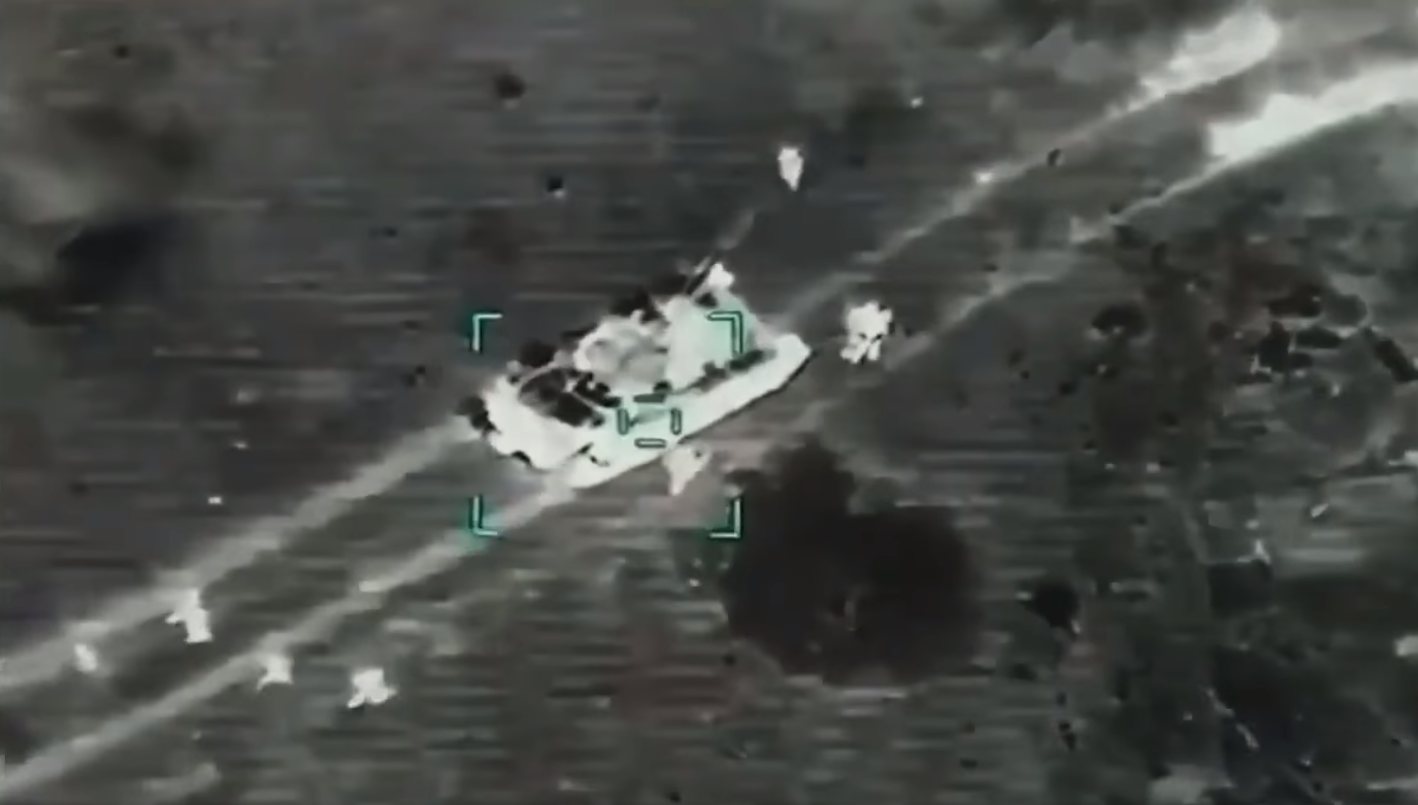
But while social media has proven to be an invaluable source of information and live updates for many, it has also been a vehicle for spreading fake material.
Much of that has involved viral content purporting to show fighting between Russia and Ukraine, but actually coming from the Middle East and North Africa (MENA) region.
Here, Middle East Eye takes a look at some of the misinformation spreading online, originating from the region:
These videos of the invasion are actually from the Middle East
Good morning. Middle East Eye will be live blogging developments in Ukraine today, with a focus on fallout across Middle East.
We awake up to a report that Russian forces have captured the southeastern Ukrainian city of Melitopol, according to Russia’s Interfax news agency, as Moscow launches coordinated cruise missile and artillery strikes on several cities, including the capital Kyiv.
Ukrainian officials were not immediately available for comment on the fate of Melitopol, a city of about 150,000 people.
If the Interfax report citing the Russian defence ministry is confirmed, it would be the first significant population centre the Russians have seized since their invasion began on Thursday.
Meanwhile, the numbers of casualties on the ground are rising. Dozens of people were wounded in overnight fighting in Kyiv. As of 6 am local time (0400 GMT), 35 people, including two children, had been wounded, city mayor Vitali Klitschko said on Saturday morning.
According to the head of the Ukrainian Health Ministry, at least 198 Ukrainians, including three children, have now been killed as a result of the Russian invasion. The official was quoted by Interfax on Saturday saying that 1,115 people were also wounded, including 33 children.
It is unclear whether the officials were referring only to civilians.
Hello MEE readers. As dark has fallen across Ukraine, larger Russian forces are continuing to bear down on Kyiv and the city is braced for a night of bombings.
After the second day of the invasion with Russian troops entering the outskirts of the capital, the global implications of the conflict are becoming more apparent.
In Turkey, which has condemned the invasion, the stock exchange fell by more than nine percent, while the Turkish lira (TRY) suffered a more than five percent loss against the US dollar.
The World Food Programme is warning that the conflict will likely increase fuel and food prices in war-torn Yemen, pushing the country further into "catastrophe" as humanitarian funding dries up.
High oil prices are also causing major concern for countries in the Middle East such as Tunisia and Syria, while the world fears potential energy shortfalls if Russia - the world's third-largest oil producer - decides to turn off the taps.
Social media, while serving as a vital tool for information gathering and sharing, has also shown again how it can be a vehicle for spreading fake material. MEE took a look at viral content purporting to show fighting between Russia and Ukraine, but it was actually from the Middle East and North Africa (MENA) region.
That's it from us here at MEE this evening, make sure to follow us on Twitter @MiddleEastEye and on Instagram @middleeasteye to stay updated.
Ukrainian President Volodymyr Zelensky has requested to Israeli Prime Minister Naftali Bennett that Israel serve as a mediator with Russia to help resolve the military conflict between the two countries.
According to a report by Kan News, Zelensky told Bennett: "We want the negotiations to take place in Jerusalem. We think that Israel is the country that could hold such negotiations in the middle of the war."
Ukraine's ambassador to Israel, Yevgen Korniychuk, confirmed the news to The New York Times, saying: "Israel is the only democratic state in the world that has great relations with both Ukraine and Russia".
He added, however, that Bennett did not give an immediate answer.
"They are trying to figure out where they are in this chess play."
According to a readout from Bennett's office earlier on Friday, he offered humanitarian assistance to Ukraine and told Zelensky that he hopes the war will end soon.
The statement from his office did not include any condemnation of Russian actions, nor did it mention Russia by name.
Turkey's foreign minister said Ankara cannot stop the passage of warships through its straits leading to the Black Sea as Ukraine has requested, referring to a clause in the Montreux Convention that allows vessels to return to their home base.
Ukraine appealed to Turkey to stop Russian warships from passing through the Dardanelles and Bosphorus straits, but Mevlut Cavusoglu said that Turkey is limited in its ability to do so.
"In the case of a war where Turkey is not a party, there are measures that can be taken regarding the countries that are parties in the war," he told the Turkish Hurriyet newspaper.
"If there is a demand for the ships of the warring countries to return to their bases, then it must be allowed," he said, referring to Russian ships.
Cavusoglu referenced a clause in the Montreux Convention, signed in 1936, an agreement that gives Turkey control over the passage of vessels through the Dardanelles and Bosphorus straits.
Warships can navigate through the straits during peacetime, but under conditions that restrict aggregate tonnage and the calibre of weapons depending on whether they are a Black Sea country - Turkey, Russia, Ukraine, Georgia or Romania.
"What we are witnessing today is the unravelling of nothing less than three decades of US policy over the world's economic and military affairs," says MEE Editor-in-Chief David Hearst.
Hearst, who was a correspondent in Russia, Europe, and Belfast, speaks about Vladimir Putin, Moscow's invasion of Ukraine, and the start of a "new world order".
Watch the full video here, and make sure to subscribe to MEE's Youtube channel for more videos.
For the 1.2 million Israeli citizens who speak Russian, the war in Ukraine is not just a political or moral issue. It's personal.
Throw in connections by marriage between Israelis and newcomers from the former Soviet bloc and this is a war that resonates like no other conflict.
MEE spoke with several Israelis whose origins go back to Russia, Ukraine, and the former Soviet Union.
“My homeland is being bombed … By some twist in history, it could have been me there. I feel physical pain. My heart is with Ukraine, but also with Russia where my brother lives," said Alex Rif, a 36-year-old poet and social activist.
“I got plenty of messages from Israelis expressing sympathy and solidarity; many volunteer to help in hosting immigrants from Ukraine, when they come.
“I also get messages condemning us for siding with Ukraine.”
For Israel's one-million Russian speakers war in Ukraine is painful and personal
The Organization of Arab Petroleum Exporting Countries (OAPEC) said in a statement on Friday that it "affirms keenness" of Arab countries to export natural gas and "ensure the stability of global markets".
OAPEC noted that in January the group exported "more than 10 million tonnes of liquefied natural gas to meet about 29 percent of global demand", which it said was the highest monthly output of gas achieved by the coalition in history.
Natural gas prices have soared in recent days amid Russia's invasion of Ukraine, and Europe continues to fear that supply disruptions from Moscow could create an energy crisis in the continent.
Russia is the world's second-largest natural gas producer and supplies roughly a third of Europe's gas imports.
OAPEC noted, however, that despite the ongoing fears, Russian gas is continuing to be pumped into Europe via Ukraine without interruption.
Qatar, one of the largest natural gas producers in the world, said earlier this week that no single country could replace Russia as Europe's natural gas supplier.
Ukrainian President Volodymyr Zelensky released a self-shot video from central Kyiv on Friday vowing alongside key aides to stay and defend the capital against the Russian invasion.
"We're all here. Our military is here. Citizens in society are here. We're all here defending our independence, our country, and it will stay this way," Zelensky said standing outside the presidency building.
Wearing olive green military-style clothing and standing with his prime minister, chief of staff and other senior aides, Zelensky appeared to be responding to pressure from Russia's President Vladimir Putin.
Russian troops clashed briefly with Ukrainian forces for the first time within Kyiv itself on Friday.
Larger forces are bearing down on the capital and the city was braced for a possible night of air strikes.
Meanwhile, in a televised address from Moscow, Putin branded Zelensky's government "terrorists" and "a gang of drug addicts and neo-Nazis", urging the Ukrainian military to mutiny.
Russia's foreign ministry has said that Foreign Minister Sergei Lavrov is set to meet with UAE Minister of Foreign Affairs Abdullah Bin Zayed in Moscow on 28 February, despite the situation in eastern Europe.
In a tweet on Friday, the ministry would "focus on further expanding multifaceted" relations between the two countries.
Russia's media regulator said it was limiting access to Facebook, accusing the US tech giant of censorship and of violating the rights of Russians.
"In accordance with a decision from the General Prosecutor with regard to the social network Facebook, from February 25, Roskomnadzor is adopting measures to partially restrict access," to Facebook, media regulator Roskomnadzor said in a statement on Friday.
Turkey's economy has been taking a beating in recent years, it's fair to say.
The Ukraine-Russia conflict is likely to be a further blow to the country's finances, wiping out whatever small recovery had been made.
MEE spoke to many Turks who fear this is just the beginning of more woes:
There are many causes for concern: the closure of airspace in Ukraine, the fear that Turkey will not maintain its neutral stance in this conflict, as well as the memories of 2015, when Turkey downed a Russian jet for allegedly violating Turkish airspace, triggering a political and economic crisis with Russia.
“This war will be a huge blow to us,” Nizamoglu said, fearing that Russian state employees were now no longer allowed to leave their country.
But it's not just the tourism sector in Turkey that will be stung by the fallout of the war.
On Thursday, Turkey’s trading markets woke up with a shock as Russia launched a full-scale invasion of Ukraine. The stock exchange fell by more than nine percent, while the Turkish lira (TRY) suffered a more than five percent loss against the US dollar.
This agitation in the markets came at a time when Turkey had been struggling to stabilise the lira and prevent inflation hikes through the introduction of several economic measures, tax reductions and state subventions.
Turkey: How Russia-Ukraine war could set back recent economic gains