
Abu Hamza aide given 20 years on US terror charges

A Briton convicted over an alleged attempt to set up a militant training camp in the US on orders from preacher Abu Hamza was sentenced to 20 years in prison on Friday in New York.
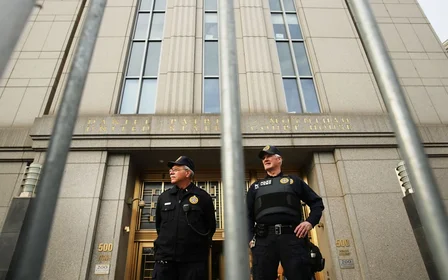
Haroon Aswat, who suffers from paranoid schizophrenia, cut a despondent figure in the Manhattan federal court, dressed in a faded prison shirt and wearing his long dark hair plaited in braids.
The 41-year-old has already spent 11 years in custody, meaning that he could qualify for early release in six years. His lawyer said he would apply for Aswat to serve out his sentence in Britain.
First arrested in Zambia in 2005, Aswat was extradited last year to the United States, where he pleaded guilty in March to one count of providing material support to al-Qaeda and one count of conspiring to support the group.
In a press release published on the official blog of the US Federal Bureau of Investigations, US attorney Preet Bharara said: “Haroon Aswat, with his co-conspirators, sought to establish a terrorist training camp on American soil, and traveled to Afghanistan to receive training from Al-Qaeda."
New MEE newsletter: Jerusalem Dispatch
Sign up to get the latest insights and analysis on Israel-Palestine, alongside Turkey Unpacked and other MEE newsletters
"Aswat’s conviction and the sentence imposed today - along with the other recent terrorism prosecutions by this office, including of Sulaiman Abu Ghayth, Abu Hamza, and Khaled al Fawwaz - serve as further proof that justice in international terrorism cases continues to be delivered in American civilian courts.”
In a brief statement, Aswat apologised for breaking US law and causing "distress" to friends and family, and said he looked forward to finding a wife and settling down.
He said he opposed violence against innocent people and recited a prayer learnt in childhood, opening his statement in Arabic in the name of God and closing with a simple "amen".
In 1999-2000, Aswat spent about two months in Seattle and Bly, Oregon at the behest of the London cleric Abu Hamza as part of a plot to set up a training camp for recruits wanting to fight in Afghanistan.
Following his return to London, he traveled to Afghanistan and Pakistan in mid-2001 in order to attend a training camp.
Prosecutors depicted Aswat as a man "at the right-hand of Abu Hamza" with a thirst for violence who kept "a host of disturbing literature" on his computer.
Aswat came to the United States "at the direction of one of the world's most dangerous terrorist leaders" and could pose a danger when he is released, prosecutors argued on Friday.
'Minimal role'
Aswat was previously held at Broadmoor, a high-security British psychiatric hospital.
His lawyer Peter Quijano told the court his client never tried to join al-Qaeda, describing him as a "child-like" individual who embraced a "hippy lifestyle" and "self-medicated" with marijuana.
After the 9/11 attacks and the US-led invasion of Afghanistan, Aswat fled to South Africa, where he had family, and embarked on a life as an itinerant salesman of pirated CDs of Islamic chants and prayer, said the defence lawyer.
Quijano told reporters he would request his client's transfer to Britain, where Aswat's parents are based.
US District Judge Katherine Forrest said it was "of the greatest importance" that he receive specialist psychiatric care and that the court would support him serving out his sentence in Britain.
The defence called for Aswat's immediate release given that he has already spent a quarter of his life in prison.
Quijano said Aswat was held at least three times in isolation in the United States, despite promises to the contrary, including one five-day period in which he did not receive medication.
Aswat's lawyer told the court his client never aligned himself with violence but had "felt sorry" for the one-armed Abu Hamza, becoming his assistant "doing day-to-day chores".
Quijano called the Bly plot "pathetic and laughable" and said all his client had done was teach Islam, Arabic and the Koran.
"What did he do there? It was minimal," he said.
American government officials say Aswat was included on a list of people associated with al-Qaeda recovered from a safe house used by 9/11 plotter Khalid Sheikh Mohammed in Pakistan.
Forrest sentenced Abu Hamza to life behind bars in January for the fatal kidnapping of Western tourists in Yemen and on a slew of terror charges, calling him "evil" and his crimes "barbaric".
Middle East Eye delivers independent and unrivalled coverage and analysis of the Middle East, North Africa and beyond. To learn more about republishing this content and the associated fees, please fill out this form. More about MEE can be found here.