
Aleppo civilians return to streets as short ceasefire takes hold

A 48-hour ceasefire took hold on Thursday in Syria's battered city of Aleppo after President Bashar al-Assad's government and rebel forces gave in to mounting diplomatic pressure.
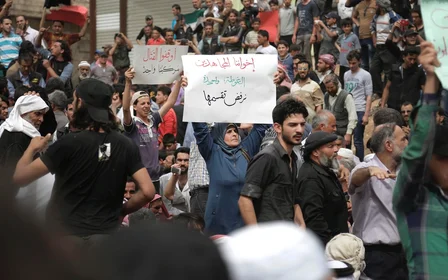
Civilians returned to the streets after two weeks of heavy fighting.
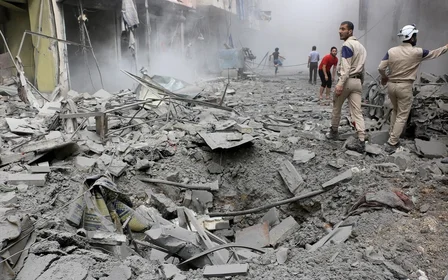
Shopkeepers reopened their doors while fruit and vegetable markets - one of which was struck in a 24 April raid that left 12 dead - were again up and running.
The Syrian army said late on Wednesday that it had agreed to calls from Russia and the United States for a two-day truce that would begin at 1am local time on Thursday.
The agreement followed an intense diplomatic push by Moscow and Washington - the co-sponsors of a 27 February ceasefire agreement that had begun to fall apart - to salvage peace efforts.
New MEE newsletter: Jerusalem Dispatch
Sign up to get the latest insights and analysis on Israel-Palestine, alongside Turkey Unpacked and other MEE newsletters
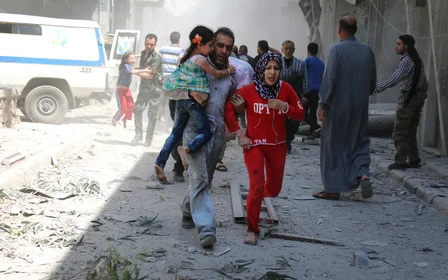
More than 280 civilians were reported killed since 22 April in the clashes in Aleppo.
Early on Thursday, an AFP correspondent in the city said there had been no signs of fresh attacks since the ceasefire took effect.
US and Russia monitoring
After a whirlwind of talks involving diplomats from world powers and the UN, US Secretary of State John Kerry announced the truce had taken effect and that violence had already fallen off.
"We've seen an overall decrease in violence in those areas even though there are some reports of continued fighting in some locations," Kerry said.
Kerry said US officials in Geneva were coordinating with their Russian colleagues on "enhanced monitoring efforts for this renewed cessation".
The Russian defence ministry said its ceasefire monitors had agreed with their US counterparts to oversee this truce until midnight on 6 May.
In Aleppo, the head of the local branch of the powerful Jaish al-Islam rebel force, Ahmad Sanada, said the group would respect the ceasefire.
"We are in favour of any initiative that relieves the suffering of civilians and avoids bloodshed and we will respect" the ceasefire, he told AFP.
Twin bombings kill 10
Attacks continued elsewhere in Syria, however. On Thursday, twin bombings in central Syria killed at least 10 civilians and wounded 40 more, activists said, amid recent fighting in the area between Islamic State (IS) fighters and government troops.
State television reported that at least six people were killed and 28 seriously wounded in the suicide attack and car bombing in a square in Mukharram al-Fawqani in Homs province.
The area, controlled by the government, is located between the cities of Homs and Palmyra, which was recaptured by the Syrian army from IS last month.
The blasts came just days after IS seized the nearby Shaer gas field, one of the biggest in Homs, in an attack that killed at least 16 government troops.
There was no immediate claim of responsibility for Thursday's attacks, but suicide and car bombings are a favourite tactic of IS fighters.
Western powers are hoping that ending the fighting in other parts of Syria will help focus efforts against IS, which a US-led coalition has been targeting with air strikes in Syria and Iraq since mid-2014.
Syrian officials have insisted they are targeting rebels in Aleppo not covered by the ceasefire, in particular members of al-Qaeda's affiliate, the Nusra Front, which is fighting in the city alongside other rebel groups. However, the vast majority of reported deaths in the city since the breakdown of the truce have been civilians.
At an emergency meeting of the UN Security Council on Aleppo Wednesday, Syria's Deputy UN Ambassador Mounzer Mounzer defended the government's actions in the city.
"What the Syrian government has been doing in the city of Aleppo is merely the fulfilment of its obligations to protect its citizens from terrorism," he told the council.
Middle East Eye delivers independent and unrivalled coverage and analysis of the Middle East, North Africa and beyond. To learn more about republishing this content and the associated fees, please fill out this form. More about MEE can be found here.