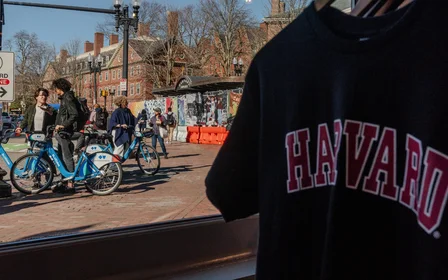
'Are they troublemakers?': Trump questions why Harvard has so many international students

US President Donald Trump is demanding to see the "lists" of students enrolled at the prestigious Harvard University in Cambridge, Massachusetts, after he said he learned that nearly one-third of those studying there are international students.
"Harvard has to show us their lists. They have foreign students. About 31 percent of their students are foreign-based. Almost 31 percent. We want to know where those students come [from]. Are they troublemakers?" he told reporters at the White House on Wednesday.
Harvard maintains that only one quarter of its student body comes from abroad.
"If somebody is coming from a certain country and they're 100 percent fine - which I hope most of them are, but many of them won't be - you're [also] going to see some very radical people," he added.
Harvard, he claimed, is "taking people from areas of the world that are very radicalised, and we don't want them making trouble in our country."
New MEE newsletter: Jerusalem Dispatch
Sign up to get the latest insights and analysis on Israel-Palestine, alongside Turkey Unpacked and other MEE newsletters
The New York Times reported this week that the administration is poised to cut all remaining federal contracts with Harvard, which are estimated to be worth an estimated $100m.
The two sides have been in a legal war for months now after the university refused to submit to the administration's demands to produce the names and statuses of all its non-American students.
The move came as the State Department and the Department of Homeland Security began cracking down on any pro-Palestinian sentiment expressed by student visa holders in the US, especially after the nationwide campus protests in 2024 for Gaza.
'I want to make sure that the foreign students are people that can love our country. We don't want to see shopping centres exploding'
- Donald Trump
Harvard did not acquiesce and was hit with a freeze of $2.3bn in federal funding in April, which represents 35.9 percent of Harvard's $6.4bn operating expenses. In response, the university sued the administration.
The US Department of Health and Human Services then said that it was terminating $60m in federal grants to the university for failing to address antisemitic harassment and ethnic discrimination on campus.
"I think they should have a cap of maybe around 15 percent, not 31 percent," Trump said on Thursday. "We have people [who] want to go to Harvard and other schools [and] they can't get in because we have foreign students there."
"I want to make sure that the foreign students are people that can love our country. We don't want to see shopping centres exploding," he added.
Last week, Harvard sued the Trump administration in federal court in Boston, Massachusetts, after its ability to enrol foreign students was revoked. Within hours, a federal judge ruled in Harvard's favour.
“Harvard has got to behave themselves. Harvard is treating our country with great disrespect, and all they're doing is getting in deeper and deeper and deeper," Trump said.
More visa restrictions
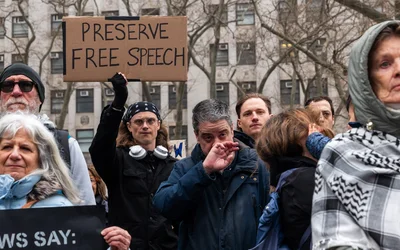
While Harvard argues that the administration is clamping down on free speech protections, Secretary of State Marco Rubio on Wednesday said he was defending those protections by issuing new visa restrictions on "foreign nationals who are responsible for censorship of protected expression in the United States".
"Even as we take action to reject censorship at home, we see troubling instances of foreign governments and foreign officials picking up the slack," he said in a statement.
"In some instances, foreign officials have taken flagrant censorship actions against US tech companies and US citizens and residents when they have no authority to do so."
The decision appears to stem from a feud between Brazilian Supreme Court judge Alexandre de Moraes and Trump confidante and CEO of social media platform X, Elon Musk. In a hearing before lawmakers last week, Rubio said he was reviewing possible sanctions against the judge.
Moraes had demanded that social media accounts spreading disinformation related to Brazil's far-right former president, Jair Bolsonaro, be suspended on platforms like X and Rumble, a far-right video platform, or else the sites themselves would be blocked entirely.
"It is unacceptable for foreign officials to issue or threaten arrest warrants on US citizens or US residents for social media posts on American platforms while physically present on US soil," Rubio said on Thursday.
"It is similarly unacceptable for foreign officials to demand that American tech platforms adopt global content moderation policies or engage in censorship activity that reaches beyond their authority and into the United States. We will not tolerate encroachments upon American sovereignty," he wrote.
Meanwhile, the Trump administration on Tuesday ordered a temporary suspension of foreign and exchange student visa appointments at its missions worldwide.
This directive, detailed in an internal cable reviewed by Reuters and other news outlets, coincides with the State Department's preparations to enhance what it calls "social media vetting" of foreign students.
Rubio communicated in the cable that revised guidelines on social media assessment for these visa categories are expected following a comprehensive review, advising consular sections to defer new appointments.
All appointments already made will be honoured, while available appointments will be cancelled.
"The Department is conducting a review of existing operations and processes for screening and vetting of student and exchange visitor (F, M, J) visa applicants, and based on that review, plans to issue guidance on expanded social media vetting for all such applicants," the cable said.
Middle East Eye delivers independent and unrivalled coverage and analysis of the Middle East, North Africa and beyond. To learn more about republishing this content and the associated fees, please fill out this form. More about MEE can be found here.