Azerbaijan accuses Turkey of stoking tensions over headscarf ban

Azerbaijan's ruling party directly accused Turkey of stoking "artificial tensions” on Tuesday between the two countries over a headscarf ban imposed in Azerbaijani primary and high schools this week.
The New Azerbaijan Party, led by President Ilham Aliyev, singled out Turkish chief presidential adviser Oktay Saral and other officials from Turkey's ruling Justice and Development Party (AKP), who had opposed the ban in social media posts.
The party said Turkish media outlets close to the AKP government were publishing reports about Azerbaijan that were "contrary to the facts" and warned that relations between the two countries could suffer.
Saral said on Monday that denying students wearing headscarves access to education in Azerbaijan was unacceptable and called on Baku to reverse the practice.
His comments came after footage of Azerbaijani students crying and protesting outside schools went viral on Turkish social media, putting pressure on Ankara to criticise the decision.
New MEE newsletter: Jerusalem Dispatch
Sign up to get the latest insights and analysis on Israel-Palestine, alongside Turkey Unpacked and other MEE newsletters
New dress code regulations for schools in Azerbaijan were adopted for students on 21 September and for teachers on 6 October.
Baku arrested at least 37 people for protesting against the headscarf ban on Monday, accusing them of violating public order. The government also reportedly throttled the internet the same day, cutting access to social media platforms such as X, TikTok and Instagram.
“I have my hijab on, but they are not letting me study.” Protests have erupted in Azerbaijan on Monday after some schools have prevented female teachers and students wearing the hijab from entering schools after an informal ban https://t.co/iEEwF0Qqlc
— Middle East Eye (@MiddleEastEye) October 13, 2026
Ankara has refrained from officially commenting on the issue despite Aliyev's strongly worded rebuke of Turkey last week.
That rebuke followed Baku's assessment that social media commentary targeting Azerbaijan was part of a government-backed campaign.
Saral is known for expressing personal opinions on a range of subjects on social media. His intervention nevertheless prompted Azerbaijan's ruling party to issue a lengthy statement addressing several points of contention in bilateral relations.
Azerbaijan-Israel ties face backlash
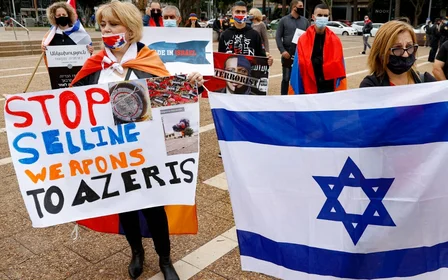
Beyond the headscarf issue, many Turkish users on X have criticised Azerbaijan's close relationship with Israel.
Azerbaijan's decision not to leave the UN hall during Israeli Prime Minister Benjamin Netanyahu’s address last month triggered a wave of negative commentary about Baku.
Demonstrations in Azerbaijan against the headscarf ban in the schools on Monday as internet access has been partially restricted in the country https://t.co/BjwneCM22Y
— Ragıp Soylu (@ragipsoylu) October 12, 2026
The party said Azerbaijan's relationship with Israel was based on international law and mutual interests. It also reiterated its support for the Palestinian people, noting that Baku had provided financial and humanitarian assistance to Palestine.
"The operations of the Embassy of the State of Palestine in Azerbaijan are also sustained through financial support from the Azerbaijani state," the statement said.
It added that Aliyev had repeatedly backed a two-state solution, with East Jerusalem as the capital of the State of Palestine.
Responding to criticism of the headscarf ban, the party said no state in the Islamic world had the right to dictate its will to other Muslim peoples, interfere in their internal affairs or regard itself as superior.
In what was widely seen as a jab at Turkish President Recep Tayyip Erdogan, the party added that any claim to serve the unity of the Muslim world must be substantiated through cooperation on an equal footing and mutual respect, "rather than hegemonic tendencies".
Addressing the ban directly, the party said Azerbaijan was constitutionally a secular state.
"We believe that using sensitive issues such as head coverings as instruments of political manipulation and division serves neither the unity of the Turkish people nor the solidarity of the Muslim world as a whole," the statement read.
"Using issues of this kind as a means of political pressure against Azerbaijan is particularly unacceptable. We call on the AKP government to refrain from this harmful policy."
Azerbaycan’da tesettürlü bir kız öğrenci, arkadaşlarının yanında gözyaşları içerisinde sınıftan çıkarıldı. Hem kız öğrenci hem de arkadaşları gözyaşlarını tutamadı. https://t.co/I1qtDTygP2
— Odak TV (@OdakTV1) October 12, 2026
Translation: In Azerbaijan, a veiled female student was removed from the classroom in tears in front of her friends. Both the student and her friends could not hold back their tears.
One nation, two states
Turkey and Azerbaijan share close linguistic, ethnic and cultural ties.
Turkey was Azerbaijan's leading backer during the second Nagorno-Karabakh war in 2020, providing drones, arms and ammunition, as well as deploying F-16s and special forces to help Baku win the war.
The party's statement recalled the principle of "One nation, two states," coined by the late Azerbaijani president Heydar Aliyev, but stressed that it did not erase the distinction between the two sovereign countries.
"It refers precisely to one nation and two independent states," the statement said. "Under no circumstances does this principle provide grounds for one state to interfere in the internal affairs of the other or impose its own political and ideological approaches upon it."
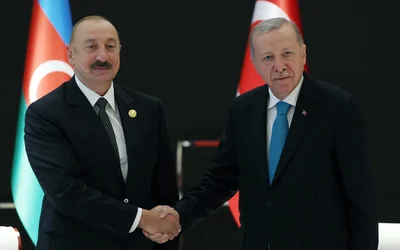
The party warned that further irresponsible statements by Turkish officials could damage bilateral ties.
A senior Turkish official told MEE last week, following Aliyev's remarks, that Ankara had no intention of interfering in Azerbaijan's domestic affairs and that no official statement suggested otherwise.
"We believe this is a misunderstanding," the official said at the time, adding that Ankara had conveyed this message at the highest levels to reassure Baku.
Multiple Turkish officials said Ankara would not respond to the indirect criticism and would instead seek to ease tensions.
The senior official described Azerbaijan as a "kin country," highlighting the strategic energy, transport and military investments the two states had jointly developed and implemented.
The official played down the spat as inconsequential and said further engagement would ease tensions, as it had in the past.
Middle East Eye delivers independent and unrivalled coverage and analysis of the Middle East, North Africa and beyond. To learn more about republishing this content and the associated fees, please fill out this form. More about MEE can be found here.