British Arabs urge UK government to impose binding restrictions on Israeli settlements

Dozens of prominent British Arabs have called on the UK government to move beyond condemning illegal Israeli settlements and put legally binding rules in place to stop British economic activity from supporting their expansion.
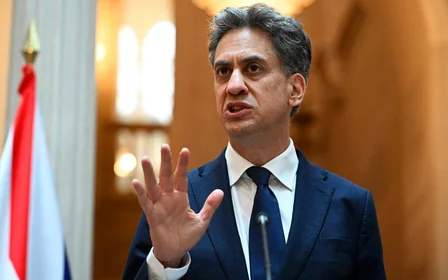
In a joint letter to Foreign Secretary Ed Miliband, dated 24 August, the signatories call on the government to act on the obligations it already recognises, "particularly the duties of non-recognition, non-assistance and differentiation between Israel and the Palestinian territory occupied since 1967."
The real question is no longer whether the Israeli settlements are unlawful, the letter says.
Rather, it is whether the UK's present combination of “voluntary guidance, tariff differentiation and targeted sanctions is sufficient in practice” to meet the country's legal obligations, including the duty identified by the ICJ to prevent trade or investment that helps sustain the settlements.
The letter calls on UK ministers to use the powers already available, together with other countries, to immediately stop British money or business from helping Israeli settlements grow.
New MEE newsletter: Jerusalem Dispatch
Sign up to get the latest insights and analysis on Israel-Palestine, alongside Turkey Unpacked and other MEE newsletters
The signatories include prominent figures from the British-Arab world such as Adnan Hmidan, chairman of the Palestinian Forum in Britain; Sabah Almukhtar, president of the Arab Lawyers Association in the UK; Dr Omar Abdel-Mannan, president of Health Workers 4 Palestine; Feda Shahin, secretary general of the Palestine Solidarity Movement; and many others from various sectors.
Mechanism to stop settler violence
Among the measures requested in the letter are binding restrictions on UK economic activity that benefits settlements, extending sanctions to individuals as well as companies, applying full differentiation across government procurement and public dealings, and working with international partners to prevent circumvention via third-country structures.
The letter notes that the Sanctions and Anti-Money Laundering Act 2018 already gives the government a domestic legal basis for such measures.
It also points to the UK's 2016 vote in favour of a UN Security Council resolution which found Israeli settlements to have "no legal validity", and to the ICJ's advisory opinion of July 2024, which ruled Israel's presence in the occupied territories unlawful and said all settlement activity must stop immediately.
Alongside the economic measures, the letter calls on the government to work with international partners to establish a mechanism to protect Palestinian civilians from settler violence, citing a 1994 UN resolution the UK itself co-sponsored.
Such a mechanism would include independent monitoring, documentation of violence and displacement, and protection for communities most at risk, the letter says.
"This is not a request for hostility towards Israel or Israeli citizens, nor for indiscriminate restrictions on lawful trade with Israel," it adds.
"Britain's commitment to the international rule of law should be demonstrated not only through statements of principle, but through consistent and effective implementation."
The joint letter remains open for additional signatures.
The UK government said earlier this month that it will announce new measures against Israel over new settlement construction that could split the occupied West Bank in two, thus threatening a two-state solution.
Foreign Secretary Ed Miliband criticised the E1 settlement plan, saying it poses a threat to a two-state solution and that he had told Israel to stop all settlement expansion.
He said Britain would set out broader measures in the coming weeks.
Middle East Eye delivers independent and unrivalled coverage and analysis of the Middle East, North Africa and beyond. To learn more about republishing this content and the associated fees, please fill out this form. More about MEE can be found here.