
Colombia summit: What's next for The Hague Group?

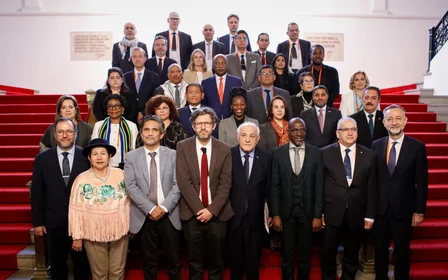
The two-day emergency summit of The Hague Group in Bogota concluded on Wednesday, culminating in a joint declaration by states demanding international sanctions against Israel and legal accountability for what participants described as "grave violations of international law" in Gaza.
This gathering, bringing together representatives from more than 30 countries across Latin America, Africa, Asia, Europe, and the Middle East, marks the most coordinated diplomatic effort yet by a coalition of states opposing Israel’s ongoing military onslaught in Gaza.
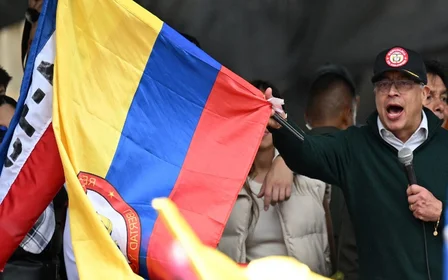
"We came to Bogota to make history - and we did," said Colombian President Gustavo Petro. "Together, we have begun the work of ending the era of impunity. These measures show that we will no longer allow international law to be treated as optional, or Palestinian life as disposable."
In their final declaration, 12 states specifically pledged to adopt a series of concrete measures aimed at increasing international pressure on Israel.
These actions include suspending military exports to Israel, refusing the transit of Israeli weapons through their ports and airspace, reviewing all public contracts to prevent state institutions and pension funds from supporting Israeli companies or the occupation of Palestinian territories, and actively supporting universal jurisdiction cases and International Criminal Court (ICC) warrants to pursue accountability for alleged war crimes.
New MEE newsletter: Jerusalem Dispatch
Sign up to get the latest insights and analysis on Israel-Palestine, alongside Turkey Unpacked and other MEE newsletters
"There were concrete commitments from the delegates of the states that are here, and the most important thing is that we were able to demonstrate that we can move from speeches, which are very important (...) to urgent actions, and I believe the success of the conference lies in that," Mauricio Jaramillo Jassir, Colombia's vice minister of multilateral affairs, told Middle East Eye.
Among the countries represented, approximately one-third of the attending nations formally endorsed the final declaration: Bolivia; Cuba; Colombia; Indonesia; Iraq; Libya; Malaysia; Namibia; Nicaragua; Oman; Saint Vincent and the Grenadines; and South Africa.
Proponents of this initiative indicated that the joint statement will remain open until 28 September, allowing more countries to endorse the declaration in the coming weeks.
Zane Dangor, South Africa’s representative, described the event as "very successful", noting that some countries need to review the declaration internally before formally adhering.
"In the room, they were very supportive of the spirit and the intention of the statement. Now some of them have to go back to capitals and take confirmation, and that's long in the diplomatic practice," the country's Department of International Relations and Cooperation director general told MEE.
'What we now need is a multilateral implementation strategy'
- Fillemon Wise Immanuel, Namibia's Minister of Justice
Palestinian ambassador to the United Nations, Riyad Mansour, urged other states to follow suit, calling on world leaders who will meet to discuss a two-state solution to the Israeli-Palestinian conflict in New York at the end of the month to "commit to carrying out actions to force Israel to comply" with international law.
"It is a significant moment in history beginning the process of action-oriented commitment by states in their national capacity, so that this is a spark that hopefully will be followed by tens of other countries to commit," he told MEE.
The UN special rapporteur on Palestine, Francesca Albanese, hailed the summit as a turning point in the global response to the war, urging other states to replicate the measures outlined in the Bogota declaration.
Questions about compliance
Despite the bold rhetoric, questions remain about the practical enforceability of these measures and the willingness of all signatory countries to follow through amidst potential political and economic constraints at home.
Several states around the world have already taken unilateral measures, such as halting arms exports to Israel or blocking weapons shipments at their ports.
Countries including Canada, Spain, Italy, and Japan have suspended arms sales to Israel. In May 2024, Spain further banned any ship carrying weapons to Israel from docking at its ports, and Colombia severed diplomatic relations with Israel last year, also suspending coal exports to Israeli power plants.
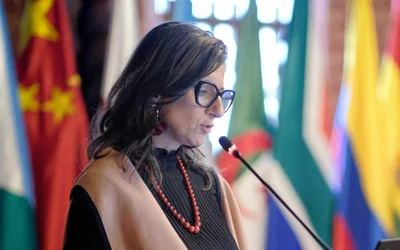
"What we now need is a multilateral implementation strategy to make sure that there's proper coordination and there is a collective voice toward implementations of those interventions that we have identified," Fillemon Wise Immanuel, Namibia's minister of justice and labour relations, told MEE at the closing press conference.
However, the conference also underscored fragmented international consensus.
Despite organisers expressing pleasant surprise at the overall turnout, key global powers from Europe notably remained absent from The Hague Group's core initiative.
At a press conference following the opening speeches on Tuesday, Albanese sharply criticised the European Union's concurrent failure to reach a consensus on imposing new sanctions against Israel.
"It is clear the EU, for whatever reasons - be it affinity with Israel and its ideology, political convenience, or other interests including those of companies, as Europe is a huge trade partner of Israel, is putting the right to life of millions of people to the side," Albanese said.
What next?
The Hague Group plans to reconvene in the future to evaluate the implementation of these commitments and explore additional diplomatic and economic measures.
Its overarching message intends to keep the Gaza crisis at the top of the international agenda and to "reduce Israel's military scope of action as soon as possible", Vice Minister Jaramillo explained.
"The '48 Genocide Convention obliges us not to provide anything, nothing, to the perpetrators of a genocide," Jaramillo added. "This is not a conference against Israel. It is a conference against the genocide in Palestine."
The Hague Group is a bloc of eight founding states, launched on 31 January in the eponymous Dutch city, with the stated goal of holding Israel accountable under international law.
Middle East Eye delivers independent and unrivalled coverage and analysis of the Middle East, North Africa and beyond. To learn more about republishing this content and the associated fees, please fill out this form. More about MEE can be found here.