‘De facto annexation’: Israel to shift civilian enforcement in West Bank from army to police

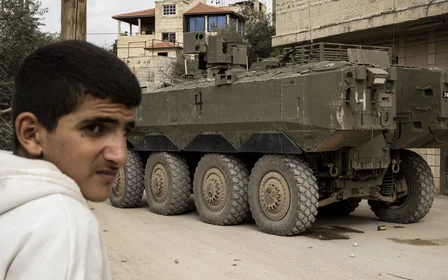
Israel is preparing to replace the army in the West Bank with civilian police forces, in a move seen as further advancing the annexation of the occupied Palestinian territory.
Defence Minister Israel Katz said on Friday that he had instructed the military to draft a plan to transfer enforcement powers for civilian matters in the occupied West Bank from the army to the police.
Under the plan, the police would “establish an appropriate force to handle and address civilian matters”, while the military would focus solely on “Palestinian terrorism” and protecting borders and communities, according to Katz’s office.
Katz said it was appropriate for the police to oversee civilian affairs in the West Bank, arguing that the force performs that role “in every other place in the State of Israel”.
The announcement was not coordinated with either the military or the police. However, Israel Hayom reported on Friday that the army welcomed the move and had been pushing for it for weeks.
New MEE newsletter: Jerusalem Dispatch
Sign up to get the latest insights and analysis on Israel-Palestine, alongside Turkey Unpacked and other MEE newsletters
The report also said National Security Minister Itamar Ben Gvir, who oversees the police, had not been informed that the statement was being issued.
Ben Gvir has yet to comment on the plan, but other settler leaders welcomed the announcement.
Israel Ganz, head of the Regional Binyamin Council in the West Bank, said Katz’s statement should be followed by the cancellation of the Oslo Accords and the imposition of “full Israeli sovereignty” over the occupied territory.
“The time has come to move from temporary management to the full application of Israeli law,” Ganz said.
Request by the army
According to Israeli news site Ynet, Friday’s announcement follows a request by army chief Eyal Zamir to reduce the military’s workload in the West Bank.
Two weeks ago, Zamir told the Israeli cabinet that the army’s responsibilities in the Palestinian territory were continuing to expand, as “new settlements will soon be established”.
“It’s untenable for IDF [Israeli army] soldiers to be chasing after a handful of people who are giving settlements a bad name,” Zamir reportedly told ministers, referring to settlers accused of terrorising Palestinian communities.
Zamir said the army was “working in cooperation with the police”, but that it was appropriate for the Israeli army to stop handling such tasks.

A military spokesperson told Ynet on Friday that the army was conducting “internal and preliminary staff-level work” on the issue to examine “the division of authorities between the security bodies” in the West Bank.
Katz’s statement referred to the entire West Bank, without distinguishing between Areas A and B, where the Palestinian Authority handles civilian affairs, and Area C, where Israel exercises civilian authority under the Oslo Accords.
Israel has never formally annexed the West Bank, which has been under Israeli military occupation since 1967.
However, the Israeli government has taken a series of steps over the past year that experts say amount to de facto annexation.
These include expanding the role of civilian bodies in administering the West Bank while reducing the military’s role in areas traditionally under its control.
Under Israeli and international law, the military is the occupying authority in the West Bank and holds enforcement powers there, including over civilian affairs.
Rise in settler violence
Katz’s statement comes amid a sharp rise in settler violence across the West Bank.
Earlier this week, Israeli settlers besieged Palestinian homes in the village of Qusra, south of Nablus.
Despite the army saying it was working to remove them, the settlers remained at the site on Friday.
Last week, veteran Ynet military correspondent Ron Ben-Yishai said the Israeli army, police and Shin Bet were “unable to enforce the law”.
A small group of extremist settlers had effectively become “the sovereign in the West Bank”, he said, adding that the army merely “secures it and its whims”.
On Friday, Ben-Yishai said Katz’s announcement amounted to “de facto annexation”.
He also questioned its legal basis and said the police lacked enough officers to assume civilian authority in the West Bank.
Middle East Eye delivers independent and unrivalled coverage and analysis of the Middle East, North Africa and beyond. To learn more about republishing this content and the associated fees, please fill out this form. More about MEE can be found here.