Egypt and Turkey wary of 'disarmament' language in Gaza UN resolution, sources says

Arab and Muslim states that the US wants to be part of an international stabilisation force in Gaza are alarmed that they could be “trapped” into disarming Hamas by force, according to a draft United Nations resolution the US is working on.
A copy of the draft resolution obtained by Middle East Eye says that an international force will take part in "demilitarizing the Gaza Strip, including the destruction and prevention of rebuilding of military, terror, and offensive infrastructure”.
Two Egyptian officials told MEE that Cairo believes more emphasis should be placed on “decommissioning” weapons, a point also addressed in the draft.
The Egyptian officials said Cairo wants time to negotiate a handover of heavy weapons with Hamas in a coordinated manner and will not confront the group.
“Egypt will not do the job that Israel was unable to do,” one official told MEE. The official said Egypt believes that emphasising amnesty to Hamas fighters who turn over their weapons should be the focus of disarmament.
New MEE newsletter: Jerusalem Dispatch
Sign up to get the latest insights and analysis on Israel-Palestine, alongside Turkey Unpacked and other MEE newsletters
A Turkish source familiar with Ankara’s position told MEE that the draft appears to be outsourcing Israeli security to Arab and Muslim troops.
“This text treats the stabilisation force as a domestic security agency rather than as peacekeepers,” the source told MEE. “The language requires the force to fully disarm all substate actors, by force, if necessary.”
Ankara believes the force should focus on preventing fighting between the two sides, establishing border control, and training Palestinians employed by a future Palestinian government to maintain peace, but it should not act as an enforcing arm of an occupation, the source said.
UN cover
While there is strong support among Palestinians for Hamas to maintain its arms, according to polls, there are some signs that pressure from Arab and Muslim states is swaying them.
For example, in October, Hamas politburo member Mohammed Nazzal said in an interview with Reuters that the group would not commit to disarming until further negotiations.
However, on Wednesday, Hamas official Mousa Abu Marzouk told Al Jazeera Arabic that the group could discuss giving up missiles and rockets with a range beyond the buffer, “that’s reasonable to discuss because they could pose a threat to the other side”, he said.
The deployment of an international stabilisation force to Gaza is a key feature of US President Donald Trump’s 20-point peace plan for the enclave. Israeli violations have marred a fragile ceasefire that the US brokered in Gaza.
Meanwhile, Hamas has not disarmed as the plan envisions.
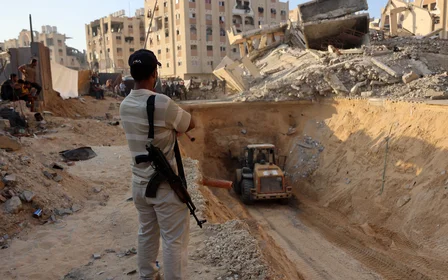
Israel still occupies roughly half of the Gaza Strip behind the so-called “yellow-line”. The Wall Street Journal reported on Thursday that some Hamas fighters are trapped inside tunnels behind the yellow line.
Both Turkish and Egyptian officials told MEE that they have not been consulted by US officials who are drafting the UN resolution.
“The Americans are playing their cards very close to their vest,” the Egyptian official said.
“Washington isn’t willing to negotiate the details of the resolution,” the Turkish source said.
Irony
Just the fact that the Trump administration has had to turn to the UN is laden with irony, given its hostility to the organisation, particularly regarding the Israel-Palestine conflict and war on Gaza.
Their pivot towards the international organisation marks a victory for Arab and Muslim states, which do not want to be viewed as occupiers on behalf of Israel.
“For the force to be seen as legitimate by the Palestinians, it must not be perceived as contracted by Israel,” Jean Marie Guehenno, former UN undersecretary general for peacekeeping operations now at Columbia University, told MEE.

The draft resolution says the security force will report to a so-called "board of peace" chaired by Trump. The US has established a military coordination centre in Israel to oversee the ceasefire.
Some peacekeeping operations are run explicitly by the UN. The forces participating in them are nicknamed the “blue helmets” - in a nod to the international organisation’s colour.
UN peacekeepers operated in Bosnia in the early 1990s, in Mali in the 2000s, and are currently in southern Lebanon.
An international stabilisation force deploying to Gaza would be similar to the one operating in Haiti. The force combating armed groups there is Kenyan-led and US-supported. Although it has a UN Security Council mandate, its command and control do not report to the UN secretary general.
The Turkish source who spoke with MEE said Ankara would like the mandate to allow for greater UN supervision over the international stabilisation force.
“It is presented as a UN-backed initiative, but the UN doesn’t actually have any role in it,” the source explained.
Middle East Eye delivers independent and unrivalled coverage and analysis of the Middle East, North Africa and beyond. To learn more about republishing this content and the associated fees, please fill out this form. More about MEE can be found here.