Egyptian construction firms surveyed sites in Gaza for 'Green Rafah' project, sources say

Egyptian construction firms surveyed sites in the ruins of the southern Gaza Strip for a housing project dubbed "Green Rafah", Egyptian sources have told Middle East Eye.
A senior military source based in Egypt's North Sinai province told MEE that Egyptian engineers surveyed several areas in eastern Rafah under the supervision of the Israeli army and air force, who accompanied them throughout the process until they left the besieged Palestinian enclave.
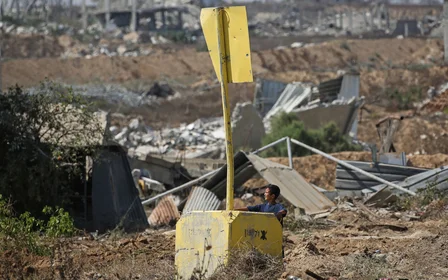
Rafah was once home to roughly 250,000 Palestinians and known for its bustling local markets, refugee camps, and surrounding green spaces.
But since Israel launched its genocidal war on the enclave, Israeli forces have demolished at least 80 percent of the buildings in the governorate, with nearly all of its former residents now rendered homeless.
Speaking on condition of anonymity because they were not authorised to speak to the media, the source said that "the proposed neighbourhood would initially house around 20,000 Palestinians and be supervised by a multinational force expected to be deployed in several parts of the Gaza Strip under the Sharm el-Sheikh peace agreement.
New MEE newsletter: Jerusalem Dispatch
Sign up to get the latest insights and analysis on Israel-Palestine, alongside Turkey Unpacked and other MEE newsletters
"Debris removal and construction operations are likely to begin after the Israeli elections so as not to affect the vote or be exploited by opponents of Prime Minister Benjamin Netanyahu," the source added.
A second Egyptian source working with the Organi Group told MEE that the company had received instructions from senior management to send a team to Rafah to survey a site earmarked for residential buildings.
Ibrahim al-Arjani, also spelt al-Organi or Organi, is a powerful Sinai businessman with longstanding ties to Egypt's security establishment.
Two companies linked to him have previously been reported to exercise substantial control over the movement of people and goods through the Rafah crossing.
'The survey of the designated area has already been delivered so that the necessary engineering drawings and studies can be prepared ahead of construction'
- Egyptian source
The Sons of Sinai, a construction and contracting firm, reportedly controlled exit permits for trucks and other goods, while Hala for Consulting and Tourism Services reportedly had the exclusive rights to control the transportation of travellers to and from the Gaza Strip.
The source with the Organi Group corroborated the first source's account of the security arrangements, saying that "the survey team was accompanied by the Israeli army".
"The survey of the designated area has already been delivered so that the necessary engineering drawings and studies can be prepared ahead of construction, including rubble removal and land preparation," the source said.
"Work would proceed once we get the go-ahead to clear the debris and level the land so we can begin construction.
"Green Rafah is intended to fall under international administration, separating Gaza from Israel," the source added.
The two sources both acknowledged that Organi's construction companies were expected to secure reconstruction work assigned to Egypt, with some projects expected to be subcontracted to smaller Egyptian firms.
MEE reached out to the Organi Group and the Egyptian State Information Service for comment but did not receive a response by time of publication.
Organi, a 49-year-old tribal leader, has frequently been accused of using his ties to the Egyptian government to expand his influence in North Sinai and build his business empire across Egypt.
He is reported to have led a tribal militia that fought alongside Egyptian security forces against an insurgency in North Sinai for almost a decade after the military coup that overthrew Egypt's first democratically elected president, Mohamed Morsi.
Reshaping Gaza
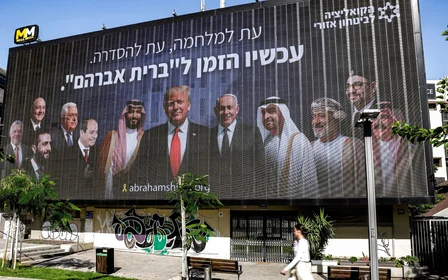
In August, Israeli Army Radio reported that Prime Minister Benjamin Netanyahu and Defence Minister Israel Katz had given the green light to infrastructure work in eastern Rafah, on the Israeli-controlled side of the Yellow Line.
The report said the area was intended for a residential project for Palestinians living outside Hamas' control.
Construction work would include excavation and connections to electricity, water and sewage networks, the report added.
Palestinian contractors and workers would undergo security checks by Israel's Shin Bet domestic intelligence agency before entering the area.
Netanyahu's office subsequently refuted parts of the report, saying Green Rafah was a UAE-backed pilot project that had already been under way for several months and that infrastructure work would take place under Israeli military supervision.
The proposed project comes amid a wider US-backed reconstruction vision presented by Jared Kushner, US President Donald Trump's son-in-law, at the World Economic Forum in Davos in January.
Dubbed "New Gaza", the plan envisages reshaping the territory through new residential districts, industrial zones, transport infrastructure and large-scale redevelopment.
The plan envisages more than 100,000 permanent housing units in a redeveloped Rafah, alongside about 200 educational centres
But the "New Gaza" plan makes no reference to transferring land deeds or explaining how new housing would be allocated to Palestinians.
Nor does it set out how families would be uprooted from existing buildings slated for demolition, particularly in central Gaza and parts of western Gaza City where many buildings remain intact.
According to reports, so far, only one contract has been awarded for reconstruction works in the enclave, with the Louisiana-based Arkel International expected to construct a military outpost for 150 international troops.
CIA blessings
According to the senior military source, the surveying of the areas in Rafah had full US backing.
"Washington conveyed instructions on the Rafah operations through CIA director John Ratcliffe during his latest visit to Egypt," the source said.
During a 20 September meeting in Cairo with Ratcliffe, attended by Egyptian General Intelligence chief Hassan Rashad, Egyptian President Abdel Fattah el-Sisi stressed the need to fully implement the second phase of Trump's Gaza Peace Plan.
According to a statement by Egypt's presidency, Sisi called for the ceasefire to be consolidated, civilians to be protected and humanitarian aid to be allowed into Gaza without restrictions. Ratcliffe praised Egypt's role in brokering the ceasefire and its ongoing mediation efforts.
Public accounts of the meeting, however, made no specific reference to plans for the proposed Green Rafah project.
At a Board of Peace event in late September, Kushner said companies interested in participating in Gaza's reconstruction would be able to take part through a "transparent bid process".
However, the Board of Peace did not respond to MEE's questions about the potential involvement of Egyptian companies in the reconstruction effort, including the reported role of contractors linked to Organi.
In April, a joint assessment by the United Nations, World Bank and European Union estimated that Gaza would need $71.4bn over the next decade to recover from the war and rebuild, including $26.3bn in the first 18 months.
But according to the Board, so far, only $280m had actually been committed, highlighting the gap between pledges and the money available for projects.
MEE reached out to the Board of Peace, the White House, the CIA and the Tony Blair Institute for Global Change for comment but did not receive a response by time of publication.
Middle East Eye delivers independent and unrivalled coverage and analysis of the Middle East, North Africa and beyond. To learn more about republishing this content and the associated fees, please fill out this form. More about MEE can be found here.