Five of six remaining Thai captives freed from Gaza, ending 15-month ordeal

Wirat Thenna, whose son Pongsak was held captive in Gaza for 15 months, says he won't let him go back to being a farm worker in southern Israel.
"It would be better if he lived in his hometown," Wirat told Thai media.
He was speaking shortly before Pongsak and four other Thai nationals, were released by Palestinian fighters on Thursday.
“Now I am so happy I can't express it. I don't know what food I will give my son to eat for his first meal after returning home safely,” Wirat said.
“First, I will tie a knot on his wrist to welcome him back. After that, I will let him become a monk because I made a promise since I couldn’t contact him.”
New MEE newsletter: Jerusalem Dispatch
Sign up to get the latest insights and analysis on Israel-Palestine, alongside Turkey Unpacked and other MEE newsletters
Pongsak had worked in Israel for six years, before being captured and taken to Gaza during the 7 October 2023 Hamas-led attack.
Alongside Ponsak, Suwannakham Sathian, Watchara Sriaoun, Bannawat Seathao and Surasak Rumnao were also freed. They were met by Thai officials at the Israeli boundary near Gaza.
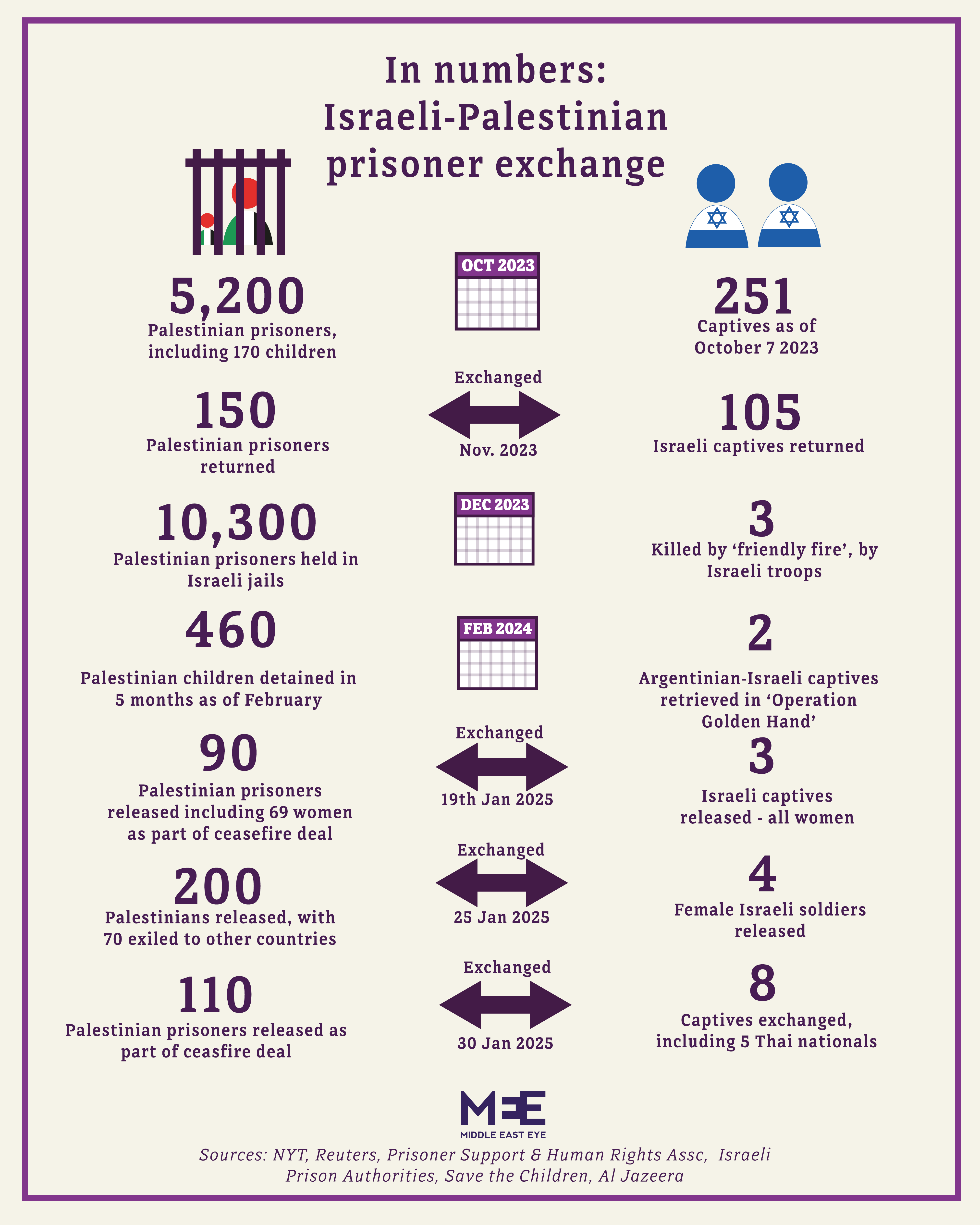
Three Israelis - Agam Berger, Arbel Yehoud and Gadi Moses - were also released.
Yahel Kurlander, a sociologist at Tel Hai college in Israel specialising in migration and agricultural labour, said it was a “great joy” to see the five Thai nationals released, while “huge concerns” remained about one Thai worker still held in Gaza.
“I hope that the people in Thailand will understand that our heart is with them,” she told Middle East Eye.
“I will continue to do everything that I can to help them get their rights for now and forever.”
Kurlander said Israelis would always remember Thais killed during the conflict: 39 died on 7 October, two more in a bomb attack in southern Israel, and five were killed along the northern frontier with Lebanon.
She added that Israeli civil society held vigils to commemorate killed Thai workers, and always included their names in campaigning for the release of captives.
The five Thai nationals had been held by Palestinian Islamic Jihad, senior Hamas official Mousa Abu Marzouk confirmed earlier this week.
Their release came as an unexpected development.
It was not part of the deal struck between Hamas and Israel for the first phase of the truce agreement. The Thai nationals had been expected to be freed in the later phases.
Turkish security sources told Anadolu Agency that Ankara’s intelligence agency was involved in working with Hamas on the captives' release.
Bangkok's foreign ministry on Thursday sent a message of "deep appreciation" to "Qatar, Egypt, Iran, Turkey, the US and other friendly countries, as well as the International Committee of the Red Cross, and all the parties involved".
Thai workers suffer heavy toll
Thailand suffered the highest death toll of any foreign country during Israel's war on Gaza.
As well as the 46 deaths, 31 Thais were taken captive, of whom 23 were released during a temporary truce in November 2023.
Nattapong Pinta is believed to be the only other Thai captive still held in Gaza.
Sudthisak Rinthalak and Sonthaya Oakkharasri, two of those taken captive, were confirmed dead by Bangkok officials last year.
Wiwwaeo Sriaoun, mother of freed captive Watchara, told The Guardian last week that the ceasefire deal had raised hopes that Thai captives would be freed. She said she had very little information about the conditions of their captivity.
“I worry about how they are living over there. I want to hear how things are over there, what their conditions are. We don’t even know if they are alive,” Wiwwaeo said.
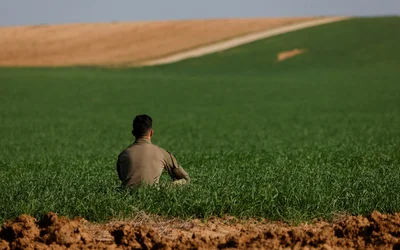
The majority of the Thai nationals impacted by the war were agricultural workers.
Israel has a history of employing migrant workers, and Palestinians, for these roles, particularly in border areas near Lebanon, Jordan, the occupied Golan Heights and the Gaza Strip.
After the killings and abductions on 7 October, the Thai government flew 8,500 of its workers home.
To make up the shortfall in agricultural workers, Israel brought in workers from India, Sri Lanka and Malawi, among other countries.
MEE reported last year that these migrant labourers worked dangerously close to rocket fire - on both Israel’s northern and southern fronts. Campaigners also said they lived and worked in poor conditions.
In March, an Indian man was killed and several other migrant workers were seriously wounded by anti-tank missiles fired from Lebanon, while cultivating an orchard in the northern town of Margaliot.
Kurlander said that since the start of the war, the Israeli government’s attitudes towards migrant labourers had worsened.
She said it was now allowing business-to-business recruitments, not just hires through bilateral agreements.
“We have a lot of concern for people to pay huge recruitment fees. Not only for agriculture. People from Thailand are now coming to the building sector, to the construction sector, and paying recruitment fees - which is not allowed.”
Middle East Eye delivers independent and unrivalled coverage and analysis of the Middle East, North Africa and beyond. To learn more about republishing this content and the associated fees, please fill out this form. More about MEE can be found here.