Five things we learnt at the Doha Forum

Syria's leader Ahmed al-Sharaa drew a rockstar’s reception at the Qatari global summit, as former US secretary of State Hillary Clinton and US political commentator Tucker Carlson sparked debate over Gaza, global conflict and Gulf politics.
Middle East Eye looks at what this year’s surprise-filled Doha Forum reveals about the region.
Sharaa’s charm offensive
A year after Bashar al-Assad’s fall, Syria’s interim president, Ahmed al-Sharaa, continued to charm the international community.
Arriving at a packed conference hall for an interview with CNN’s Christiane Amanpour, Sharaa was met with enthusiastic applause as audience members stood, phones raised, craning for a glimpse of Syria’s leader.
New MEE newsletter: Jerusalem Dispatch
Sign up to get the latest insights and analysis on Israel-Palestine, alongside Turkey Unpacked and other MEE newsletters
The pair discussed Syria’s future, its relations with Israel, and his own political evolution. Pressed about what Amanpour called his “past of being a terrorist”, Sharaa dismissed the label as “politicised”.
Sharaa pointed to Israel's genocidal war in Gaza, Syria under 14 years of Assad's rule and past wars in Afghanistan and Iraq to argue “people are now aware about who is a real terrorist and who deserves to be called a terrorist”.
Buoyed by a recent visit to the White House - where US President Donald Trump affectionately sprayed him with cologne in the Oval Office - Sharaa delivered his response to resounding applause.
And the approval was not limited to the audience.
US to ditch 'colonialised mandates'
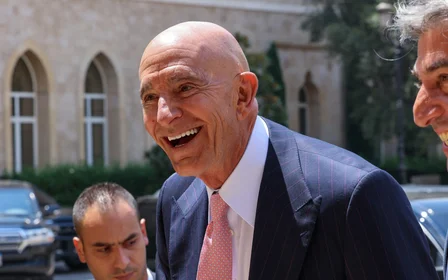
Speaking on a panel about Syria’s future, the US ambassador to Turkey, Tom Barrack, said the Trump administration would not approach the country’s transition with “Western expectations of democracy in 12 months”, which he likened to previous “colonialised mandates” to impose democratic models in postwar Libya and Iraq.
Praising Syria’s current leadership, Barrack said the country would “define [that future] for themselves” - a marked shift from the language of political reform and civic culture used by earlier US administrations.
America First meets Doha
Evolving American attitudes toward the region were on full display throughout the forum, particularly the Trump administration’s “America First” agenda, which calls for a reduced US role on the world stage and greater burden-sharing from allies.
Taking the stage to make that case was the president’s son, Donald Trump Jr, who said the United States would no longer be “the big dumb guy with the chequebook” expected to “cover all of the world’s problems”.
Instead, he argued, the “transactional perspective” of Trump’s “pragmatic foreign policy” allowed Gulf states to “become real partners to the United States”, given the region’s vast energy reserves.
Limits to what US could offer Gulf
But not all Gulf states are thrilled about America First.
Speaking on a panel about the future of US policy in the region, Saudi Arabian analyst Dr Abdulaziz Alghashian said the kingdom had developed a “better understanding” of the “limitations of what [the US] could offer” when it came to security commitments in Trump’s second term.
He pointed to Washington’s lack of response to the drone strikes carried out by Yemen's Houthis on Saudi oil facilities in 2019 as a “signal” that the relationship “wasn’t very stable”. This, he said, has prompted Riyadh to pursue rapprochement with its longtime rival Iran and diversify its security ties.
Security priorities seemed to also diverge in other areas between the Trump administration and its regional allies.
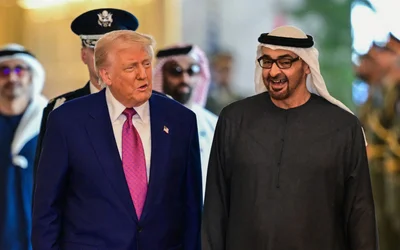
While US delegates spoke of expanding the Abraham Accords with Israel, exploring future investment opportunities, and funding Gaza’s reconstruction, their regional counterparts struck a far more cautious note. They emphasised the need for a pathway to Palestinian statehood and criticising Israel’s ongoing strikes in Gaza, Syria, and Lebanon.
Egypt’s foreign minister, Badr Abdelatty, underlined the importance of moving to phase two of the Gaza ceasefire deal, under which Israel’s military would withdraw from the strip, an international stabilisation force would be deployed, and Hamas would be disarmed or decommissioned.
But progress appears unlikely.
Turkish Foreign Minister Hakan Fidan argued that disarmament needed not precede that process, in marked contradiction to Israel’s position.
Meanwhile, both Qatar and Saudi Arabia said they could not be expected to provide reconstruction funds without a “credible pathway” to Palestinian statehood, something Israel’s government vehemently opposes.
US divisions on Gaza
Concern for Palestinians’ political future was not limited to the region.
In a cordial interview with Qatar’s prime and foreign minister, Mohammed bin Abdulrahman Al Thani, US commentator Tucker Carlson asked about Gaza’s future, Israel’s strike on Doha in September, and the state of US-Qatari relations.
Calling it “grotesque” that Qatar was “asked to pay for the rebuilding” of Gaza, Carlson also addressed accusations that he was “an agent of Qatar”. He denied taking money from the Gulf state, adding that he was “buying a place” there - meaning, as he put it, “I have not taken any money from Qatar; I have instead given money to Qatar.”
Former US secretary of state Hillary Clinton was also questioned on Gaza and Palestine, pressed on her earlier comments that young people were consuming “pure propaganda” from “made-up videos” about the war on TikTok.
Defending her remarks, Clinton said young people did not understand the full “history” of the conflict. The former secretary of state said she was also “angry” about many wars around the world, including Ukraine, Sudan and the eastern Congo.
The audience appeared unconvinced - one example of the persistent gap between US and regional attitudes to Gaza, even amid the fragile ceasefire deal.
And while the Trump administration continues to highlight the region’s value as a source of normalisation and investment agreements, the long-term security commitments and diplomatic processes its partners had hoped for remain out of reach.
Figures like Tom Barrack, Donald Trump Jr, and Tucker Carlson may have brought the rhetoric of America First to this year’s Doha Forum, but the policies themselves may prove a harder sell.
Middle East Eye delivers independent and unrivalled coverage and analysis of the Middle East, North Africa and beyond. To learn more about republishing this content and the associated fees, please fill out this form. More about MEE can be found here.