Former French President Sarkozy given five-year prison term over Gaddafi funding

Former French President Nicolas Sarkozy was found guilty on Thursday by a court in France of criminal conspiracy, but acquitted of corruption and accepting illegal campaign financing by former Libyan leader Muammar Gaddafi.
The presiding judge of the Paris Criminal Court said that Sarkozy, 70, then interior minister, was guilty of criminal conspiracy for having "allowed his close associates and political supporters over whom he had authority" to solicit Libyan authorities as early as autumn 2005 "in order to obtain or attempt to obtain financial support in Libya with a view to obtaining financing" for his victorious 2007 presidential campaign.
This was done in exchange for "diplomatic, economic and legal compensation, in particular a promise to lift the arrest warrant for Abdullah Senussi," Gaddafi's brother-in-law, who was sentenced to life imprisonment for his role in the attack on a civilian aircraft over Niger, UTA DC-10, which killed 170 people in 1989.
Sarkozy was handed a five-year prison sentence by the court, which ordered that he should be placed in custody at a later date. Prosecutors will be given one month to inform the former head of state when he should go to prison.
This measure remains in force even though Sarkozy lodged an appeal on receiving the verdict. He will be the first head of state to be jailed since Philippe Petain, the head of the Vichy regime, France's Nazi collaboration government in World War Two.
New MEE newsletter: Jerusalem Dispatch
Sign up to get the latest insights and analysis on Israel-Palestine, alongside Turkey Unpacked and other MEE newsletters
He was also fined €100,000 ($117,000) and banned from holding public office.
The court, however, acquitted Sarkozy of charges of concealment of embezzlement of Libyan public funds, passive corruption and illegal campaign financing.
It ruled that the investigation failed to prove "that the money sent from Libya" was used in Sarkozy's 2007 campaign.
"For the court, the material elements have not been established that a corruption offence has been committed," said presiding judge Nathalie Gavarino.
However, if the corruption pact - a particularly difficult offence to demonstrate - is not proven, the planned corruption is, and entails the "criminal conspiracy" conviction.
"The criminal conspiracy [Sarkozy] formed with [his associates] Claude Guéant, Brice Hortefeux and [French-Lebanese businessman and intermediary] Ziad Takieddine aimed to prepare for corruption at the highest possible level once he was elected President of the Republic, responsible for ensuring compliance with the Constitution and guarantor of national independence.
"These are therefore acts of exceptional gravity, likely to undermine citizens' trust in those who represent them and are supposed to act in the public interest, but also in the very institutions of the Republic," the court concluded.
'Sleep in prison with head held high'
Sarkozy described the verdict as "extremely serious for rule of law" and said he will "sleep in prison with [his] head held high", protesting his innocence.
In addition to appealing against the conviction, he could request parole on the grounds of his age.
The former president has been convicted already in two separate trials but has avoided jail, in one case serving his prison sentence for corruption with an electronic tag instead, which has now been removed.
His two former close associates and ministers, Guéant and Hortefeux, were found guilty of criminal conspiracy. The former was also found guilty of passive corruption and forgery and sentenced to six years, while Hortefeux received a two-year prison sentence.
Eric Woerth, the campaign treasurer, was acquitted.
Following the death in Lebanon on Tuesday of Takieddine, one of the defendants and a key figure in the case, the court also declared the prosecution against him to be terminated.
In March, following a three-month trial, representatives of the National Financial Prosecutor's Office (PNF) had called for a seven-year prison sentence for the former head of state, accusing him of having entered into a "Faustian corruption pact with one of the most disreputable dictators of the last 30 years".
According to the prosecution, the former president promoted, in exchange for bribes, the end of the ostracism of Libya by the international community and pledged to absolve Senussi.
Prosecutors claimed Sarkozy was both a "sponsor" and a beneficiary of this financing.
For judge Gavarino, there are "material elements" as well as "specific, serious and consistent" facts which demonstrate that the Libyan authorities did pay €6m through Takieddine, with the aim of financing the 2007 campaign. But there is no absolute proof that the money was indeed provided for the said campaign.
"There was an agreement between Sarkozy, Hortefeux, Guéant and Takieddine to prepare the pact. The aim was to obtain a commitment from Libya to finance the campaign" in exchange for a promise of a review of Senussi's criminal situation. The court found "an agreement up to June 2007".
She also noted that while Saif al-Islam Gaddafi, the former leader's son, and Senussi are public officials, "the embezzlement of public funds by foreign public officials is not covered by French law, which explains the acquittals" for these charges.
The former French president has always proclaimed his innocence, describing the accusations - initially made by Libyan dignitaries - as the result of a plot hatched by the Gaddafi clan to take revenge for Sarkozy's decisive role in the fall of the Libyan leader in 2011.
Illustration of ‘France's postcolonial history’
In 2017, Fabrice Arfi, the journalist who, along with his colleagues at Mediapart, uncovered the affair, told Middle East Eye that it was "the most serious of the Fifth Republic and even of the Republics that preceded it".
He further described the affair and the 2011 Libya war as an illustration of "France's postcolonial history".
"We are therefore talking about postcolonial history because, following this diabolical honeymoon, in which France pretended to no longer see that it was facing a dictator, it then unleashed a war that was a war of reconquest".
In March 2011, as the popular uprising in Libya in the wake of the Arab Spring turned into an armed conflict, Sarkozy struggled to have the UN Security Council adopt a resolution authorising air strikes against Gaddafi's forces. Operations were soon after led by Nato and contributed to the defeat of Gaddafi's government.
On 20 October 2011, Gaddafi was killed in Sirte by revolutionary forces in circumstances that remain unclear to this day.
"If Gaddafi had entered Benghazi, Srebrenica would have been considered a non-event," Sarkozy said to justify his intervention, referring to the massacre of 8,000 Bosnian Muslim men and children in July 1995.
However, several confidential memos and reports have cast doubt on the legitimacy of the international intervention spearheaded by Sarkozy.
A memo discovered in the so-called Hillary Clinton "emailgate" affair lists five factors motivating Sarkozy's commitment to the war: "A desire to obtain a greater share of Libyan oil production; increase French influence in North Africa; improve his internal political situation in France; provide the French military with an opportunity to reassert its position in the world; address his advisors' concerns about Gaddafi's long-term plans to supplant France as the dominant power in Francophone Africa."
This analysis was partly shared by the British Parliament's Foreign Affairs Select Committee in a 2016 report, which states that the military intervention "was based on erroneous assumptions", that the threat of a massacre of civilians was "overstated", and that the coalition failed to "verify the real threat to civilians".
It also believes that Sarkozy's true motives were to serve French interests and "improve his political position in France".
Arfi suggested another possible reason: "We know that when the insurgents take over the government ministries, they also take over the archives. But if you're the one waging war, it's a little easier to prevent compromising documents from being dispersed. If you're the one arming the insurgents and bombing the ministries, the risks are under control.
"What outrages me is that we pretended to have discovered in March 2011 that Gaddafi was a dictator. Yet, just a few months earlier, we were arming him and receiving him," he told MEE.
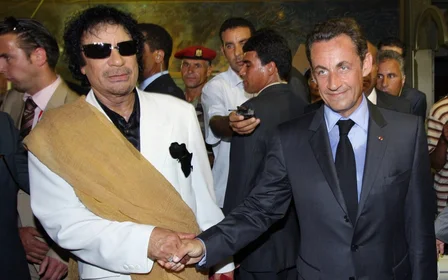
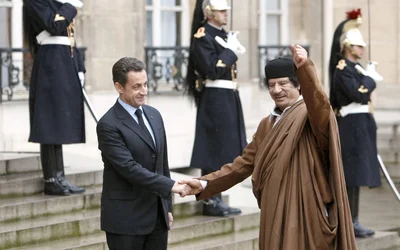
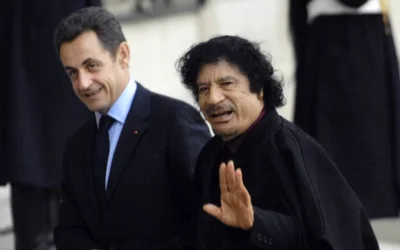
The way Sarkozy received Gaddafi in Paris in December 2007 has been described as "the most controversial visit of the Fifth Republic".
During the visit, which marked Gaddafi's rehabilitation on the international stage, the Libyan leader pitched his Bedouin tent, where he traditionally received his guests, in the gardens of the Hotel de Marigny, the official residence of state guests.
Meanwhile, the consequences of the war in Libya are still being felt today, as the country is divided between two rival administrations in the east and west, incapable and unwilling to organise democratic elections, and marred by recurring clashes between militias.
Middle East Eye delivers independent and unrivalled coverage and analysis of the Middle East, North Africa and beyond. To learn more about republishing this content and the associated fees, please fill out this form. More about MEE can be found here.