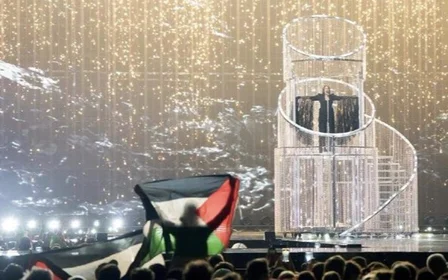
Palestine campaigners to increase pressure on Eurovision after Israel approved to take part

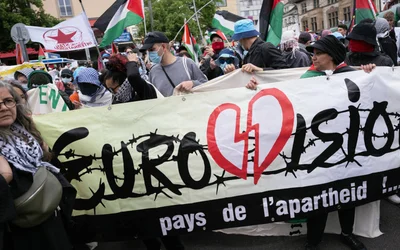
Pro-Palestine campaigners have promised to increase the pressure on more European countries to pull out of the Eurovision song contest after the event's governing body announced that Israel would be allowed to take part.
Spain, Ireland, Slovenia and the Netherlands have all said they would not be participating due to Israel's ongoing genocide in Gaza and controversy surrounding the massive public support for Israeli candidates in previous editions.
Iceland has also previously suggested it would boycott, though it has yet to officially confirm.
Despite an expected showdown at the general assembly of the European Broadcasting Union (EBU) on Thursday, in the end, no vote was taken over Israel's participation.
“A large majority of members agreed that there was no need for a further vote on participation and that the Eurovision song contest 2026 should proceed as planned, with the additional safeguards in place,” the EBU said in a statement.
New MEE newsletter: Jerusalem Dispatch
Sign up to get the latest insights and analysis on Israel-Palestine, alongside Turkey Unpacked and other MEE newsletters
The Ireland-Palestine Solidarity Campaign (IPSC) praised the Irish national broadcaster RTE for confirming it would not be participating and condemned the EBU's decision not to hold a vote.
"We really welcome RTE standing firm in their commitments and commend the other national broadcasters for also doing the same, but it's really disgraceful that the EBU didn't have the vote on Israel's participation, and it's really shameful that the EBU hasn't expelled Israel," said chairperson Zoe Lawlor.
She told Middle East Eye that IPSC would continue working with other European campaigners to pressure national broadcasters to follow Ireland's example and pull out of the competition.
"Not surprising, but it is very shameful, and it is rank hypocrisy because Russia was expelled the day after the invasion of Ukraine," she added.
The Spanish national broadcaster RTVE, along with seven other countries, had formally requested a secret ballot at the general assembly over whether to exclude Israel. However, the EBU denied their request.
"This decision increases RTVE’s distrust of the festival’s organisation and confirms the political pressure surrounding it," the Spanish broadcaster responded in a statement.
"The situation in Gaza, despite the ceasefire and the approval of the peace process, as well as the use of the contest for political purposes by Israel, make it increasingly difficult to maintain Eurovision as a neutral cultural event," said RTVE secretary general Alfonso Morales.
Conflicting values
The Slovenian national broadcaster, RTVSLO, said taking part “would conflict with its values of peace, equality and respect”.
The British and German national broadcasters have both confirmed they will continue to participate.
Campaigners in the UK derided the BBC decision to take part as "pinkwashing" that helped conceal the crimes committed by Israel in Gaza, where more than 70,000 people have been killed in what international observers and rights groups have called a genocide.
"It is testament to the strength of the international solidarity movement that Ireland, Spain, Slovenia, and the Netherlands have made the principled stance of boycotting Eurovision until Israel is rightfully removed for its grave human rights violations," Stella Swain, campaigns officer at the Palestine Solidarity Campaign, told MEE.
"The BBC must follow suit and not hide behind the fiction of Eurovision being 'apolitical', particularly after Russia's expulsion from the competition."
New rules to detect fraud
The next edition of the contest will be the 70th anniversary and is due to take place in May 2026 in Vienna, after Austrian entry JJ won this year's contest with his song Wasted Love.
Israel was this year represented by Yuav Raphael, who survived the attack by Palestinian gunmen at the Nova festival in southern Israel on 7 October 2023, during which 378 people were killed.
Raphael came second, although afterwards there were accusations of vote manipulation during the public round, with Spain’s national broadcaster requesting an audit of the results.
Under pressure from calls for boycott, the EBU announced on 21 November a change to the rules of the competition and a strengthening of efforts to "detect and prevent any fraudulent or coordinated voting activity".
The new measures, approved on Thursday, "strongly discourage any disproportionate promotional campaign ... particularly if it is launched or supported by third parties, including a government or government agency", the EBU said.
The competition allows all residents of the dozens of participating countries to vote by phone, SMS, or online. In each country, a jury of professionals also votes. Both votes carry equal weight.
But under the new rules, the maximum number of votes per payment method "will be reduced from 20 to 10".
Sixty-five percent of delegates voted in favour of the changes to the contest and for no further discussion on Israel's participation, while 23 percent of members voted against and 10 percent abstained.
The Palestinian Campaign for the Academic and Cultural Boycott of Israel criticised the decision on X, though it praised the countries planning to boycott.
"By helping to enable and whitewash Israel’s ongoing genocide against Palestinians in Gaza, Eurovision organisers the EBU are presiding over what is already the most disastrous edition of the contest ever," they wrote.
"We call on fans to pressure broadcasters, contestants, presenters and all others to withdraw from Eurovision."
Middle East Eye delivers independent and unrivalled coverage and analysis of the Middle East, North Africa and beyond. To learn more about republishing this content and the associated fees, please fill out this form. More about MEE can be found here.