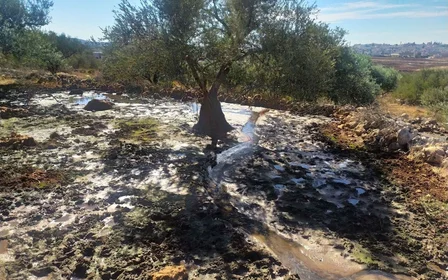
Gaza’s destroyed sewage system linked to ‘rare’ algae bloom shutting Israeli desalination plants

Untreated sewage from Gaza may have helped cause a huge algae bloom that shut down five of Israel’s six major desalination plants on the Mediterranean, Israeli news outlet Ynet has reported.
Scientists are trying to assess possible environmental fallout from Gaza’s destroyed wastewater infrastructure, the report said.
In an alarming development, the algae bloom spread along Israel's Mediterranean coast, disrupting seawater desalination plants that provide much of the country's drinking water, CNN reported, citing Mekorot, Israel's national water company.
Desalination provides at least 65 percent of Israel's drinking water, with most plants located on the coast.
“An event of this kind has never occurred before in Israel … it was an extremely rare event,” said Lior Gutman, a spokesperson for Mekorot.
New MEE newsletter: Jerusalem Dispatch
Sign up to get the latest insights and analysis on Israel-Palestine, alongside Turkey Unpacked and other MEE newsletters
Five of Israel's six major desalination plants, including Ashkelon, Ashdod, Palmachim, Sorek A, and Sorek B, were temporarily shut down.
Israel’s water authority said the water sector was stable as authorities increased supplies from the Sea of Galilee, groundwater wells and reservoirs while restricting some agricultural and public irrigation.
But the crisis has exposed the fragility of Israel’s dependence on desalination to major environmental disruptions.
'A perfect storm'
Gaza’s wastewater treatment system has been heavily damaged during the war, with some 40,000 cubic metres of untreated wastewater reportedly flowing into the sea each day, figures cited by Ynet and Palestinian authorities said.
Algae blooms require warm water and nutrients, such as phosphorus and nitrogen, said Avner Gross, head of Ben-Gurion University’s Climate Change Laboratory.
He said satellite imagery showed similar algae-filled waters around Egypt’s Nile Delta, where agricultural runoff pours into the Mediterranean.
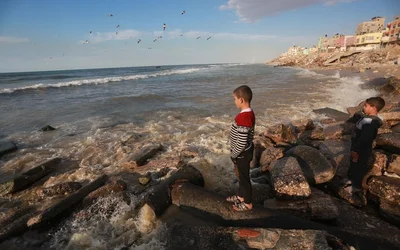
“In our case, I currently have no other explanation except a pollution source in the southern Gaza Strip,” Gross said to Ynet.
Writing on X, Gross said global warming had turned the Mediterranean into “a bathtub in August”.
“Add phosphorus and nitrogen pollution and you get a deadly algal bloom,” he wrote.
“Coincidentally, in recent days there were weak, steady winds that mixed the fertiliser from the sewage along Israel’s coast. A perfect storm.”
Noga Armi, chief executive of Israeli environmental organisation Zalul, also said that the Gaza sewage had contributed to the outbreak.
“The scientific link is well established. Untreated sewage discharged into the sea from Gaza was one of the factors that contributed to the incident,” Armi told Roya News.
According to Tamar Guy-Haim, a marine ecologist at Israel's National Institute of Oceanography, the probability that Gaza sewage was the main driver of the bloom is relatively low.
The organism responsible for the Israeli bloom has been identified by researchers as a cyanobacterium of the genus Synechococcus, though the exact species and reason for its sudden proliferation are still under investigation.
Warm waters
Scientists also cited the warm Mediterranean waters, strong sunlight, currents and a recent storm that made the seawater more turbid as possible contributing factors.
Or Bialik, a researcher at Israel Oceanographic and Limnological Research, told Haaretz: “I've worked in the Mediterranean Sea for a long time and have never seen anything like this.”

“The water is green like a lake. The turbidity is such that you can't see your instruments after half a metre,” he said.
According to researchers cited by CNN and Haaretz, the bloom began near Egypt’s Nile Delta and moved north with ocean currents.
Edo Bar-Zeev, a water researcher at Ben-Gurion University, cautioned that such events could become more frequent as the Mediterranean warms.
“It’s a fair estimation that this will not be a once-in-a-lifetime kind of event … you can assume that this will occur more and more through climate change,” he told CNN.
Scientists have not yet identified a definitive cause.
Competing explanations for the phenomenon include warming seas, natural currents, pollution from the Nile Delta, untreated sewage from Gaza or a combination of environmental factors.
Middle East Eye delivers independent and unrivalled coverage and analysis of the Middle East, North Africa and beyond. To learn more about republishing this content and the associated fees, please fill out this form. More about MEE can be found here.