GCC to establish joint forward-command centre in Kuwait

The Gulf Cooperation Council (GCC) has approved a new joint forward-command centre to deepen military integration among members, as doubts rise about the US’s commitment to regional security amid the war on Iran.
The command centre will be built in Kuwait, a Gulf state that endured thousands of missile and drone strikes from Iran and Iraqi militias aligned with Tehran.
GCC secretary general Jasem al-Budaiwi said in a statement on Tuesday that the deployment of "appropriate" forces to the centre would take place, but did not provide additional details.
The GCC body representing six Gulf states established a joint defence agreement in 2000, stating that an attack on one member is an attack on all.
The GCC’s commitment to self-defence, however, is not as ironclad as that of the Nato military alliance.
New MEE newsletter: Jerusalem Dispatch
Sign up to get the latest insights and analysis on Israel-Palestine, alongside Turkey Unpacked and other MEE newsletters
The move could be seen as an effort to address the GCC's lack of a joint military command structure. The organisation has failed to respond to attacks on members from several fronts.
The GCC did not respond when Israel attacked Hamas negotiators in Doha, Qatar, in September 2025. The organisation has also failed to respond to devastating Houthi missile and drone attacks on Saudi Arabia.
The decision to base the command centre in Kuwait may also raise questions about its practical viability.
Kuwait’s geography at the hook of the Gulf made it especially vulnerable to missile and drone attacks from both Iran and Iraqi militias during the war.
Kuwait hosted around 14,000 US troops before the war, more than any other country in the Middle East. It is home to two large bases - Camp Arifjan and Ali al-Salem Air Base - both of which came under intense attack from Iran.
It's unclear how the GCC could defend a command centre when the US could not defend its bases.
US security guarantees in doubt
Gulf states have turned to external partners for security. Saudi Arabia has activated the Mecca Pact with Pakistan and Turkey amid Houthi attacks.
Meanwhile, the UAE has doubled down on its security relationship with Israel.
The US has been the security guarantor of the Gulf states for over half a century. But that relationship has been called into question as a result of the US-Israeli war on Iran.
Saudi Arabia, Qatar and the UAE lobbied the US against attacking Iran, but their pleas went unanswered. In retaliation, Iran attacked Gulf states that are home to US military bases.
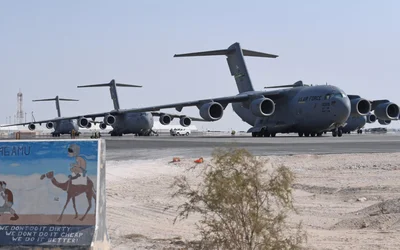
The presence of US troops on their soil has been perceived by some Gulf analysts as making them a target.
Oman, for example, which has one of the oldest diplomatic relationships with the US, has no permanent US military presence and was the least hit Gulf state.
The US Department of War’s inspector general said in a report published in September that “hundreds of buildings and structures” at US bases in Kuwait, Bahrain, Qatar, the UAE, Saudi Arabia, Iraq, Oman, and Jordan were damaged or destroyed by Iranian strikes.
Current and former US officials say the Iran war exposed vulnerabilities in the US’s strategy of establishing bases close to Iran and that some facilities are unlikely to be rebuilt.
“The truth is that we are not as inclined to occupy these bases now that we have seen what the Iranians can throw at them,” David Petraeus, a former director of the CIA and head of Centcom, told Bloomberg in May.
“This is much more than when I was commander at Central Command,” he added.
Another former head of Centcom, General Frank McKenzie, said in July that the US needs to relocate its bases in the Gulf to Israel and neighbouring countries to better protect its assets from Iran’s missiles and drones.
“No one in their right mind would ever put the Centcom forward headquarters, you know, 100 miles away from Iran, [in Qatar], yet that’s where it is,” he told the Jewish Institute for National Security of America, referring to al-Udeid.
Middle East Eye delivers independent and unrivalled coverage and analysis of the Middle East, North Africa and beyond. To learn more about republishing this content and the associated fees, please fill out this form. More about MEE can be found here.