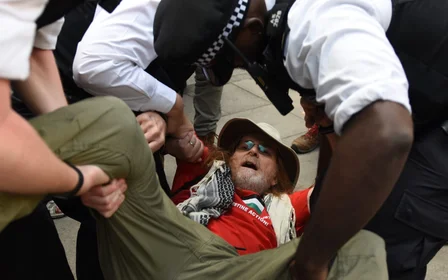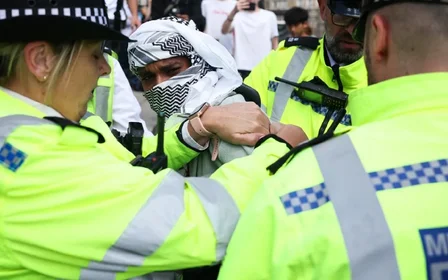

Hearing set to decide 'terror sentencing' of activists who targeted Barclays

A judge has ordered a hearing in which he will decide whether five Palestine Action defendants convicted of criminal damage will be sentenced as terrorists.
The five defendants - Brendon O’Hagan, 28, Amanda Kelly, 31, Hmeera Atiqnisar, 31, Mohammed Malik, 28, and Alma Yaniv, 70 - were found guilty in June 2026 of causing £212,000 ($283,000) worth of damage to a Barclays branch in Burnley in August 2024.
Following their convictions, presiding Judge Phillip Parry told defence lawyers that he would consider applying a “terrorist connection”, despite jurors not being told about a potential terror sentencing in the case.
He then referred the matter to Judge Robert Altham who will decide whether to apply the terror designation at a hearing on 21 August, two weeks ahead of their sentencing on 4 September.
In 2018, the court of appeal found that Judge Altham had issued "manifestly excessive" prison sentences to anti-fracking activists for causing public nuisance outside a site near Blackpool. The court ruled that the sentences were inappropriate and that the activists should be freed immediately.
New MEE newsletter: Jerusalem Dispatch
Sign up to get the latest insights and analysis on Israel-Palestine, alongside Turkey Unpacked and other MEE newsletters
After the Barclays trial concluded, Judge Parry circulated a ruling made by Justice Johnson, the presiding judge in a recent Palestine Action case in which four activists convicted of criminal damage at an Elbit Systems site in Filton, near Bristol, were sentenced as terrorists despite being convicted of criminal charges.
Gross overreach
The CPS subsequently argued that the defendants should receive a terror sentencing, despite not mentioning the possibility during the trial.
The Barclays action took place prior to the proscription of Palestine Action and is not listed among the three incidents connected to the group which the government classified as terrorism, each allegedly involving over £1m ($1.35m) in damage.
Simon Roscoe Blevins, an anti-fracking activist who was handed a 16-month custodial sentence by Altham in 2018, said: "Surely this move to add a terror connection to the sentencing of another direct action case, after no mention before or during trial, is another gross overreach and one he in particular cannot be trusted with?"
Palestine Action co-founder Huda Ammori said that it was "shocking" that Altham is deciding whether the terrorist designation will be applied.
She added that both in the Filton case and the Barclays case "the jury were under the impression that they were simply deciding whether criminal damage was caused.
They were completely unaware that a conviction of criminal damage, would essentially be convicting the defendants of terrorism".
Middle East Eye delivers independent and unrivalled coverage and analysis of the Middle East, North Africa and beyond. To learn more about republishing this content and the associated fees, please fill out this form. More about MEE can be found here.