'Riyadh no longer feels safe': Houthi strikes shatter Saudi capital's aura of calm

Riyadh has long presented itself as a safe haven from the turmoil engulfing the Middle East.
But deadly Houthi strikes on the Saudi capital's main airport have shattered that sense of security, leaving expatriate families questioning whether they can continue to build their lives in the kingdom.
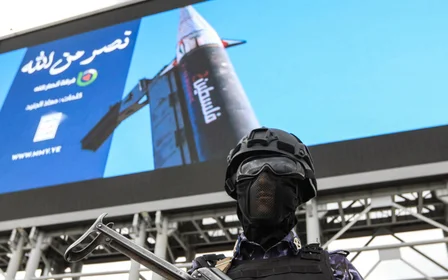
At least 12 people were killed and more than 300 injured when Yemen's Houthis attacked the King Khalid International Airport on Saturday.
The movement, which also fired cruise missiles at oil facilities and Dammam airport in eastern Saudi Arabia, said the attacks were in response to Riyadh's support for government forces in Yemen's civil war and a Saudi air strike on Sanaa airport earlier this year.
CCTV footage aired by state broadcaster Al Ekhbariya showed pilgrims dressed in white, waiting to travel to Mecca for Umrah, scrambling for safety as dust filled an airport lounge and ceiling panels fell to the floor.
New MEE newsletter: Jerusalem Dispatch
Sign up to get the latest insights and analysis on Israel-Palestine, alongside Turkey Unpacked and other MEE newsletters
Among the dead were a Bangladeshi cleric, a Syrian mother of four and a US citizen.
A second strike the following day killed one person and injured at least 11 others.
"Pilgrims should never have to fear for their lives while travelling on a religious journey," Bilal, a 39-year-old British national who has lived in the capital for at least seven years, told Middle East Eye.
"There's no way the Houthis can spin this. There's no justifying attacks on ordinary people, and no way they can defend striking a civilian facility - whatever the Saudi-led coalition did in the war years ago."
Beyond the immediate carnage, the attacks struck at the heart of the kingdom's carefully cultivated image as a secure destination for international business, tourism and investment.
'There's no justifying attacks on ordinary people, and no way they [the Houthis] can defend striking a civilian facility - whatever the Saudi-led coalition did in the war years ago'
- Bilal, British expat
On Sunday, a major energy conference drew only a handful of delegates and with the kingdom's flagship business event, the Future Investment Initiative, just two weeks away, the attacks have raised questions about Riyadh's ability to project an image of stability.
Bilal told MEE that while he would find it difficult to give up his well-paid job and comfortable life in the kingdom, the scale and frequency of the attacks had prompted some expatriate families to question whether civilian spaces were safe.
"I have no intention of returning to the UK. My family and I have made a life here. But would I consider sending them back if the situation spiralled and there were more frequent attacks? Absolutely."
Mohamed, a British national who has lived in Riyadh on and off for the past decade, said while he also considered the kingdom a safe place to raise his family, he was unsettled by the failure of missile interceptors to protect the airport, one of the kingdom's most important transport hubs.
"My children are also pretty scared by what's happening," he told MEE.
"I've reassured them that they will be safe, but with schools being cancelled and some foreigners openly expressing their plans to return to their home countries, it's becoming much harder to explain
"Riyadh no longer feels safe."
Vulnerable economic ambitions
The attacks mark a dangerous escalation in Saudi Arabia's confrontation with Yemen's Houthis, who control much of the country's north.
The conflict was largely locked in a stalemate until Saudi-led forces struck Sanaa airport in July, seeking to prevent an aircraft carrying Houthi officials from Iran from landing in the rebel-held capital.
The Houthis responded by threatening to impose a reciprocal blockade, vowing to target Saudi interests in response to restrictions on their own access to the airspace and transport networks they rely on.
They subsequently declared an embargo on Saudi shipping in the Red Sea, an increasingly important alternative route for the kingdom's oil exports after the Iran war disrupted shipments through the Strait of Hormuz.
The latest escalation is rooted in hostilities that began in 2014, when the Houthis capitalised on widespread discontent over fuel subsidy cuts and the failure of a UN-sponsored national dialogue to resolve Yemen's deep political and economic divisions.
After rejecting proposals for a new federal structure, the Iran-aligned movement advanced south and seized the capital, Sanaa, forcing President Abd-Rabbu Mansour Hadi's government into retreat.
The Houthis' advance prompted a Saudi-led coalition to intervene in March 2015, launching a military campaign aimed at restoring the internationally recognised government.
Armed with US-made bombs and British-made fighter jets, Saudi Arabia and its allies launched a devastating war that killed hundreds of thousands of people, many of them through hunger, disease and the collapse of essential services.
Saudi Crown Prince Mohammed bin Salman, who spearheaded the kingdom's war effort in 2015, has since sought to transform Saudi Arabia into a destination for foreign investment, international conferences, entertainment and tourism.
But the Houthi attacks, alongside Iran's blockade of the Strait of Hormuz - through which roughly a fifth of global oil and gas supplies normally pass - have exposed the vulnerability of those ambitions to regional conflict.
Growing tensions
The crisis has also exposed growing tensions between Gulf states and Washington.
For decades, Bahrain, Kuwait, Saudi Arabia, the United Arab Emirates, Qatar and Oman either hosted US military bases, infrastructure or access, and spent heavily on American weapons and technology.
In return, Washington served as the region's principal military partner and security guarantor.
But a Gulf analyst, who requested anonymity to discuss sensitive matters, said the relationship was under severe strain.
'Trump can't tell Saudi Arabia it's on its own and expect the kingdom to accept that as a serious security guarantee'
- Gulf analyst
The kingdom was already concerned by US President Donald Trump's decision to abandon diplomacy in favour of war with Iran, the analyst said, leaving regional allies to bear the consequences of a conflict they had not chosen.
Trump's response to the attacks on Riyadh deepened that frustration after he said Saudi Arabia was "able to defend" itself.
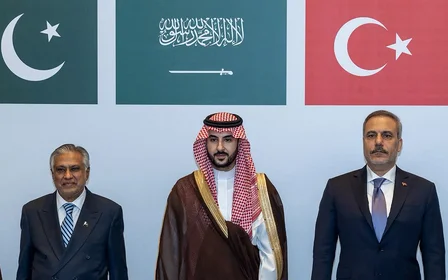
The uncertainty has increased the significance of the Mecca Joint Defence Agreement, signed by Saudi Arabia, Turkey and Pakistan in August.
The pact is intended to strengthen collective deterrence, although the timing and scale of any Turkish troop deployment remain uncertain as Ankara considers its next steps.
"Trump can't tell Saudi Arabia it's on its own and expect the kingdom to accept that as a serious security guarantee," the analyst said.
"The US has spent decades asking Gulf states to invest in American weapons and build their security around Washington. When the threat materialises, dismissing it as something Saudi Arabia can handle raises serious questions about what that partnership is actually worth."
Middle East Eye delivers independent and unrivalled coverage and analysis of the Middle East, North Africa and beyond. To learn more about republishing this content and the associated fees, please fill out this form. More about MEE can be found here.