

How drought and oil expansion are eroding livelihoods in Iraq's Hawizeh Marshes
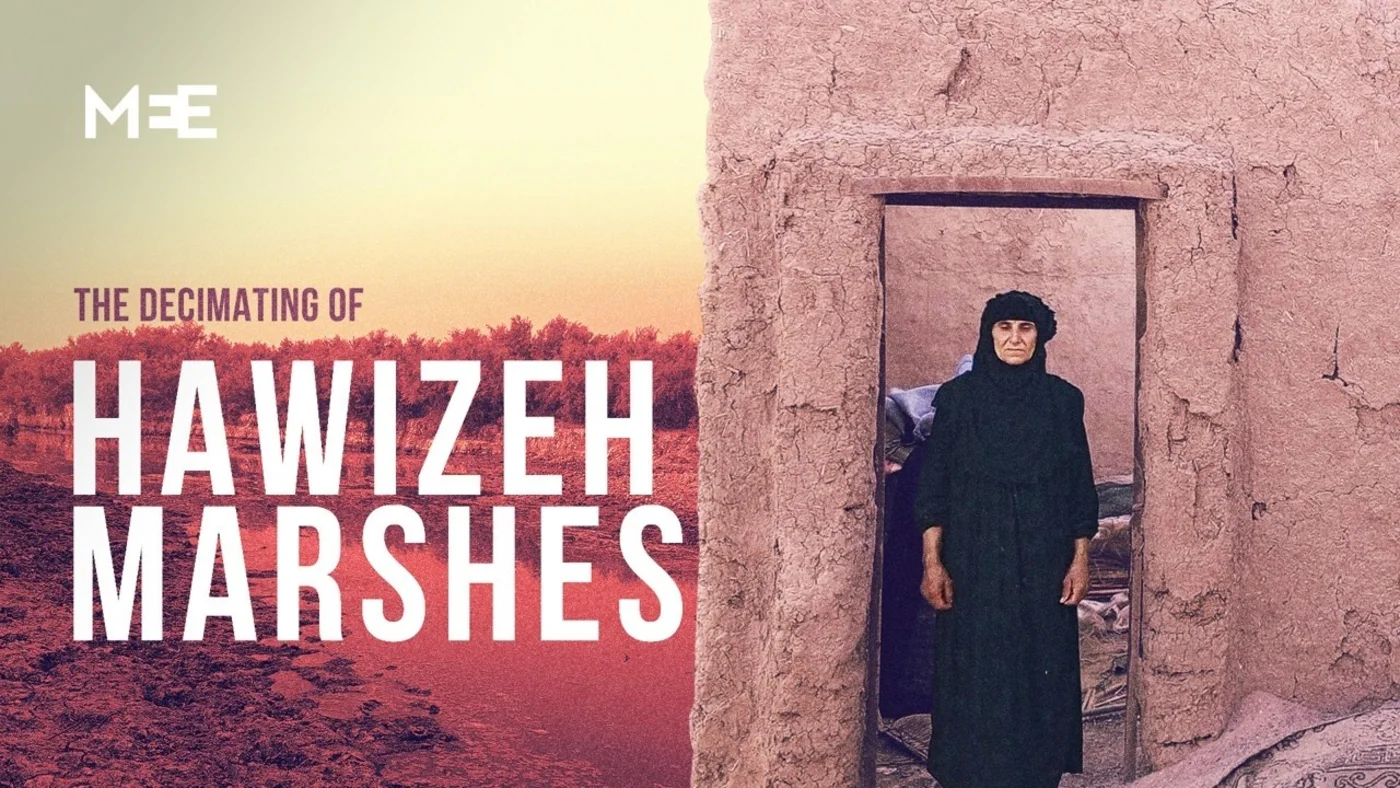
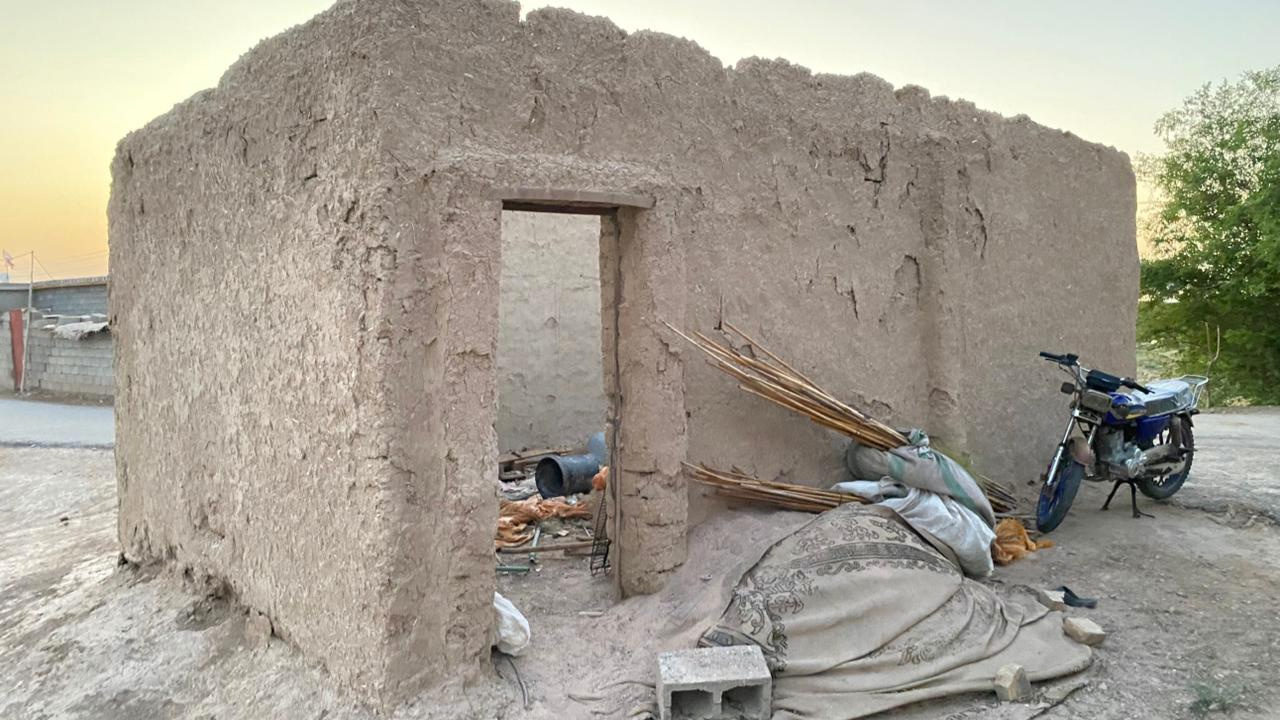
In a corner of Halima Flaih’s property in the Iraqi village of Abu Khasaf, just steps from her family’s home, a small concrete structure sits empty under the blazing sun.
Flaih and her daughters molded each concrete block by hand. Her husband raised the walls, and she plastered the interior, slowly building out a small gathering space where friends and family could come together, connect, and mark special occasions.
Today, the roof is gone, having collapsed due to years of harsh weather and neglect. The land supporting this tiny structure is cracked and dry - a product of a changing climate, exacerbated by a series of state decisions that critics say have prioritised oil extraction over the ecological needs of this sensitive region.
Yet Flaih and her family refuse to leave. Instead, they are planning to transform this empty room into a monument to the past - to the life their family once knew here, on the edges of the Hawizeh Marshes.
“If the water does not return, future visitors and our children must still learn how the Ma’adan lived in harmony with these wetlands,” Flaih tells Middle East Eye.
New MEE newsletter: Jerusalem Dispatch
Sign up to get the latest insights and analysis on Israel-Palestine, alongside Turkey Unpacked and other MEE newsletters
The micro-museum that she plans to create here would showcase traditional marsh culture, including bariya mats hand-woven from wild reeds, fishing nets crafted from cotton threads, and oars for the mashoof, the narrow canoe used by the Ma’adan people to navigate local waters.
More than simply preserving the structure her family built by hand nearly two decades ago, Flaih hopes to create a resilient archive of a community pushed to the brink. It will not just be a collection of artifacts, she explains; it will be a last stand against the permanent erasure of the Ma’adan identity.
“This room is a living extension of everything my family and I have endured. It is the sole reason we stay,” Flaih says. “We want every visitor to see the profound bond we share with this land … and protect the oral heritage we have carried through centuries, before it is lost forever.”
Unique sanctuary
Around 350 kilometres southeast of Baghdad, the Hawizeh Marshes stretch across the shared border between Iraq and Iran. A decade ago, these ancient wetlands were inscribed onto the Unesco World Heritage list, recognised as a cradle of human civilisation and a unique sanctuary for biodiversity.
The marshes have survived for millennia through the delicate, symbiotic relationship between the ecosystem and local residents - particularly women, whose work has long formed the community’s economic and social backbone.
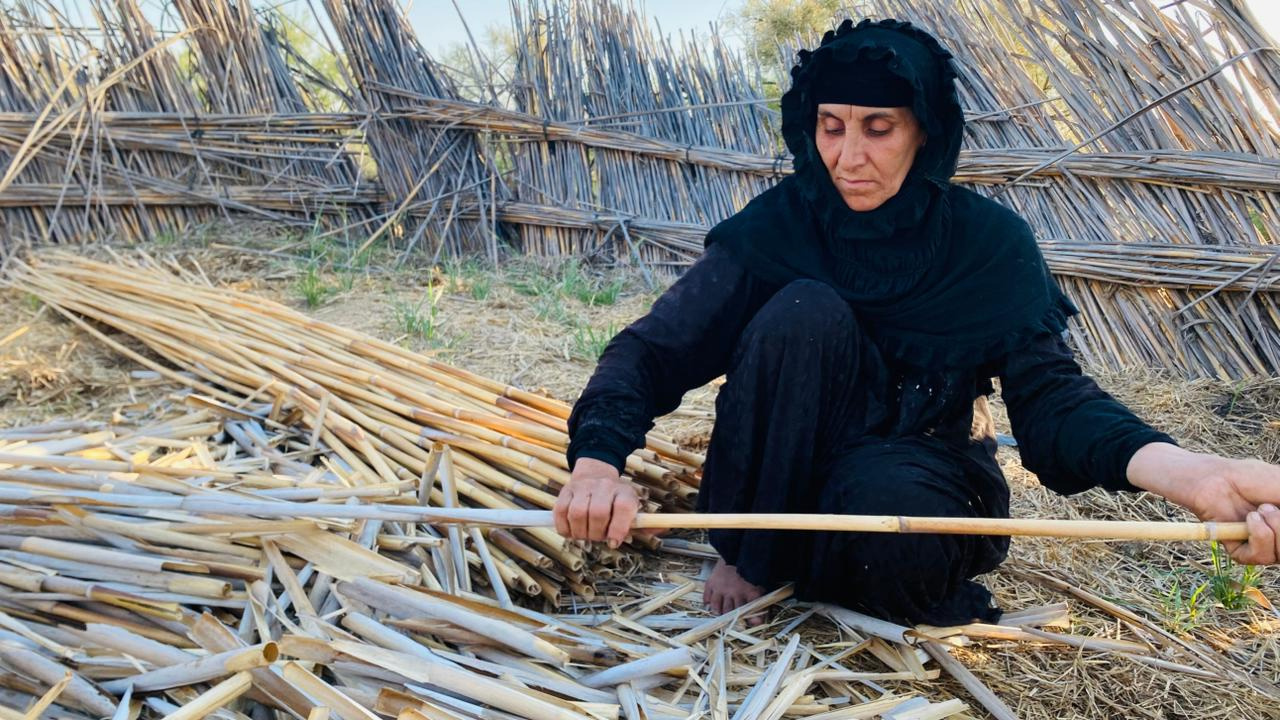
From milking water buffaloes to produce the clotted cream known as qaymar, to weaving bariya mats and hauling in nets of fish to sell in neighbouring urban markets, women have sustained their families here for generations. But today, that way of life is at risk of disappearing.
Years of drought have ravaged the fragile landscape in a region where temperatures can approach 50C in the summertime. Intense development activities, including upstream dams and the expansion of oil facilities, have further choked off the water flow to these vital wetlands.

Some residents believe they are being deliberately pushed out to make way for heavy industry.
“The earthen berms [the state has] built to protect their wells and facilities blocked the water from us, and their operations consume water allocations,” Flaih’s son, Mustafa, tells MEE, noting that his family must now purchase drinking water to meet their daily needs. “They took the riches of our land and left us to buy a drop of water.”
According to research published this March by the London School of Economics Middle East Centre, a massive earthen berm built around the marshes in 2022 - a state initiative officially framed as a measure to combat cross-border drug smuggling - significantly curtailed water inflow, with clear consequences: “Dust replaced water, reeds collapsed, buffalo herds sickened, and entire communities [were] pushed toward displacement.”
Hundreds of families from four local villages have been driven out in recent years, researchers noted, calling it a “catastrophe by design”. By 2024, one-fifth of Iraq’s environmentally displaced population hailed from Maysan governorate, where the Hawizeh Marshes are situated.
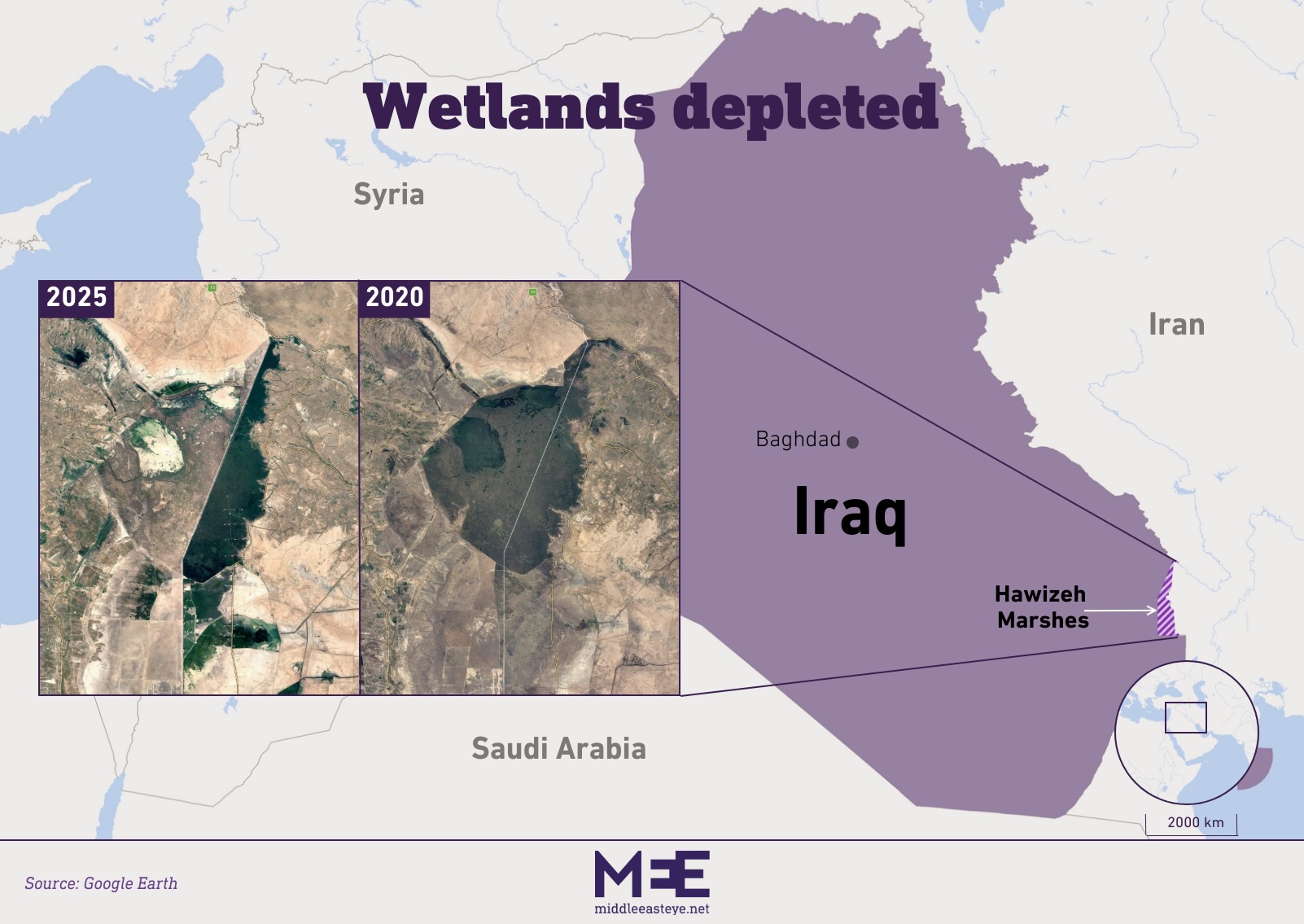
Although Iraqi officials have publicly denied a link between oil development and the depletion of the wetlands, a recent investigation by Daraj Media found that several oil and gas licences overlap with Hawizeh and other protected areas in the country’s south.
The Chinese company Geo-Jade Petroleum was awarded a contract to develop one of these fields, HWZ 1, located in the Hawizeh Marshes. The oil extraction area overlaps the Unesco-protected zone by 300 square kilometres, according to Save the Tigris, a civil society advocacy group promoting water justice in the Mesopotamian basin.
A document from the oil ministry’s legal department, obtained by MEE, shows that while Geo-Jade’s 20-year investment contract entered into force in 2023, environmental assessment work was not completed until the following year, after field operations had already begun, according to local observers. The environmental impact study has not been publicly released.
Hauling water
Other government documents obtained by MEE shed further light on the encroachment. In March 2025, Iraq’s state-run Oil Exploration Company sent a letter asking the water resources ministry to facilitate exploratory work in the Hawizeh Marshes, including the creation of 10-metre-wide pathways and the drilling of power points.
A subsequent letter from the water ministry confirmed that the location of the requested work overlapped the Unesco-protected core zone.
MEE reached out to Iraq’s oil ministry and representatives of Geo-Jade for comment on the nature and timing of this work, and asked for clarification on what steps were being taken to mitigate potential harms, but did not receive any response.
Hussein Ali al-Kinani, director general of the Centre for the Restoration of the Iraqi Marshes and Wetlands at the water resources ministry, said the state actively monitors infrastructure to protect the ecosystem.
“Our field teams in Maysan closely track the compliance of the Ministry of Oil and its subsidiary companies to ensure no activities take place within the boundaries of the Hawizeh Marshes, or negatively impact its feeder channels and hydrological regime,” Kinani told MEE.
He explained that a joint high-level committee comprising representatives of the water, oil and environment ministries, among others, regularly reviews spatial overlaps between oil concessions and wetland sanctuaries.
“If any earthen berms or oil installations are proven to obstruct water flow or divert natural pathways, directives are issued to halt those activities and rectify the damage,” Kinani said, noting that feeder water supplying the marshes “is not used in oil injection operations”.
'Government tankers came maybe once or twice to serve a tiny fraction of the village, but then vanished'
- Murtadha al-Janoubi, environmental activist
Addressing the severe socioeconomic toll of the drought on indigenous communities, Kinani noted that the government’s emergency response includes dispatching water tankers to ensure villagers can meet their daily needs.
But locals on the ground describe a starkly different reality.
In Abu Khasaf, residents say government water tankers are virtually non-existent, with families spending up to 60,000 Iraqi dinars ($45) daily for small private water trucks to keep themselves and their remaining buffalo herds alive.
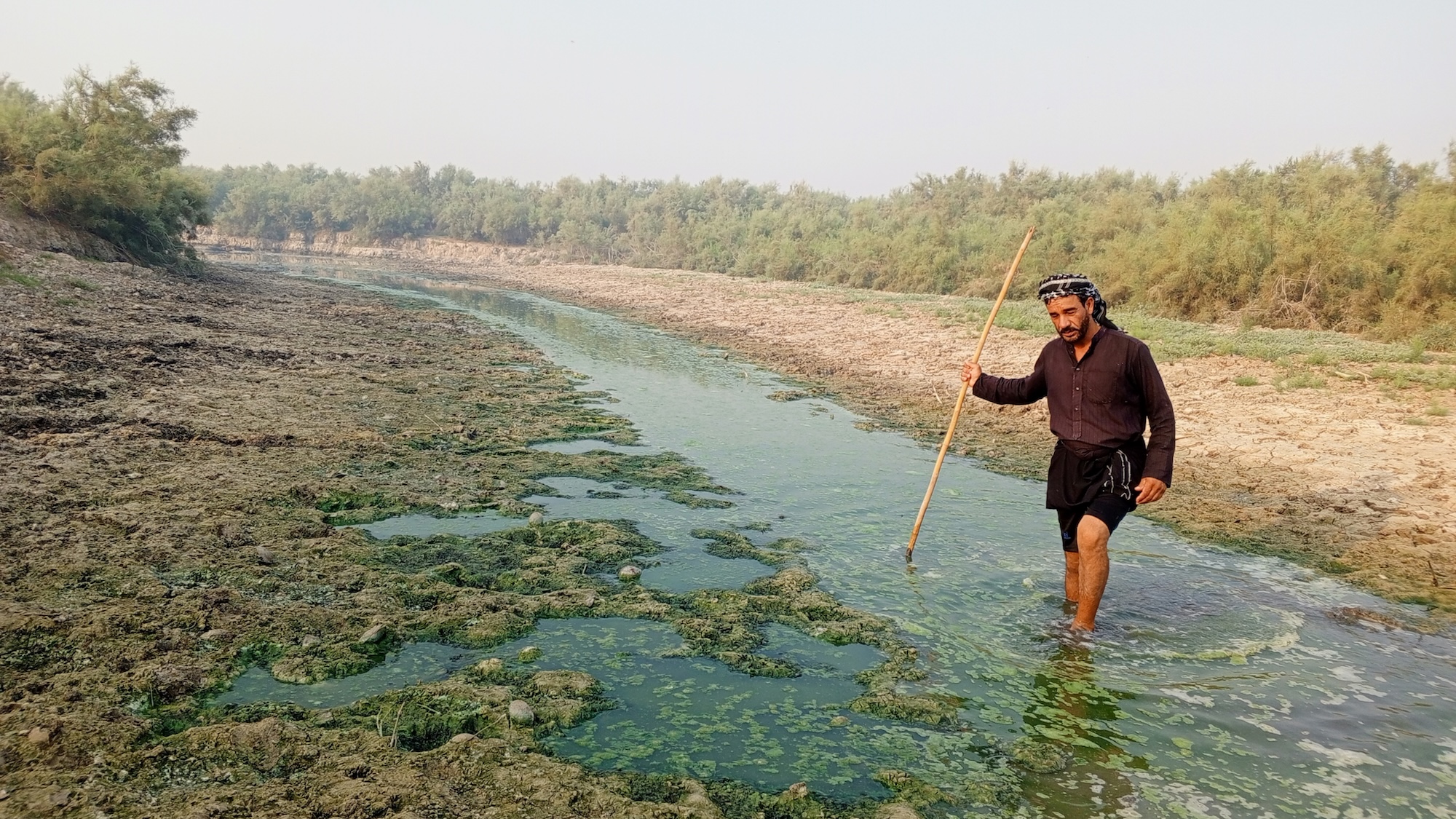
“The drought has continued for nine months without a drop of water in the river,” Murtadha al-Janoubi, a local environmental activist, told MEE. “Government tankers came maybe once or twice to serve a tiny fraction of the village, but then vanished.”
According to Flaih’s son, Mustafa, “we have to haul water ourselves on motorised tricycles using plastic jerrycans. We never received a single drop from state-funded tankers. The reality is that they leave us to buy our own survival.”
'Devastating impact'
Opposition has been growing among local activists, who warn that oil exploration in this area risks damaging an ecological treasure. In April, Save the Tigris sent a letter to Unesco noting that because of the fragility of the marshland ecosystem, such activities “would have a devastating impact”.
The exploratory work coincides with “a near-complete cessation of water flow from the Karkheh River in Iran” due to dam-building, the group added, calling on Iraqi authorities to establish an immediate ban on all oil-related activities around the Hawizeh Marshes, and to begin restoration work on areas affected by desiccation and oil projects.
In addition to HWZ-1, Save the Tigris pointed to the impacts of oil installations on the adjacent Halfaya field, where pumping stations take in large amounts of freshwater, further drying up the marshlands.
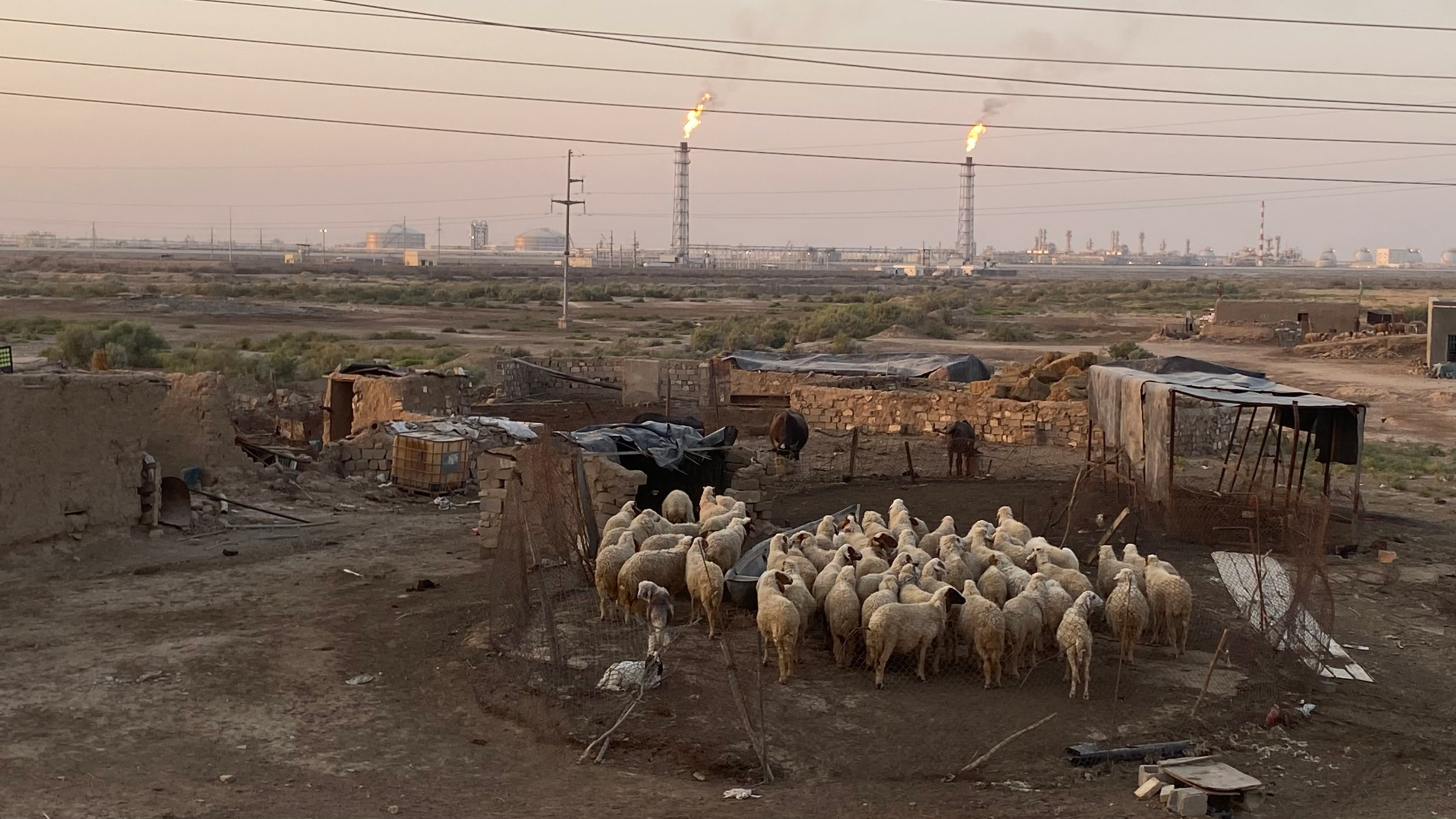
Satellite imagery of the Hawizeh Marshes obtained by AFP from Planet Labs last year revealed visible tracks from heavy vehicles. One resident told the news agency that he saw workers laying cables and drilling holes, while leaked photographs and videos geolocated by the Guardian appeared to show excavators and pipelines in the heart of the protected zone.
“The situation on the ground signals a complete catastrophe,” Janoubi said. He has collected photo and video evidence of heavy machinery “operating deep inside the Hawizeh oil field” near the core protected zone, along with footage of oil leakage from another site in Maysan governorate.
The Iraqi constitution guarantees all citizens the right to live in a healthy environment, while explicitly safeguarding the country’s biodiversity. But critics say the state is now at risk of violating these commitments - both by allowing oil companies to directly encroach on the marshlands, and by fuelling air pollution, a byproduct of heavy industry.

According to the Netherlands-based NGO Pax, dozens of pollution sources are present in Maysan governorate, generating an annual climate impact equivalent to 22 million metric tonnes of carbon dioxide. IQAir, a Swiss air quality technology company, ranked Iraq as the world’s 11th-most polluted country in 2025. Methane plumes and gas flaring contribute significantly to emissions in Iraq’s south.
Ameer Hassoun, a spokesperson for Iraq’s environment ministry, told MEE that the government monitors violations by oil companies and their health impacts, and issues legal warnings for non-compliance. He declined to provide specific data on the number of warnings issued over the past year or whether companies had ultimately complied.
Protecting the marshlands and surrounding communities by upholding global environmental standards is a key priority for the ministry, Hassoun added. He did not respond to specific questions about the threat posed by oil exploration within the Hawizeh Marshes.
Janoubi said the Iraqi state’s response on this issue has been insufficient, noting that concerted action to restore water flow to the marshlands “is the only way to preserve what is left of our biodiversity”.
He added: “If the government is truly serious about saving what remains of the marshes, it must immediately halt all current and future oil expansions, and grant the wetlands their rightful water allocations.”
Driven out
While Flaih’s family wages a stubborn battle to remain on their land, thousands of others have already been driven from the southern marshlands into an unforgiving expanse of urban sprawl.
According to 2024 data from the International Organization for Migration, which began tracking these trends in 2018, more than 140,000 people across central and southern Iraq have been displaced due to climatic and environmental factors. Of the more than 23,000 families affected, around 5,200 hailed from Maysan governorate.
Among them are Abu Qasim and Um Qasim, who were forced to pack their belongings in 2022 after the devastation of their buffalo herd. They have since settled in a semi-agricultural area on the outskirts of Amarah city, trading the open horizon of the marsh for a dilapidated house with narrow concrete walls. Rent, which costs them roughly $200 a month, is a heavy burden.
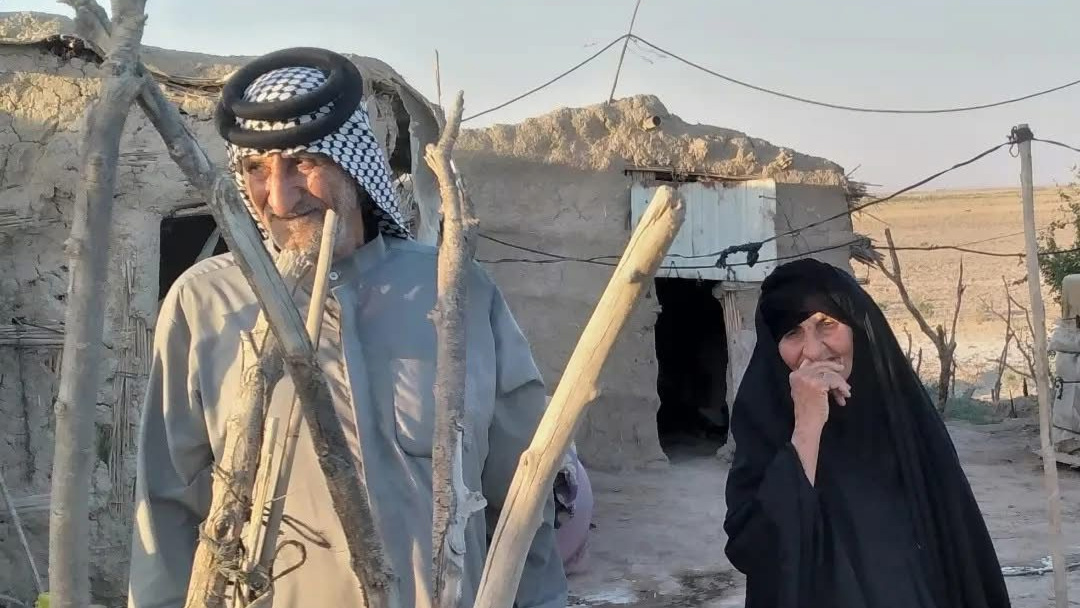
Once a qaymar artisan, Um Qasim’s daily activities are now limited to caring for their few remaining buffaloes, which live in a small mud pen behind their home. Her sons work in the city market, selling fruits and vegetables for $10-25 on the best days.
“It feels like being cast into a foreign country - an alienation I can barely put into words,” Um Qasim tells MEE.
“We were never used to this life, these city lights, the roads, or this entire way of living. We spent our lives in a quiet, isolated paradise where even a single car rarely passed by. Moving here disrupted everything we knew.”
'We spent our lives in a quiet, isolated paradise where even a single car rarely passed by. Moving here disrupted everything we knew'
- Um Qasim, displaced resident
The family must also grapple with social stigma, Abu Qasim says bitterly, noting that some neighbourhoods refuse to sell or rent homes to any family of marsh origin. The Ma’adan are accused of “ruining the city and bringing buffaloes”, he explains, as city residents blame displaced Iraqis for the area’s decayed infrastructure.
Their ultimate dream is to pack up and return to the Hawizeh Marshes, as soon as the water is flowing again.
But time is running out. Last year, citing third-party reports of oil exploration within the Hawizeh Marshes, Unesco warned that the site’s heritage status could be at risk.
The agency’s World Heritage Committee expressed “significant concern over the continued vulnerability of the marsh components and the related natural values of the property to oil and gas developments”, adding that “extractive activities are incompatible with World Heritage status”.
It called on the state to “extend its commitment to a permanent ban on all extractive industries within the property”, and to provide an update on the matter by December this year.
Heritage status deteriorating
According to the International Union for Conservation of Nature’s World Heritage Outlook, which provides regular assessments on the status of protected sites, the outlook for the marshlands of southern Iraq has grown increasingly grim in recent years: from a rating of “significant concern” in 2020, it deteriorated in 2025 to “critical” - the highest threat level.
A Unesco spokesperson told MEE that the agency was “very aware of the concerns” about oil and gas development in the Hawizeh Marshes, and that it was “closely monitoring its state of conservation”.
A monitoring mission in 2027 will “allow the assessment of progress achieved towards implementing the recommendations to conserve the site, including to re-evaluate whether the property then meets the criteria for its inscription on the List of World Heritage in Danger”, the spokesperson added. Such a move would enable the World Heritage Committee to mobilise international technical and financial support for its protection.
Adel al-Mukhtar, an Iraqi water expert and former adviser to the parliamentary agriculture committee, told MEE that the drying of the marshlands was not merely an inevitable outcome of climate change, but a direct product of what he calls “the absence of effective water diplomacy” with neighbouring states, alongside the government’s failure to mandate a fixed, legally protected water quota for the wetlands.
Continuing to prioritise aggressive oil expansion over the sensitive marshlands could mark the end of this once-thriving ecosystem, while threatening to erase the cultural and economic existence of one of the world’s oldest sustainable communities, he added.
Mohammed Khidr Mohammed al-Jubouri, an Iraqi consultant specialising in environmental and climate issues, said the risk of irreversible ecological damage hangs heavy. The creation of wide elevated pathways in the core zone of the Hawizeh Marshes - as documented by local activists - could disrupt their natural hydrological flow, he told MEE.
“They create stagnant zones, drying out entire sections while flooding others, which decimates spawning grounds for fish and destroys native plant life. It fragments the habitat, physically isolating wildlife populations and severely crippling the reserve’s biodiversity,” Jubouri said.
The potential for oil leaks and ruptures near the protected areas is also a concern, as this could contaminate the groundwater and saturate the soil with toxic compounds, destroying the micro-ecosystems responsible for natural water purification, he added.
“In waterlogged, anaerobic conditions, these toxins decompose at an agonisingly slow rate,” Jubouri said. “The soil remains a continuous source of poison for years, making natural recovery virtually impossible.”
Helpless onlookers
Back in Abu Khasaf, Flaih wistfully recalls the historic role of women before the onset of engineered drought across their land.
“We made everything from nothing,” she says, describing the production of al-matal, a traditional biofuel made by gathering buffalo and cattle dung, mixing it with straw, and shaping it into circular patties that dry under the sun. This fuel has long been a vital component of heating and cooking during harsh winters, with the patties capable of burning for hours to bake rice-flour bread or to grill fish.
Supporting six children alongside her husband, Flaih primarily built her livelihood around the weaving of massive bariya mats, which sometimes reached 10 metres in length, from long wild reeds. She sold them in urban markets for around 10,000 Iraqi dinars ($8) apiece.
The ongoing drought did not just choke waterways, she explains; it paralysed women’s hands, turning once-proud producers into helpless onlookers awaiting an unknown fate. With many families now pushed to the impoverished concrete peripheries of Iraq’s southern cities, their ancestral knowledge is of increasingly little use.
Flaih and her family are resisting such a life of urban exile, but each day, staying on their land becomes a little bit harder.
Her husband, Hashem al-Sarray, recalls the days when the marshlands teemed with fresh water and green reeds, providing ample food for the buffalo herds. The last time he remembers such abundance was more than five years ago, in 2021, before successive waves of drought devastated their land.
Back then, Sarray owned more than 20 water buffalo, but he gradually lost half of them to thirst and disease - caused, he believes, by the animals drinking from unsanitary pools of water after the wetlands were depleted. He then sold several others off to afford feed, and trucked-in drinking water for the rest of the herd.
'Selling one buffalo just to buy water to keep the others alive is a slow suicide for our livelihood. There is no profit left here'
- Hashem al-Sarray, resident
But the quality of their milk plummeted sharply in the absence of natural food sources, collapsing the process of qaymar production that Flaih and her daughters once relied on as another financial lifeline.
“We are burning through our savings to buy water and feed for animals that are dying anyway,” Sarray tells MEE. “Selling one buffalo just to buy water to keep the others alive is a slow suicide for our livelihood. There is no profit left here - only a desperate struggle to protect the last ten [animals].”
Their eldest son, Mustafa, 23, has now become the family’s main breadwinner. Every day, he travels an hour each way by motorcycle to work at a power plant in Amarah. His daily wage is around $15, barely enough to cover expenses for his siblings’ education and the cost of household water, once obtained freely from the wetlands.
Attending classes has become a chore for his two high-school-age siblings. Where they once boarded a mashoof and glided across still waters to their school around two kilometres away, they must now walk a longer route on foot, amid swirling dust and intense heat.
Mustafa still prefers this to the alternative. Leaving the marsh, he says, “means dying another way, in urban slums”.
This article was produced as part of the 2026 Middle East Eye Fellowship.
Middle East Eye delivers independent and unrivalled coverage and analysis of the Middle East, North Africa and beyond. To learn more about republishing this content and the associated fees, please fill out this form. More about MEE can be found here.


