‘Policy to displace us’: How settler attacks are drying up the West Bank

Standing beside the dry land that once fed his 120 sheep, Montaser al-Malki dreads the next Israeli settler attack.
A farmer in Kafr Malik, northeast of Ramallah, Malki is one of thousands of Palestinians caught in a worsening water crisis in the occupied West Bank, caused by systematic settler sabotage.
In recent weeks, Israeli settlers have repeatedly attacked Ein Samia, a key spring that supplies dozens of villages. They have destroyed pipes, pumps and access roads, cutting off clean water to entire communities.
On Monday, the Jerusalem Governorate Water Utility announced a complete shutdown of water pumping from Ein Samia.
The Water Authority said it has lost all technical and administrative control over the system.
New MEE newsletter: Jerusalem Dispatch
Sign up to get the latest insights and analysis on Israel-Palestine, alongside Turkey Unpacked and other MEE newsletters
Water, once a lifeline, has become a tool of displacement, Palestinians say.
“I have a family of nine, and I own crops and livestock,” said Malki. “Our economic situation is dire. We’re exhausted by the seizure of pastures.”
Water supply cuts, sometimes lasting more than 10 days, have forced farmers like Malki to buy water from expensive tanks, and most of it is unfit for drinking.
“We fear the settlers' permanent control over Ein Samia,” he told Middle East Eye. “If I rely on tanked water, I won’t last a month. I’ll go bankrupt.”
Water crisis
Najeh Rustum, head of Kafr Malik council, warned the crisis could soon affect over 100,000 Palestinians.
Ein Samia is one of the most important water sources in the West Bank, he said.
For more than 50 years, six wells have provided drinking water to the area.
Those wells are now out of service. Repair crews face daily threats from settlers, making maintenance nearly impossible.
“This is a serious water crisis,” said Rustum. “If no one intervenes, hundreds of thousands risk losing access to water.”
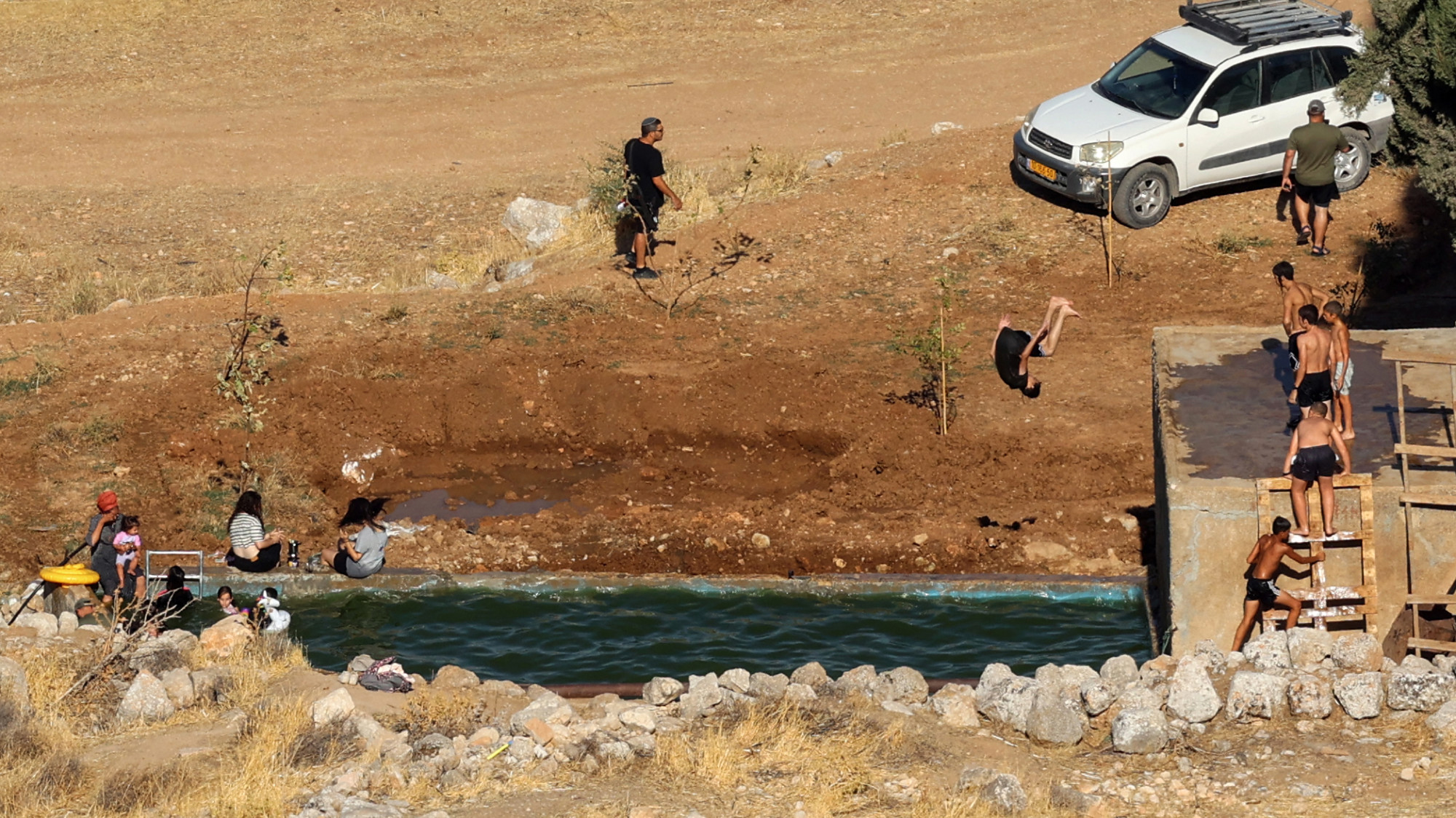

The attacks aren’t new. In 2022, settlers established an outpost near Ein Samia. Since then, violence has escalated, from harassment and theft to the destruction of infrastructure.
“In 2023, during the Gaza war, settlers destroyed major pipes and blocked access to the spring,” Rustum said.
“This year, attacks have doubled. We’ve documented at least nine strikes on pumps and wells, all under Israeli army protection.”
In the latest attack, Israeli settlers bulldozed the western entrance of Umm Safa, northwest of Ramallah, cutting the main water line and leaving the village’s 750 residents without water.
Marwan Sabah, head of the local council, told Middle East Eye that the outage lasted over six hours.
'This is part of a systematic policy to displace us and seize our land'
- Marwan Sabah, Umm Safa village council head
Israeli forces, he said, initially prevented residents from repairing the damage, later allowing only a temporary fix. That repair could collapse at any time, he said.
Meanwhile, the village remains isolated, with its entrances closed by Israeli forces since October 2023.
Sabah said the water cut was no accident.
“This is part of a systematic policy to displace us and seize our land,” he told MEE.
In contrast, settlers who recently set up an illegal outpost on Jabal al-Ras hilltop in the same village enjoy full services, including water, electricity, and growing numbers of mobile homes.
Roads have been bulldozed, and cement trucks brought in to reinforce their presence.
More than 700,000 settlers live in the West Bank, in violation of international law, compared to approximately 3.2 million Palestinians.
Raed Muqadi, a researcher at the Land Research Center, said Israel’s water policy is one of the most dangerous tools of land control and demographic engineering in the West Bank.
He said that Israel is building water transport roads and new networks to supply expanding settlements. This has drained local springs and water basins.
“In Al-Auja in the Jordan Valley, 112 Bedouin families now live without access to water,” Muqadi said.
“They’ve been displaced, their livestock confined, and their agricultural practices drastically changed, due to the scarcity.”
Middle East Eye delivers independent and unrivalled coverage and analysis of the Middle East, North Africa and beyond. To learn more about republishing this content and the associated fees, please fill out this form. More about MEE can be found here.