How Lamine Yamal became a symbol of Spain’s identity debate

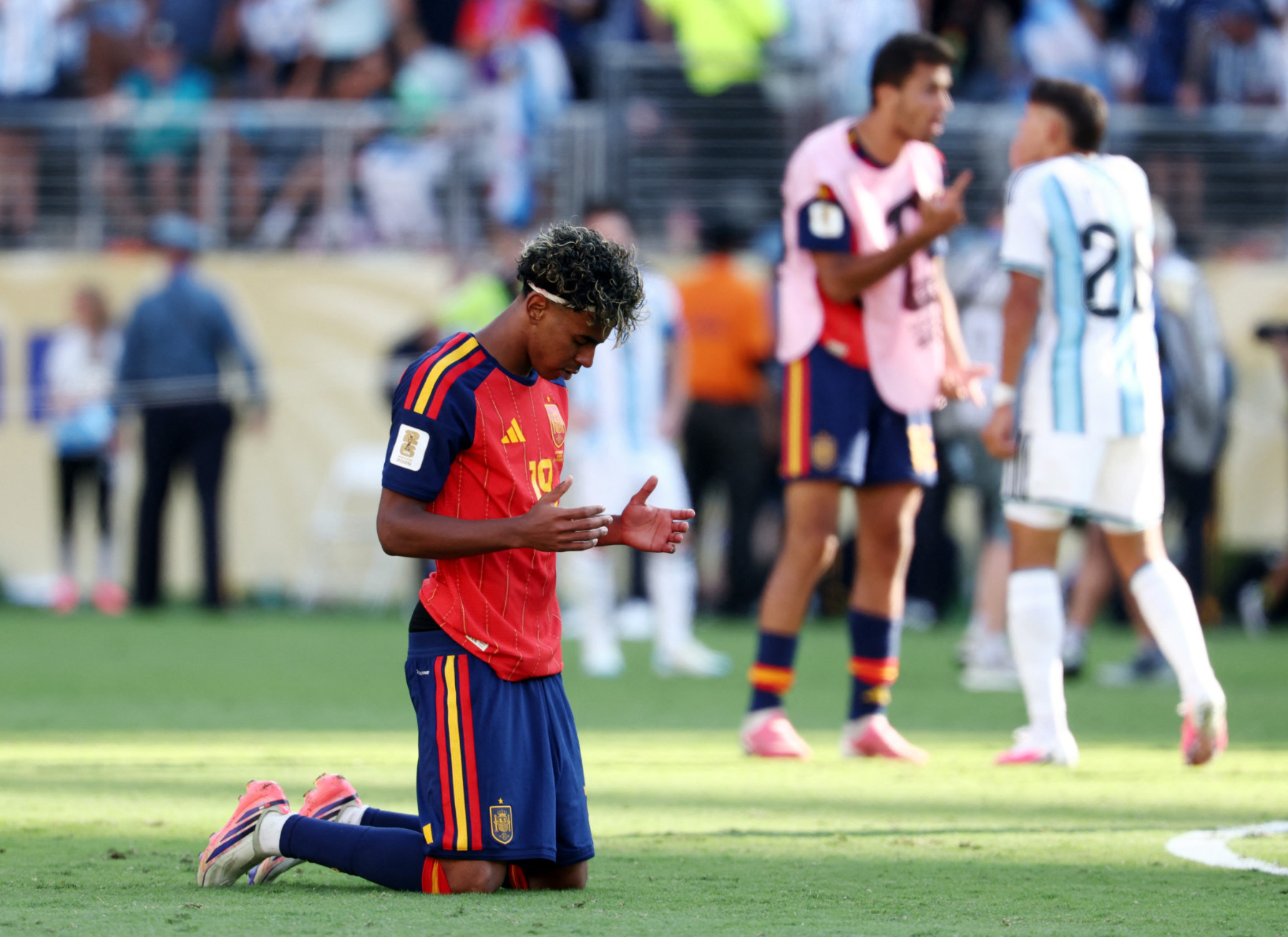
The image of Lamine Yamal, in the colours of La Roja, falling to his knees in prayer as Argentine and Spanish players shoved each other in the background, quickly spread on social media. Lamine Yamal Nasraoui, 19, became the youngest player since Pele and Kylian Mbappe to start and win a World Cup final.
In the days since, much of the sporting conversation in Spain has moved beyond the scoreline. Instead, it has settled on a question that has followed Yamal since he broke into the national team: who gets to count as Spanish, and on whose terms?
Yamal, who was born in Rocafonda, a working-class neighbourhood of Mataró, to a Moroccan father and an Equatorial Guinean mother, has spoken in interviews about reciting a dua his grandmother taught him before matches and fasting during Ramadan while training at Camp Nou, Barcelona's stadium.
During this summer's World Cup group stage, after scoring against Saudi Arabia, he performed sujud, a prostration of gratitude commonly observed by Muslim footballers. The gesture prompted widespread discussion on social media, with some fans praising the display, while others criticised it, arguing it had no place during an international match while a player was representing Spain.
Yamal is not the first Muslim to play for Spain (Munir Al Haddadi was, in 2014), but as the most prominent player of his generation, and the heir to Barcelona's number 10 shirt once worn by Lionel Messi, Yamal has seen his loyalty to the country of his birth repeatedly questioned in public.
New MEE newsletter: Jerusalem Dispatch
Sign up to get the latest insights and analysis on Israel-Palestine, alongside Turkey Unpacked and other MEE newsletters
Ione Belarra, a former minister and leading figure in the left-wing Podemos party, defended multiculturalism, saying she "liked the Spain of Lamine Yamal much more than the Spain being promoted by the conservative People's Party and [far-right party] Vox".
Like many fans, she also delighted in images of Yamal’s younger brother running through the stadium in a Spain shirt, cheering on the national team.
Not everyone shared that view. For some Spaniards, the growing prominence of a Muslim public figure has become a flashpoint in broader debates over Spanish national identity.
The Spanish Observatory on Racism and Xenophobia recorded more than 40,000 pieces of online hate content, with sport accounting for 16 percent of monitored posts and Yamal identified as the primary target.

Hostility intensified after his sujud, with some using the gesture to question his legitimacy as a representative of the country of his birth, posting comments such as "our roots have been humiliated" and "he is not worthy of being Spanish".
Santiago Abascal, leader of Vox party, defended the slogans on X, writing that "these people are tearing their hair out over a chant that isn't even an insult, just a display of identity".
“They expect Spaniards to silently put up with the Islamist invasion and the mafia government,” he added.
The same party has also described Rocafonda, the neighbourhood where Yamal grew up, as a "multicultural shithole", years before Yamal's rise to global prominence.
At a small café in Rocafonda, decorated with murals of its most famous residents, including bullfighter El Cordobés, owner Juan Carlos Serrano Muñoz dismissed such rhetoric as divisive.
Referring to Vox, he told Middle East Eye: "They want to focus on migration, on delinquency, but what Lamine did was give a kick to these people and tell a different story about this neighbourhood; a better story about the integration of the many cultures that live here."
'He is Spanish'
Although Spain's cultural landscape continues to reflect its Catholic heritage, it is a secular state, and people of any faith are eligible to represent the national football team.
With football remaining a major unifying force, and Spain having one of the highest densities of public sports facilities in Europe, the presence of Muslim players on pitches across the country is likely to increase.
In response, the Royal Spanish Football Federation (RFEF) and clubs have introduced measures aimed at creating more inclusive environments and ensuring equal opportunities. These efforts included the establishment of an Equality Department in 2023, a year before Yamal made his international debut at Euro 2024.
This marked a significant step towards formalising protections against discrimination in sport, regardless of a person's background or faith.
Many white Spaniards have also expressed support for Yamal. In a public survey by The New Arab, one participant said: “He is Spanish, and regardless of his origins, he has defended his country, as the Spaniard that he is.”
The comment did not seek to erase Yamal’s background, but instead reflected a view that his heritage and Spanish identity can co-exist.
Stayed, scored, won
The image of Yamal on his knees, hands raised, surrounded by the chaos of a World Cup final, has by now been interpreted in two different ways.
For some, it is simply what it appears to be: a young athlete’s private moment of gratitude, no different in nature from a player crossing himself or pointing to the sky. For others, filtered through the same anxieties Vox has spent years stoking around Rocafonda and neighbourhoods like it, the gesture became a talking point in political rhetoric and online debate.
The RFEF's Equality Department and the steady growth of public football pitches across the country point towards one future, where players who look and pray like Yamal become a normal part of the national team.
However, the politics surrounding him point to another, where every gesture he makes is folded back into a decades-old debate that extends far beyond football.
Unlike players such as Achraf Hakimi, who was born and raised in Madrid but chose to represent his parents' homeland, Morocco, Yamal never resolved the question of belonging by choosing another flag.
Instead, he stayed with Spain, scored, prayed and won, making it considerably harder for either side of the country's identity debate to argue its case without invoking his name.
Middle East Eye delivers independent and unrivalled coverage and analysis of the Middle East, North Africa and beyond. To learn more about republishing this content and the associated fees, please fill out this form. More about MEE can be found here.