‘I am trapped here’: Gulf-based Nepali workers agonise as devastating floods ravage home

Under Dubai’s blinding afternoon sun, Hari Krishna lays bricks for a luxury residential complex.
But his thoughts are 2,000 miles away, amid the mud and debris of Nepal’s Bhote Khosi-Trishuli corridor.
For the past week, the 32-year-old construction worker, who sends most of his earnings home, has spent every spare minute frantically trying to call his relatives on iMO and checking local news channels on his cracked smartphone.
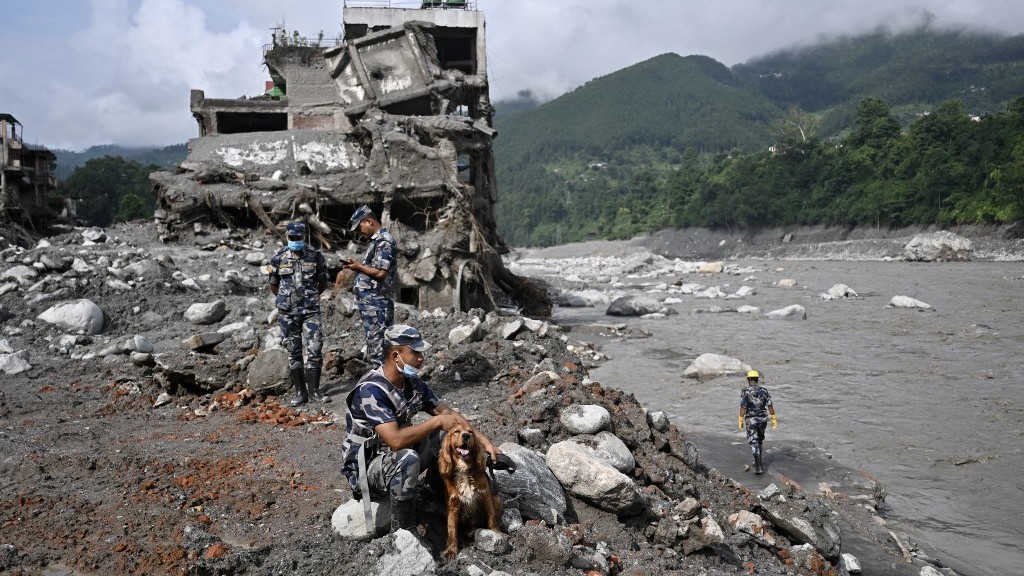
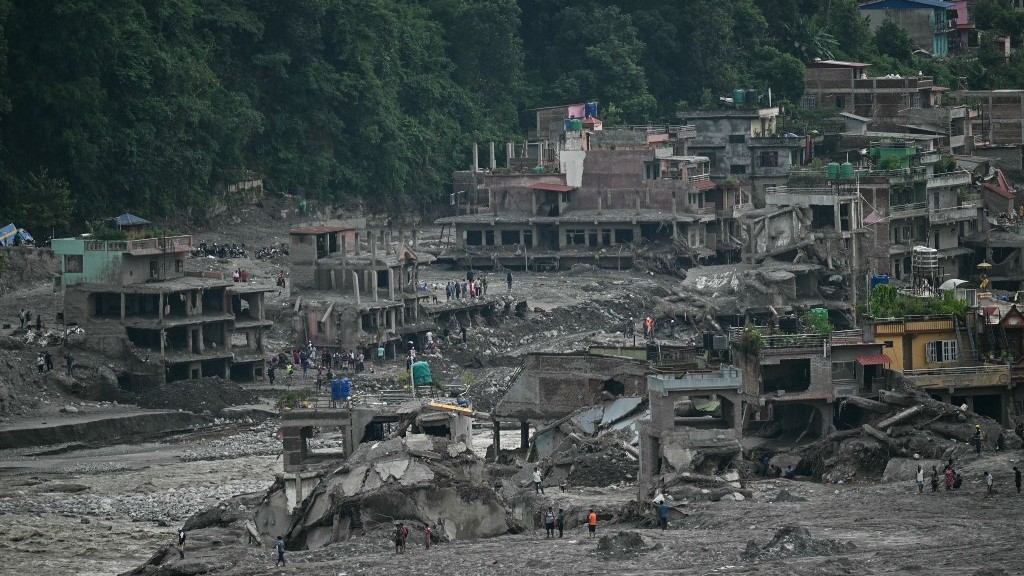
Late August brought catastrophic flash floods to his home district of Nuwakot in Nepal. The waters swept away bridges, roads, and entire hillside settlements, leaving at least 1,399 people dead across the country and nearly 5,400 missing at the time of writing.
And like thousands of Nepalis, the floods swept away everything Krishna’s family owned - their house, household supplies, money, gold and a shed housing their cows and goats. With their land destroyed, Krishna said there is no possibility of farming in the future.
New MEE newsletter: Jerusalem Dispatch
Sign up to get the latest insights and analysis on Israel-Palestine, alongside Turkey Unpacked and other MEE newsletters
The disaster struck his hometown in the Bidur Municipality of Nuwakot District, claiming the life of his 67-year-old grandfather.
“I planned to visit my family for the upcoming Dashain festival, but that wish will now be unfulfilled with my grandfather gone,” Krishna told Middle East Eye, his voice trembling as he thought about the loss his family have experienced.
“My family is sleeping in a holding centre, terrified of the next landslide, and planning my grandfather’s final death rites.

“I asked my supervisor for emergency leave, but I don’t have the money for a sudden flight, and even if I did, the roads to my village are completely washed out.
“It would have been better if I was home and killed by the flood. I am trapped here.”
Krishna’s plight is echoed across the Gulf, where hundreds of thousands of Nepali migrants work to support their families back home. The glittering skylines of Qatar, the United Arab Emirates and Saudi Arabia have been built largely by South Asian labour.
Now, as Nepal faces one of its most catastrophic climate disasters in recent history, the burden of rebuilding will inevitably fall on these same workers.
Nepal relies heavily on its diaspora, with remittances accounting for roughly a third of its gross domestic product; remittances from the Gulf, according to the Nepal Rastra Bank, account for 40 per cent of all Nepali remittances.
'A systematic horror'
UN agencies like the International Labour Organisation (ILO) note that extreme crises highlight how precarious the situation is for these workers.
Across the migration cycle, Nepali labourers face immense risks, from their wages being withheld to limited access to healthcare.
Rameshwar Nepal, an investigator for Equidem, a global human and labour rights organisation, said many Nepali workers are desperate to leave but face overwhelming logistical hurdles.
“They are thousands of miles away [in the Gulf], while their families and communities face the devastation at home,” Nepal told MEE from Kathmandu, where he is coordinating relief efforts for workers and their families.
“They desperately want to return home and be with their families, see if they are still alive, and see the state of their homes, properties, relatives and communities for themselves.”
But the journey back is laced with fear and uncertainty about whether they can return to work in the Gulf.
“They don’t know whether they will be allowed to go, whether they will get paid leave, or, even if they are willing to go on unpaid leave, whether they will be allowed to do so,” Nepal explained.
Beyond securing permission and covering flight costs, workers fear the long-term impact on their livelihoods.
“Many of them need these jobs, particularly if they have lost their homes and property in the disaster. They need to know that they will still have a job to return to.”
Nepal pointed out that the region's labour sponsorship framework exacerbates this immobility, comparing the current anxiety to the Covid-19 lockdowns.
“The kafala system, which is a systematic kind of horror for migrant workers in terms of their freedom of mobility, is pertinent even in difficult situations like this,” he noted.
“We saw a similar situation back in 2020... They really wanted to return to their families, but they were prevented from doing so. It sounds like a very inhuman type of situation.”
'Starting from Zero'
In Qatar, 37-year-old driver Shiva Ujjwal is living that exact nightmare.
Ujjwal has spent the last three years driving workers from the labour camps housing thousands of cleaners and construction workers on the outskirts of Doha to offices and building sites dotted across the Gulf capital.
The driver was starting his early morning shift when disaster struck. Without a chance to check social media, he first heard the news from fellow workers.
When his supervisor allowed him to use his phone, his frantic calls home failed - the communication networks in the region had been completely cut off.
“My heart was breaking,” Ujjwal said, recalling the first time he saw the devastating videos online.
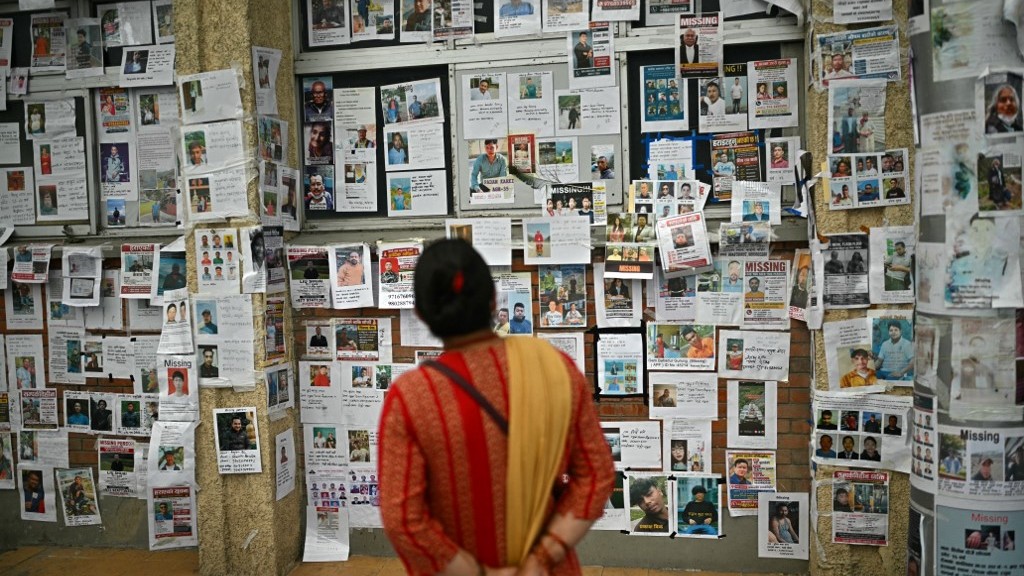
“From the scale of the flood, I could easily imagine my house had been taken away, but I was very worried about my family.”
While his wife, children, and parents managed to escape safely, the human toll around them was staggering. Nine of his relatives were killed, and countless others from his village remain missing.
“My family members ran with empty hands, with no chance to take important papers, money, or gold,” he explained.
“We lost all our property in less than five seconds by a single hit of a live-bullet-type flood.”
Burden of rebuilding
For Ujjwal, who previously worked in Saudi Arabia and the UAE before moving to Qatar three years ago, the material loss represents years of erased labour.
He had painstakingly built his family’s home in phases over several years, using his modest savings to fund one floor at a time. Though his Gulf wages were modest, the opportunity helped “light his kitchen” and keep his family afloat. Now, he faces the daunting prospect of starting from zero.
'We lost all our property in less than five seconds by a single hit of a live-bullet-type flood'
- Shiva Ujjwal, Nepalese worker in Qatar
His supervisor is arranging to send him back to Nepal on unpaid leave, but the geographic and emotional distance has taken a heavy toll, especially during the initial multi-day communication blackout.
“It is very stressful to stay here as my family is in a holding centre now,” he said, burdened by the thought of how to eventually rebuild their home. “My body is here, but I am not here.”
For the Nepali diaspora in the Gulf, the immediate response has been mobilisation. Grassroots fundraising campaigns are circulating through WhatsApp groups as workers pool their meagre savings to send bulk relief to the hardest-hit districts.
Yet, for men like Ujjwal and Krishna, the financial support feels like a hollow substitute for being home.
Middle East Eye delivers independent and unrivalled coverage and analysis of the Middle East, North Africa and beyond. To learn more about republishing this content and the associated fees, please fill out this form. More about MEE can be found here.