
Iran could restart enriching uranium in 'matter of months', UN nuclear chief says

Iran could restart producing enriched uranium in a few months, the head of the International Atomic Energy Agency (IAEA), Rafael Grossi, said on Sunday, raising questions about US President Donald Trump’s assertion that Iran’s nuclear programme was “blown up to Kingdom come”.
Grossi told CBS News that Iran still retained the “capacities” to enrich. “They can have, you know, in a matter of months, I would say, a few cascades of centrifuges spinning and producing enriched uranium, or less than that."
"But as I said, frankly speaking, one cannot claim that everything has disappeared and there is nothing there,” he told CBS, according to a transcript of his interview released ahead of his interview.
“It is clear that there has been severe damage, but it’s not total damage…Iran has the capacities there, industrial and technological capacities. So if they so wish, they will be able to start doing this again.”
New MEE newsletter: Jerusalem Dispatch
Sign up to get the latest insights and analysis on Israel-Palestine, alongside Turkey Unpacked and other MEE newsletters
Iran has lashed out at the IAEA. President Masoud Pezeshkian told his French counterpart, Emmanuel Macron, that Tehran had halted cooperation with the UN nuclear watchdog due to what he called the agency chief's "destructive" behaviour towards the Islamic Republic, his office said on Monday.
Iranian lawmakers last week voted in favour of a bill to suspend cooperation with the IAEA, citing Israel's 13 June attack on Iran and later strikes by the United States on nuclear facilities.
"The action taken by parliament members... is a natural response to the unjustified, unconstructive, and destructive conduct of the Director General of the International Atomic Energy Agency," Pezeshkian told Macron in a phone call late Sunday, according to a presidency statement.
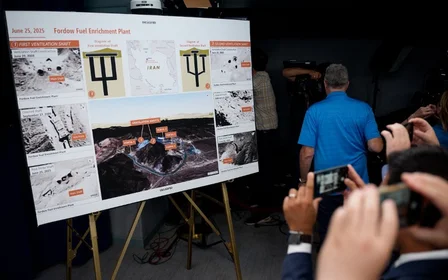
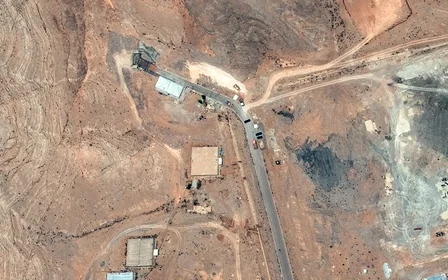
The fate of Iran’s nuclear programme after US strikes on Iran’s Fordow, Natanz, and Isfahan nuclear facilities has been hotly debated.
An Arab official previously told Middle East Eye that Iran had received advance warning of the US strikes on its Fordow, Natanz, and Isfahan nuclear facilities. Amwaj Media first reported that Tehran was notified before the US attacked.
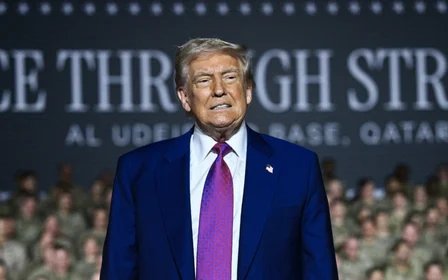
Trump has insisted that US strikes “obliterated” Iran’s programme.
The White House pushed back aggressively on a leaked Department of Defence intelligence document, first reported by CNN, which assessed that US strikes only set Iran’s programme back a few months. Later, the White House shared a statement from the CIA disputing the leaked assessment.
Iranian Foreign Ministry spokesman Esmail Baghaei said last week that the country’s nuclear facilities had been “badly damaged”.
But Iran's supreme leader, Ayatollah Ali Khamenei, downplayed any lasting impact last week, saying Iran scored a "victory" over Israel in the war.
”The American president exaggerated events in unusual ways," he added, insisting the strikes had done "nothing significant" to Iran's nuclear infrastructure.
Trump said last week the US was going to meet with Iran. He signalled that he might consider sanctions relief on Iran, saying that China could continue buying Iranian oil.
However, on Monday, he took a hard line. "I am not offering Iran ANYTHING, unlike Obama," Trump wrote on his Truth Social platform.
"Nor am I even talking to them since we totally OBLITERATED their Nuclear Facilities.”
The statement comes as Iran's deputy foreign minister told the BBC that talks between Washington and Tehran cannot resume unless the US rules out further strikes on Iran.
Majid Takht-Ravanchi told the British broadcaster that the US had signalled it wants to return to the negotiating table, a week after it struck three Iranian nuclear facilities.
"We have not agreed to any date, we have not agreed to the modality," said Takht-Ravanchi.
Middle East Eye delivers independent and unrivalled coverage and analysis of the Middle East, North Africa and beyond. To learn more about republishing this content and the associated fees, please fill out this form. More about MEE can be found here.