Iranian press review: State TV airs weapons training

TV hosts fire weapons on live broadcasts
Iranian state television has begun broadcasting weapons training programmes, including lessons on how to use rifles and machine guns, marking a shift in the type of content aired by the country’s public broadcaster.
The programmes show how to assemble and disassemble Kalashnikov rifles and PK machine guns.
The Islamic Republic of Iran Broadcasting (IRIB), the country’s only television network, is controlled by hardliners, and its director is appointed by Iran’s supreme leader.
In one live broadcast on Channel 3, dedicated to Kalashnikov training, a masked man wearing an Islamic Revolutionary Guard Corps (IRGC) uniform demonstrated how to use the weapon.
New MEE newsletter: Jerusalem Dispatch
Sign up to get the latest insights and analysis on Israel-Palestine, alongside Turkey Unpacked and other MEE newsletters
The programme’s host then prepared the rifle and asked the IRGC officer for permission to shoot at a UAE flag in the studio, which he then did on air.
In another live broadcast, a television presenter joined supporters of the establishment gathered in Tehran’s main squares and fired a shot into the air in front of the camera.
He then said, “This was just a shot for fun, but if necessary, each of us will take up arms and cut off the ear of those who want to invade this land.”
The display of weapons on Iranian state television was not limited to male presenters.
Mobina Nasiri, a well-known pro-establishment TV presenter, also held a Kalashnikov during a live broadcast and said she had recently received the weapon and was ready to join the war against Israel and the US if necessary.
Arrests and executions surge
US-based Iranian rights activists news agency HRANA said the human rights situation in Iran has worsened since the start of the US-Israeli war, with more than 4,000 people arrested on security-related charges.
According to a report by HRANA, at least 4,023 people were arrested in Iran between 28 February and 8 April on charges including espionage, threatening national security, spreading war-related information, and cooperating with hostile countries.
The report also said that 50 people were executed during the same period, including 32 linked to political and security-related charges.
According to HRANA, conditions in prisons and detention centres have worsened significantly. Outside the prisons, authorities have expanded checkpoints and increased movement restrictions.
The report also said children were being deployed at checkpoints set up across Iranian cities, with some as young as 12.
'These dogs are rescue angels', says Red Crescent
Iranian Red Crescent rescue workers have condemned disparaging remarks made on state television about the organisation’s rescue dogs.
During a gathering of establishment supporters in Tehran, a TV host asked one of the participants: “Who is more despicable than the Red Crescent rescue dogs?”
Following the broadcast, Khabar Online interviewed members of the Red Crescent rescue teams, who criticised the remarks made on national television.
In the interview, rescue dog trainer Omid Barzegari described the role the dogs played in helping people trapped under rubble following US and Israeli attacks, saying, “These dogs are rescue angels.
“Each of us and these dogs works as a team,” he added. “These dogs are not despicable. They are trained to serve the people.”
The interview received wide attention in Iranian media, and many reacted online to both the comments about the rescue dogs and the conduct of the state broadcasting organisation.
One viewer wrote: “There is not a single person with common sense among the policymakers of this gigantic [IRIB] organisation, this has nothing but terrible costs for the people.”
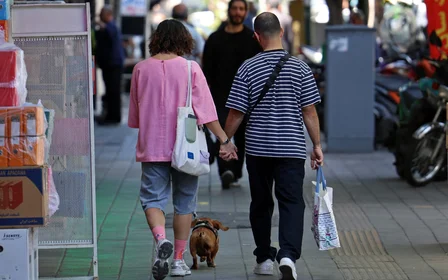
Officials in Iran have long imposed restrictions on dog ownership, based on a strict interpretation of Islamic law. At different times, authorities have also banned dog walking in public.
Anger over Savak symbols at rallies
Videos showing supporters of Reza Pahlavi, the son of Iran's last shah, carrying flags linked to Savak, the shah’s feared intelligence organisation, sparked widespread criticism on Persian-language social media, with many users mocking and condemning the displays.
In recent weeks, groups of monarchist supporters have held military-style parades in London, Copenhagen and Regensburg (in Germany) while carrying Savak flags. Some critics said the events resembled the marches of fascist groups before World War Two.
One social media user mocked the parades by posting an edited version of the Savak logo, replacing the lion with a ketchup bottle.
Another Iranian user criticised the nationalist slogans used during the marches. Sharing a map of Iran showing the country’s ethnic groups, she posted on X, “I don’t want to hear Iran shouted like this from these people. Their Iran is nothing like our Iran.”
In recent months, many Iranians have criticised monarchists, who are supported by Israel, for backing military attacks on Iran. Despite this, international media outlets often continue to present monarchists as leading figures of the opposition to the Islamic Republic.
Reacting to both the media coverage and the parades, another Persian-speaking user wrote on X: “In the bitter days when the brave children of Iran are being led to the gallows, part of the diaspora is putting on ridiculous shows. They have turned the real struggle and the price people pay inside the country into vulgarity abroad, and unfortunately, the world only sees this picture.”
*Iranian press review is a digest of news reports not independently verified as accurate by MEE.
Middle East Eye delivers independent and unrivalled coverage and analysis of the Middle East, North Africa and beyond. To learn more about republishing this content and the associated fees, please fill out this form. More about MEE can be found here.