Israel election 2026: Netanyahu may be weak but the right wing remains as strong as ever

As so often in recent years, Israel’s latest election has centred on the personality of Benjamin Netanyahu.
You might think, exactly three years after the 7 October 2023, that the Hamas-led attack and Israel’s genocide in Gaza would be the formative issue for these polls.
And in a sense they are, but only in so much as how they relate to Netanyahu, his conduct and to what extent the prime minister knew an assault was going to take place.
There is a feeling before polling day on Tuesday that the electorate has already made its mind up. Those who vote for Netanyahu or his coalition partners are doing so despite - or indeed because of - 7 October and everything that Israel has done since.
This has contributed to a surprisingly muted election.
New MEE newsletter: Jerusalem Dispatch
Sign up to get the latest insights and analysis on Israel-Palestine, alongside Turkey Unpacked and other MEE newsletters
It wasn’t so long ago that Israelis mobilised in their hundreds of thousands in opposition to Netanyahu and his judicial reforms.
He also repeatedly drew angry protesters to the streets during the Gaza genocide for relentlessly prosecuting the war regardless of the danger it placed on Israeli captives held in the Palestinian enclave.
After all this, you would expect tension to be a lot higher, and for Netanyahu and the right wing to be set to lose power.
Yet you see no demonstrations on the streets, no mass mobilisation.
Right-wingers on both sides
On a personal level, Netanyahu is weak. His Likud party is set to lose 10 to 15 seats, around a third of its current total.
But while the right-wing prime minister may be weak individually, the right-wing mentality of Israeli voters remains very strong.
There are at least three far-right parties that have the deportation of Palestinians as part of their agenda. Polls suggest that together these parties will win around 20 seats next week - a sixth of the total.
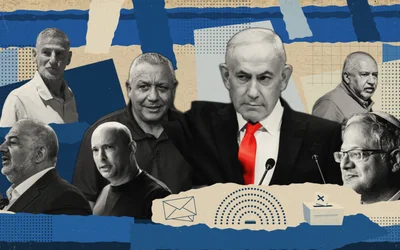
As for the opposition, we do not see a unified group of parties with a clear political agenda. There are just two things they can all agree on: Netanyahu must leave office and the ultra-Orthodox should serve in the army.
Several of these parties can be described as right wing themselves.
Naftali Bennett, head of the Together party, and Israel Is Our Home leader Avigdor Lieberman are both former defence ministers under Netanyahu.
Gabi Eisenkot, the military chief of staff turned chief rival of Netanyahu, is heralded as Israel’s centre-left figure of hope.
Yet he has promised to develop existing settlements and has several settlers, ex-settlers and right-wingers on his electoral list, including people who supported Netanyahu’s highly controversial judicial reforms.
And while he has previously opened the door for the participation of parties representing Palestinian citizens of Israel, criticism of that stance from key allies has prompted him to pour cold water on the prospect.
No one really knows what to expect from Eisenkot. He has certainly tried to portray a quite right-wing image to the domestic Israeli public, while seeming more liberal to the international community.
Meanwhile, though Bennett and Lieberman have sought to attract left-wing and centrist voters, there is no hiding that they are openly racist, supportive of settlements and hawkish.
The threat of a settler rebellion
Importantly, there’s almost zero talk about where Israel is heading, and what will happen with Gaza, Lebanon, the occupied West Bank and Iran.
The opposition parties do not talk about having a political settlement in Gaza, or progressing with the second stage of last year’s ceasefire deal.
They do not discuss how to handle the West Bank, the rampaging settler attacks there or relations with the Palestinian Authority.
In fact, violent settlers could be emboldened by an Eisenkot victory.
The former army chief has vowed to bring the settlements back under the control of the military, reversing Finance Minister Bezalel Smotrich’s reforms that amounted to a form of de-facto annexation.
I think that even now, Eisenkot is quite afraid that he will lose control, and settlers will do their best to prove to him that he has no real leverage in the West Bank.
Even conservative Israeli commentators are saying that the army has lost control of the West Bank. If Eisenkot wins, he could face a sort of settler rebellion.
There is great fear that the settler attacks on Palestinians that we have seen in the West Bank over recent months will be nothing compared to what they will do to undermine a government led by Eisenkot.
The settlers have hundreds, if not thousands, of armed militiamen. They are well-connected in the army, and it’s not clear where the military’s loyalties will lie in such a situation.
One solution to Eisenkot, to relieve himself of the right-wing settler pressure in the West Bank, could be to form a unity government with Netanyahu.
To be clear, this will be difficult to do. The last thing that Eisenkot’s voters and allies want to see is Netanyahu in government, taking up a power-sharing rotating premiership as the prime minister did with another former army chief, Benny Gantz, in 2020 to disastrous effect.
And it is extremely unlikely that Netanyahu would accept any deal where he would not have primacy in the government.
However, such an outcome could take the sting out of the radical right wing, avoiding the prospect of a settler rebellion and even ensuring that radical ministers Itamar Ben Gvir and Smotrich are locked out of government.
Much depends on how close Netanyahu and his allies get to the magic number of 61 seats - a majority in the Knesset.
Currently, polls put the prime minister’s coalition at 51 seats. If Netanyahu is able to get closer to 61, there is a large chance that he will manage to steal some of the many right-wing MPs from rival parties and stay in power once again.
Middle East Eye delivers independent and unrivalled coverage and analysis of the Middle East, North Africa and beyond. To learn more about republishing this content and the associated fees, please fill out this form. More about MEE can be found here.